Key takeaways
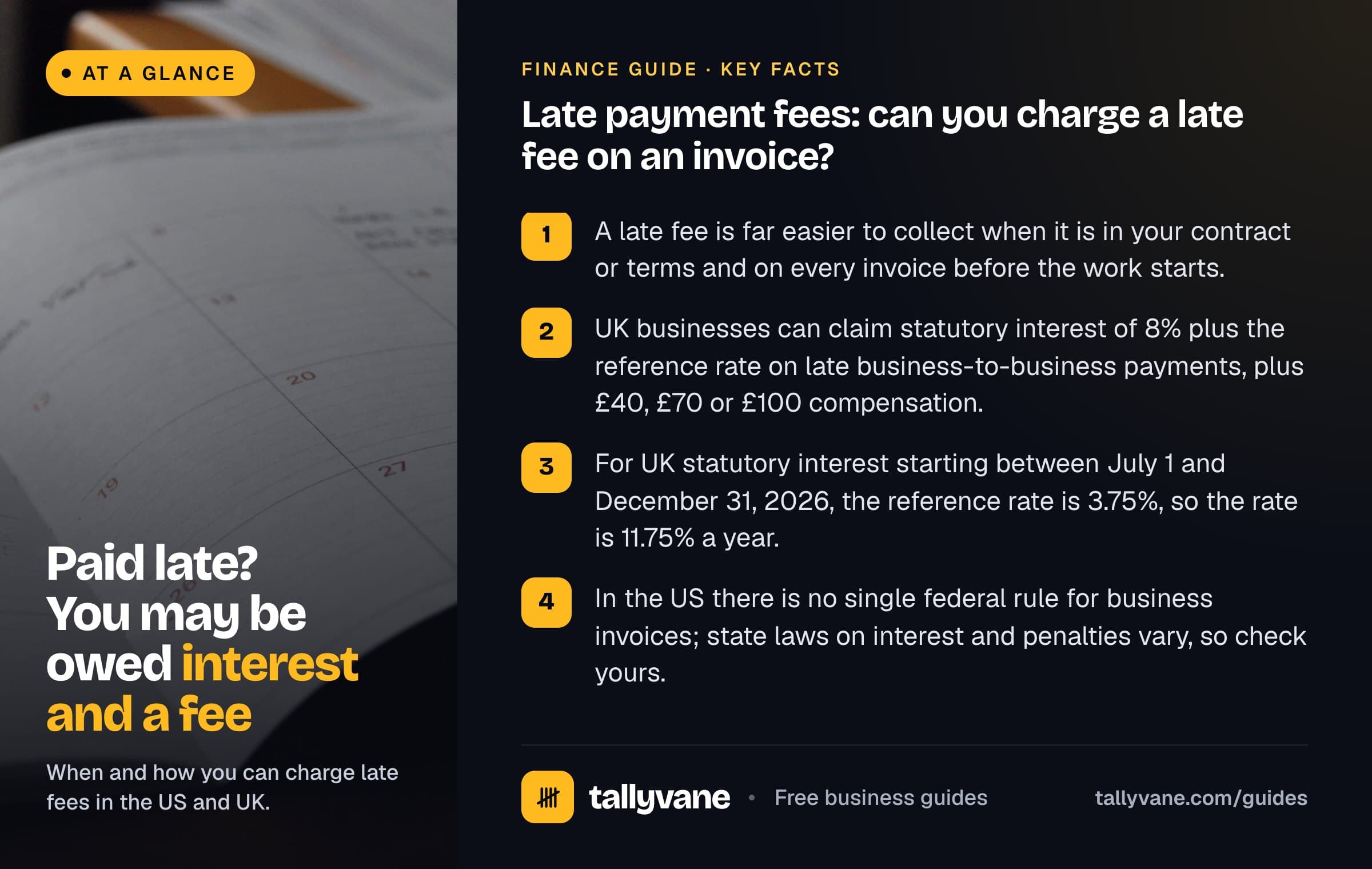
- A late fee is far easier to collect when it is in your contract or terms and on every invoice before the work starts.
- UK businesses can claim statutory interest of 8% plus the reference rate on late business-to-business payments, plus £40, £70 or £100 compensation.
- For UK statutory interest starting between July 1 and December 31, 2026, the reference rate is 3.75%, so the rate is 11.75% a year.
- In the US there is no single federal rule for business invoices; state laws on interest and penalties vary, so check yours.
The short answer
Yes, in most cases you can charge a business customer for paying late, as long as you follow the rules where you are. The safest route everywhere is the same: put the payment terms and the late charge in your contract or terms of business, get the customer to agree before you start, and repeat them on every invoice.
What you cannot usually do is invent a fee after the fact. If the customer never agreed to a late charge, you may have no right to add one, except where the law gives you one, as it does for business-to-business debts in the UK.
Consumer sales are different. Rules for charging individuals are stricter in most places, and the UK statutory interest scheme below only covers business-to-business transactions.
UK: statutory interest and compensation
Under the Late Payment of Commercial Debts (Interest) Act 1998, a business supplying goods or services to another business can claim statutory interest on a late payment. GOV.UK gives the rate as 8% plus the Bank of England base rate for business-to-business transactions.
The base rate used is fixed for six months at a time. Under the 2002 order that sets the rate, interest that starts running between July 1 and December 31 uses the rate in force on June 30, and interest that starts between January 1 and June 30 uses the rate in force on December 31. The Bank of England held Bank Rate at 3.75% at its June 18, 2026 decision, so interest that starts running in the second half of 2026 is charged at 11.75% a year.
If no payment date was agreed, a payment is late 30 days after the customer receives the invoice or after you deliver the goods or service, whichever is later. Where a date is agreed, GOV.UK says it must usually be within 60 days for business transactions and 30 days for public authorities.
You can also claim a fixed sum for debt recovery costs, once per invoice, plus any reasonable recovery costs above that amount. A contract can set a different interest rate instead of the statutory one, but GOV.UK notes you cannot use a lower rate in a contract with a public authority.
Annual interest = Debt × (8% + Reference rate) Daily interest = Annual interest ÷ 365 Interest owed = Daily interest × Days late
| Amount of the debt | Fixed sum you can claim |
|---|---|
| Up to £999.99 | £40 |
| £1,000 to £9,999.99 | £70 |
| £10,000 or more | £100 |
Worked example: a UK invoice paid 45 days late
A design studio invoices another business £5,000, due on September 1, 2026. It is paid 45 days late. Interest starts running in the second half of 2026, so the rate is 8% + 3.75% = 11.75%.
The studio can claim £72.43 in interest plus £70 fixed compensation, £142.43 in all. That is not a fortune, but on a business with many late payers it adds up, and simply mentioning the claim often speeds up payment.
| Step | Calculation | Amount |
|---|---|---|
| Annual interest | £5,000 × 11.75% | £587.50 |
| Daily interest | £587.50 ÷ 365 | £1.61 |
| Interest for 45 days | £587.50 ÷ 365 × 45 | £72.43 |
| Fixed compensation | £1,000 to £9,999.99 band | £70.00 |
| Total claim | £142.43 |
US: contracts, state law and reasonable fees
There is no general federal law that sets a late fee or interest rate for business invoices in the US. Whether you can charge one, and how much, depends on what the customer agreed to and on the law of the state that governs the contract.
Two kinds of state law matter. Usury laws cap the interest rate that can be charged, and the caps and exemptions differ from state to state, sometimes depending on the type of transaction. Contract law in many states also refuses to enforce a charge that looks like a penalty rather than a reasonable estimate of what late payment costs you.
Many businesses use a monthly percentage on the overdue balance, a flat fee, or both. Whatever you choose, make sure it is in writing before the work, applied consistently, and within your state’s limits. If the amounts are large or you are unsure, ask a local attorney or check your state attorney general’s or legislature’s website.
Example with illustrative terms: a contractor’s agreement says overdue balances accrue 1.5% per month. A $2,400 invoice paid two months late would carry $36 per month, $72 in total, using simple interest. Note that 1.5% a month is 18% a year, which may be more than your state allows for some transactions, so check before you copy it.
Monthly late charge = Overdue balance × Monthly rate Example: $2,400 × 1.5% = $36 per month
How to set up late fees so they work
A late fee does most of its work before anything is late. Customers who can see a clear charge on the invoice tend to pay on time, and you rarely need to argue about it later.
- Agree payment terms in writing before the work starts: due date, accepted payment methods and the late charge.
- Show the due date as a date, not just “Net 30”, and repeat the late payment terms on every invoice.
- Send a friendly reminder a few days before the due date and on the day after it is missed.
- When you add a late charge, send an updated invoice or statement that shows the original amount, the charge and how it was calculated.
- Keep records of every invoice, reminder and reply in case you need to go to small claims court.
- Decide in advance when you will waive a fee for a good customer. Being flexible once can keep a relationship that is worth more than the fee.

Example invoice wording
Keep the wording short and specific. Adjust it to match the terms you have actually agreed, and to your country and state.
- UK, business customers: “Payment is due within 30 days of the invoice date. We reserve the right to claim interest and compensation under the Late Payment of Commercial Debts (Interest) Act 1998 on any amount not paid by the due date.”
- US, with an agreed rate: “Payment is due by [date]. As agreed in our contract, balances unpaid after the due date accrue a late charge of [rate] per month until paid.”