Key takeaways
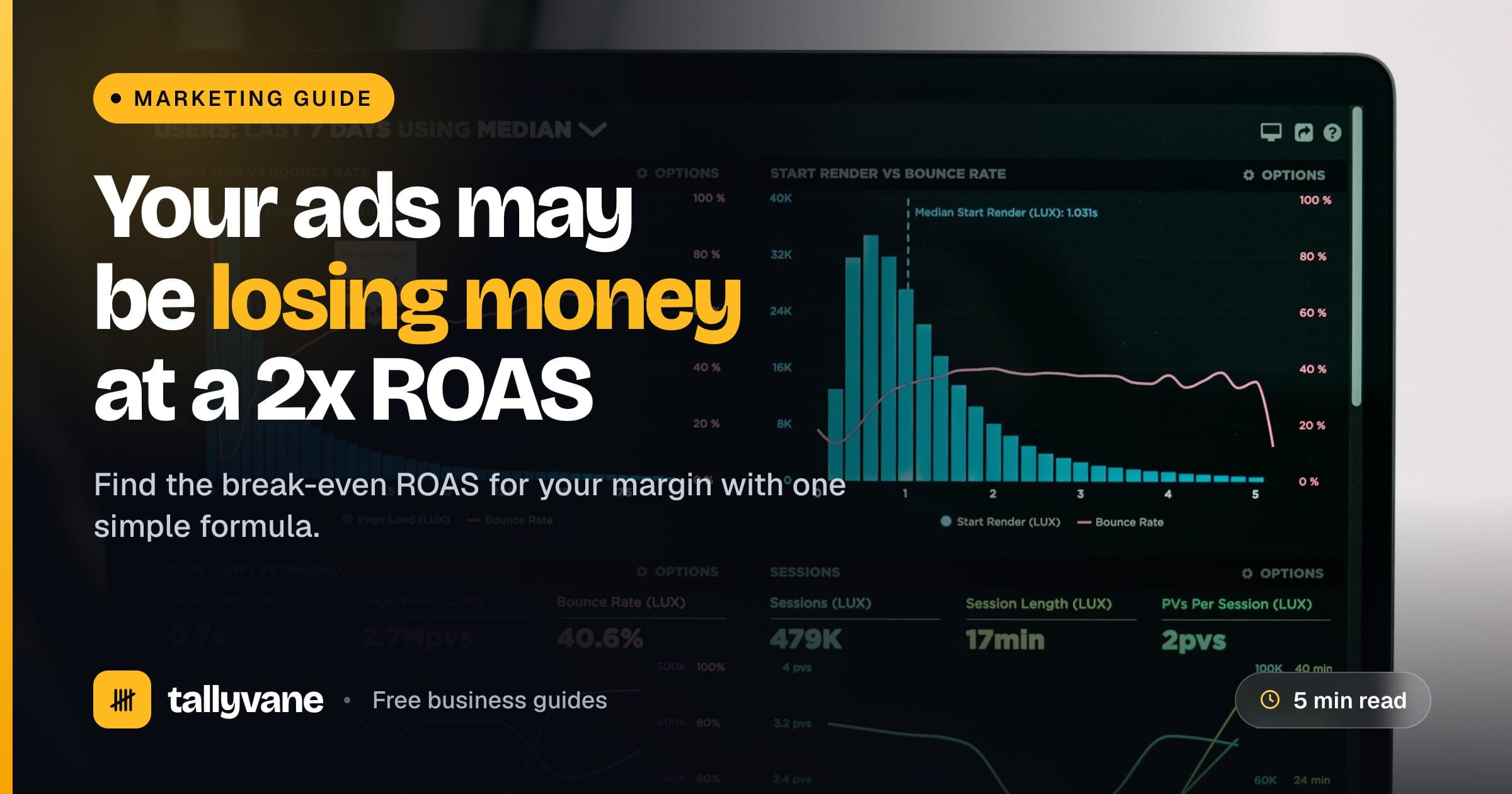
- Break-even ROAS = 1 ÷ your margin before ad spend, written as a decimal.
- Use your margin after product cost, shipping, payment fees and returns, not just the product markup.
- At a 40% margin you need a ROAS of 2.5 to break even; at 25% you need 4.0.
- Set your target ROAS above break-even so each order also earns the profit you want.
- Platform-reported ROAS is an estimate, so check it against the revenue in your store.
What ROAS is, and why break-even matters
Return on ad spend (ROAS) is the revenue your ads bring in divided by what you spent on them. Spend $1,000 and get $3,000 in attributed sales and your ROAS is 3, often written as 3x or 300%.
ROAS on its own does not tell you whether you made money, because revenue is not profit. A ROAS of 3 is excellent for a store that keeps 60% of each sale and a loss for one that keeps 25%. The number that matters is your break-even ROAS: the point where the profit from ad-driven sales exactly pays for the ads.
Ad platforms such as Google Ads let you bid toward a target ROAS, which Google describes as the average conversion value you want for each dollar spent. That target is only useful if it is based on your real margin.
ROAS = Revenue from ads ÷ Ad spend
The break-even ROAS formula
Work out what you keep from an average order after every cost except advertising. That is your contribution margin. Divide 1 by that margin as a decimal and you have break-even ROAS.
If you keep 40% of each order before ads, you have $0.40 to spend on ads for every $1 of revenue. Spend exactly that and you break even, which happens at a ROAS of $1 ÷ $0.40 = 2.5.
The same idea per order gives you break-even cost per acquisition (CPA): the most you can pay in ads for one order. It is simply the profit per order before ads.
Contribution margin = (Order value − Product cost − Shipping − Fees − Other variable costs) ÷ Order value Break-even ROAS = 1 ÷ Contribution margin Break-even CPA = Order value × Contribution margin
| Margin before ad spend | Break-even ROAS | Break-even ROAS % |
|---|---|---|
| 20% | 5.00 | 500% |
| 25% | 4.00 | 400% |
| 30% | 3.33 | 333% |
| 40% | 2.50 | 250% |
| 50% | 2.00 | 200% |
| 60% | 1.67 | 167% |
| 70% | 1.43 | 143% |
Worked example: a dropshipping store
A dropshipping store sells a posture corrector for $40, with free shipping. The supplier charges $14 for the product and $6 to ship it to the customer. Payment processing and app fees come to about $1.50 per order. The figures are illustrative; use your own supplier and payment processor rates.
The store keeps $18.50 per order before ads, a 46.25% contribution margin. Break-even ROAS is 1 ÷ 0.4625 = 2.16, and break-even CPA is $18.50. If the ad account reports a ROAS of 2.0, the store is losing money on every ad-driven order, even though “2x” sounds healthy.
| Line | Amount |
|---|---|
| Order value | $40.00 |
| Product cost | −$14.00 |
| Shipping to customer | −$6.00 |
| Payment and app fees (estimate) | −$1.50 |
| Profit before ads (break-even CPA) | $18.50 |
| Contribution margin | 46.25% |
| Break-even ROAS | 2.16 |
From break-even to target ROAS
Break-even is the floor, not the goal. Decide how much profit you want from each order, subtract it from your profit before ads, and the rest is what you can afford to spend on ads.
In the example, suppose the store wants a 10% net margin, or $4 per $40 order. That leaves $18.50 − $4.00 = $14.50 for ads per order. Target ROAS is $40 ÷ $14.50 = 2.76, and target CPA is $14.50.
You can then work backwards to cost per click. If 2% of visitors buy, you need 50 clicks per order, so you can afford up to $14.50 ÷ 50 = $0.29 per click at your target. An ad cost calculator helps here.
Ad budget per order = Profit before ads − Target profit per order Target ROAS = Order value ÷ Ad budget per order Max CPC = Ad budget per order × Conversion rate
Free toolAd cost calculatorWhen products have different margins
One break-even ROAS for the whole store only works if every product has a similar margin. If they do not, work out break-even per product or per campaign, because a campaign selling low-margin items needs a higher ROAS than one selling high-margin items.
Say a store sells a $60 bundle with a 50% margin before ads and a $25 accessory with a 30% margin. The bundle breaks even at a ROAS of 2.0, the accessory at 3.33. A campaign that reports a ROAS of 2.8 is profitable if it mostly sells bundles and loses money if it mostly sells accessories.
If you run one campaign across many products, use the margin of the mix it actually sells, weighted by revenue, not the margin of your best product.
Costs people leave out
Most break-even ROAS mistakes come from using a margin that is too high. Before trusting your number, check that it includes:
- Returns and refunds. If 8% of orders are refunded and you cannot resell the item, your effective margin falls.
- Chargebacks and fraud losses.
- Payment processing, marketplace fees and app subscriptions that scale with orders.
- Packaging, inserts and any shipping you pay that the customer does not.
- Discounts and coupon codes used on ad-driven orders.
- Sales tax or VAT if it is included in the revenue figure the ad platform reports. Use revenue before tax.
Reported ROAS versus real ROAS
Ad platforms report the revenue they think their ads caused, using their own attribution window and rules. Two platforms can both claim the same sale, and some sales would have happened without the ad. Add up the revenue every platform reports, compare it with the total sales in your store, and you will often find the platforms claim more than you actually sold.
A useful check is blended ROAS, sometimes called MER: total store revenue divided by total ad spend across every channel for the same period. It cannot tell you which ad works, but it cannot be double-counted either. If blended ROAS is below your break-even, the business is losing money on advertising overall, whatever each dashboard says.
Finally, think about repeat customers. If buyers come back and order again without more ad spend, a first order at or slightly below break-even can still be worth it. That only holds if you have real repeat purchase data, not a hope. A customer lifetime value calculation helps you decide how far below break-even you can go on the first order.
Blended ROAS (MER) = Total revenue ÷ Total ad spend, same period
Free toolCustomer acquisition cost calculator