Key takeaways
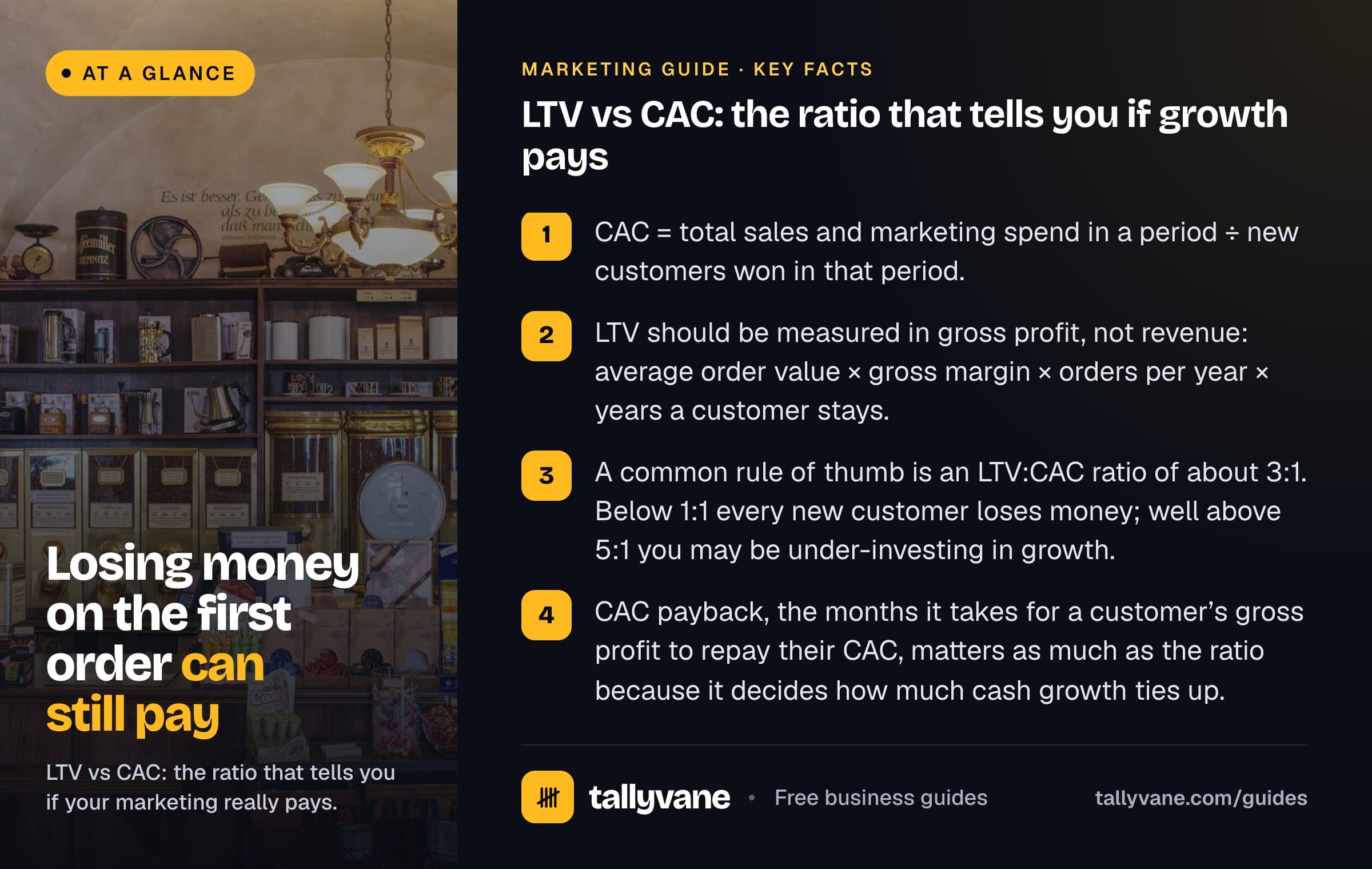
- CAC = total sales and marketing spend in a period ÷ new customers won in that period.
- LTV should be measured in gross profit, not revenue: average order value × gross margin × orders per year × years a customer stays.
- A common rule of thumb is an LTV:CAC ratio of about 3:1. Below 1:1 every new customer loses money; well above 5:1 you may be under-investing in growth.
- CAC payback, the months it takes for a customer’s gross profit to repay their CAC, matters as much as the ratio because it decides how much cash growth ties up.
Why compare LTV with CAC
Most marketing reports look at one sale at a time: cost per click, cost per order, return on ad spend. That can make a campaign look unprofitable when the first order barely covers the ad, even though the customer goes on to buy again for years. It can also hide the opposite problem, where cheap one-off buyers never come back.
Comparing lifetime value with acquisition cost looks at the whole relationship. If a customer earns you more gross profit over their life than it cost to win them, spending to win more customers grows profit. If not, more spending only makes the losses bigger.
How to calculate customer acquisition cost (CAC)
Add up everything you spent to win new customers in a period, then divide by the number of new customers you won in the same period. Include ad spend, agency and freelancer fees, discounts and free gifts for first orders, and, if you have them, the salaries of staff whose job is sales or marketing.
Count only new customers. Repeat buyers did not cost you acquisition spend this month, so including them makes CAC look lower than it is. If you want a figure for one channel, divide that channel’s spend by the customers it brought in, and accept that attribution is never perfect.
CAC = Sales and marketing spend ÷ New customers won Blended CAC = all spend ÷ all new customers, including those who found you for free
Free toolCustomer acquisition cost calculatorHow to calculate customer lifetime value (LTV)
For a shop where customers place repeat orders, multiply what a customer is worth per order in gross profit by how many orders they place over their life. Using gross profit rather than revenue matters: a $100 order with a 30% margin is worth $30 to you, not $100.
For a subscription, use the monthly churn rate, the share of customers who cancel each month. On average a customer stays 1 ÷ churn months, so a 4% monthly churn means an average life of 25 months.
Use real figures from your own records where you can, and keep the time span sensible. If you have only been selling for a year, an LTV that assumes customers stay five years is a guess.
Repeat-purchase LTV = Average order value × Gross margin × Orders per year × Years a customer stays Subscription LTV = Monthly revenue per customer × Gross margin ÷ Monthly churn rate
Free toolCustomer lifetime value calculatorWorked example: an online tea shop
An online tea shop has an average order value of $40 and a 60% gross margin after the cost of tea, packaging and payment fees, so each order is worth $24 in gross profit. Its customers order three times a year on average and stay for two years. Last month it spent $6,000 on ads and influencer gifts and won 150 new customers.
- The first order alone ($24 gross profit) does not cover the $40 CAC, so a first-order ROAS report would call these ads a loss.
- Over a customer’s life the shop earns $144 of gross profit for each $40 spent, comfortably above 3:1.
- If repeat customers dropped to staying one year, LTV would halve to $72 and the ratio to 1.8:1. Retention moves this number as much as ad costs do.
| Figure | Working | Result |
|---|---|---|
| Gross profit per order | $40 × 60% | $24 |
| Orders over a customer’s life | 3 a year × 2 years | 6 |
| LTV (gross profit) | $24 × 6 | $144 |
| CAC | $6,000 ÷ 150 | $40 |
| LTV:CAC ratio | $144 ÷ $40 | 3.6:1 |
| CAC payback | 2 orders ($48) repay $40; orders come every 4 months | About 4 months |
What is a good LTV:CAC ratio?
The often-quoted benchmark is about 3:1: each customer brings in three times their acquisition cost in gross profit. It is a rule of thumb from subscription businesses rather than a law, but it is a reasonable starting point for most small businesses.
| Ratio | What it usually means |
|---|---|
| Below 1:1 | Each new customer loses money over their whole life. Cut spend or fix margin and retention first. |
| 1:1 to 2:1 | Customers repay their cost, but little is left to cover overheads. Growth is fragile. |
| About 3:1 | Healthy for most businesses: growth pays for itself with room for overheads and profit. |
| 5:1 or more | Very efficient, but you may be missing customers you could profitably win by spending more. |

CAC payback: the cash side of the ratio
A 3:1 ratio says a customer is profitable in the end. It does not say when. If it takes two years for a customer’s gross profit to repay what you spent to win them, fast growth can drain your bank account even though every customer is profitable on paper.
CAC payback measures that delay. Many subscription businesses aim to recover CAC within about 12 months; businesses with little cash in reserve should aim for much less. The tea shop in the example gets its money back in about four months.
CAC payback (months) = CAC ÷ Gross profit per customer per month
Free toolROAS calculatorHow to improve the ratio
There are two sides to work on, and the cheapest wins are often on the LTV side.
- Raise gross margin per order: review prices, supplier costs, packaging and payment fees.
- Raise average order value with bundles, sensible minimums for free shipping, and add-ons at checkout.
- Keep customers longer: follow-up emails, reminders to reorder, loyalty rewards and good service after the sale.
- Cut CAC by moving spend away from channels whose customers rarely buy again, even if their first-order cost looks cheap.
- Track the ratio by channel and by month, not once a year, so you can see changes before they cost much.