Key takeaways
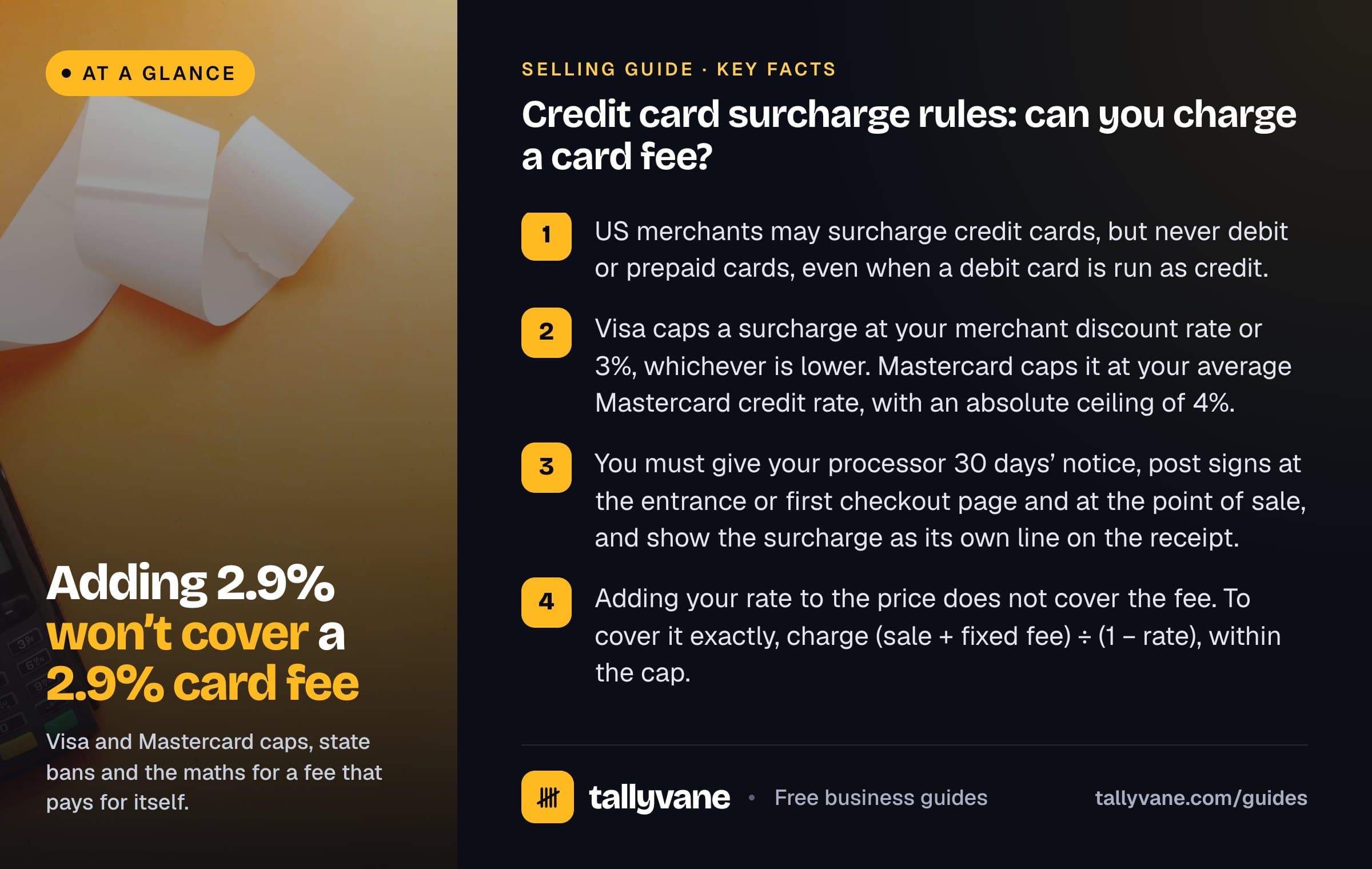
- US merchants may surcharge credit cards, but never debit or prepaid cards, even when a debit card is run as credit.
- Visa caps a surcharge at your merchant discount rate or 3%, whichever is lower. Mastercard caps it at your average Mastercard credit rate, with an absolute ceiling of 4%.
- You must give your processor 30 days’ notice, post signs at the entrance or first checkout page and at the point of sale, and show the surcharge as its own line on the receipt.
- Adding your rate to the price does not cover the fee. To cover it exactly, charge (sale + fixed fee) ÷ (1 − rate), within the cap.
- Some states ban or limit surcharges. A cash discount, where the card price is the posted price, is the usual alternative.
Can you charge customers a credit card fee?
Usually yes, if you are in the US and follow the rules. Mastercard has allowed US merchants to surcharge its credit cards since January 2013, and Visa allows it too. The surcharge must stay under a cap, and both your processor and your customers must be told first.
Three things can stop you. Debit and prepaid cards can never be surcharged. Some states ban or limit surcharges. And outside the US the rules are stricter: Visa says surcharging stays prohibited outside the US and its territories apart from limited exceptions.
This guide is not legal advice. Laws and network rules change, so confirm with your payment processor and, if you are unsure, a lawyer before you add any fee.
Surcharge vs convenience fee vs cash discount
The card networks treat these three very differently, and renaming a fee does not change which rules apply.
- A convenience fee cannot pass on a percentage card fee, because it must be the same flat amount whatever the sale.
| Surcharge | Convenience fee | Cash discount | |
|---|---|---|---|
| What it is | An extra charge for paying by credit card | A fee for paying through a channel that is not your usual one, such as online or by phone | A lower price for paying by cash or another cheaper method |
| How it is set | A percentage, up to the cap | A flat amount, not a percentage | Any amount off the posted price |
| Main rules | Cap, 30 days’ notice to processor, signs, receipt line, state law | Must be clearly disclosed and reflect a real alternate channel | Show the card price, or card and cash prices side by side |
Visa and Mastercard surcharge rules
Visa’s U.S. Merchant Surcharge Q&A sets these requirements. Mastercard’s rules are similar, with a higher absolute ceiling.
- Credit cards only. Visa says you cannot surcharge a debit card even when the customer selects credit at the terminal, because it is still a debit card. Mastercard bars surcharges on its debit and prepaid cards too.
- Visa cap: your merchant discount rate for that credit card or 3%, whichever is lower.
- Mastercard cap: the lower of your average effective rate for Mastercard credit cards or the maximum surcharge cap, which Mastercard publishes as 4%. At a 2.5% rate the cap is 2.5%, not 4%.
- Notice: Visa requires you to notify your acquirer, the company that processes your cards, at least 30 days before you start. Mastercard’s rules also call for 30 days’ notice, though it currently says it is not requiring merchants to register with it while it updates its rules.
- Disclosure: post notice at the point of entry (the shop door or first page of an online checkout) and at the point of sale, and show the surcharge as a separate line on every receipt.
- Brand or product level: you may surcharge all of a network’s credit cards at one rate, or only certain card products, but not both.
Visa maximum surcharge = Sale × the lower of (your rate, 3%) Mastercard maximum surcharge = Sale × the lower of (your Mastercard credit rate, 4%)
States that ban or limit surcharges
Network rules never override state law. Where a state bans surcharging, a store located there cannot surcharge, though Visa says a business with stores in several states can surcharge in the states that allow it. The list below covers only states whose position we could check against official or network sources in November 2026. If your state is not listed, do not assume it has no rules: check your attorney general’s or consumer protection office’s guidance.
- Banned: Visa’s list names Connecticut, Massachusetts and Puerto Rico as prohibiting surcharges. Maine’s statute says a seller may not impose a surcharge on a customer who uses a credit or debit card, though a discount from the regular price is allowed.
- Oklahoma: no longer banned. From November 1, 2025, a surcharge is allowed up to 2% of the transaction or your actual processing cost, whichever is less, with notice at the entrance and point of sale, or on the home page and checkout page online. Further changes were proposed in 2026, so check the current law.
- Colorado: you may charge up to 2% of the total, or up to the actual processing fee you pay on that transaction. Each option has its own required sign wording, and the surcharge must appear as a separate line on the receipt.
- New York: you must post the total price for paying by credit card, including the surcharge, before checkout. A sign saying a percentage surcharge applies at the register is not enough. The surcharge cannot exceed what the card company charges you.
- New Jersey and Minnesota: Visa lists both as having their own surcharge requirements. Read the state rules before you start.
How to calculate a surcharge that covers your fee
Most people add their processing rate to the price. That leaves you short, because your processor charges its rate on the whole amount the customer pays, surcharge included, and the fixed fee per transaction is not covered at all.
To cover the fee exactly, gross the sale up. Add the fixed fee to the sale, then divide by one minus your rate. The surcharge is the difference between that total and the sale. This is the same maths our surcharge calculator uses.
Then apply the cap. If the gross-up surcharge is above the network cap or your state’s cap, you can only charge up to the cap and you absorb the rest. Ask your processor how it measures your rate for the cap, since a quoted rate and your effective rate can differ.
Simple add-on (falls short) = Sale × Rate Total that covers the fee = (Sale + Fixed fee) ÷ (1 − Rate) Surcharge = Total − Sale Allowed surcharge = the lower of (Surcharge, Sale × Cap %)
Free toolCredit card surcharge calculator
Worked example: a $300 online sale
An online furniture repair business bills a customer $300 and pays 2.9% + $0.30 per card payment. Here is what it keeps under five approaches.
- The full gross-up surcharge is $9.27, or 3.09% of the sale. That is above Visa’s 3% cap, so under Visa’s rules this business can add at most $9.00.
- Adding just the rate leaves $0.55 uncovered on every $300 sale, which adds up across hundreds of payments.
- In person at 2.6% + $0.15, the same $300 sale grosses up to $308.16, an $8.16 surcharge of 2.72%, which fits under a 3% cap.
| Approach | Customer pays | Processing fee | Business keeps | Shortfall |
|---|---|---|---|---|
| No surcharge | $300.00 | $9.00 | $291.00 | $9.00 |
| Add the rate (2.9% = $8.70) | $308.70 | $9.25 | $299.45 | $0.55 |
| Gross-up ($300.30 ÷ 0.971) | $309.27 | $9.27 | $300.00 | $0.00 |
| Capped at Visa’s 3% ($9.00) | $309.00 | $9.26 | $299.74 | $0.26 |
| Capped at 2% ($6.00), as in Oklahoma | $306.00 | $9.17 | $296.83 | $3.17 |
Running a cash discount program properly
A cash discount program is the main alternative where surcharges are banned or unpopular. Your posted price is the card price, and customers who pay another way get money off. Visa’s rules allow a discount for paying another way, as long as it is a reduction from the standard price.
Visa says you must show prices in one of two ways: the card price only, or the card price and the cash price side by side for each item. The final card total must come from those posted prices. If the bill shows a cash price and then adds a fee at the till for paying by card, Visa may treat it as a surcharge, with all the surcharge rules and caps.
Using the example above, the business would post $309.27 as its price and offer $300.00 to customers paying by cash, check or bank transfer, a discount of $9.27, about 3%.
Free toolRetail price calculatorBefore you start: a checklist
Rules on surcharging are moving. A Visa and Mastercard settlement with merchants received preliminary court approval in June 2026; if it gets final approval, the networks will change parts of their surcharge rules. Check with your processor before you start, and again each year.
- Check your state’s law, and the law in each state where you have a store.
- Tell your processor at least 30 days before you begin, and ask how its system marks surcharges on transactions.
- Set the surcharge at or below the lowest cap that applies: your rate, the network cap, or your state’s cap.
- Make sure debit and prepaid cards are not surcharged.
- Put up signs at the entrance and the till, or on the first checkout page and payment page online, and show the surcharge on receipts.
- This is not legal advice. If you are unsure whether your plan is allowed, ask a lawyer or your state consumer protection office.