Key takeaways
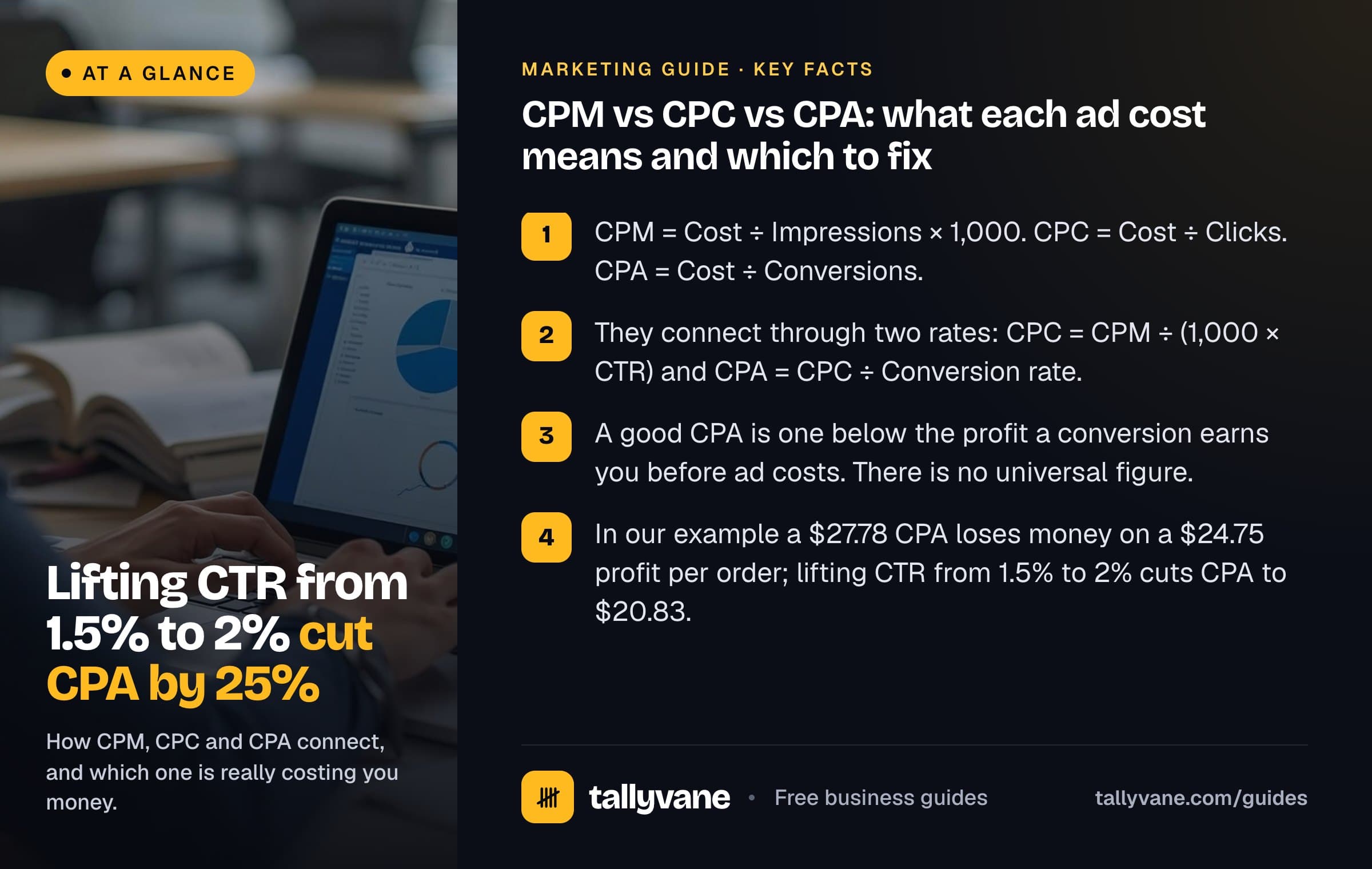
- CPM = Cost ÷ Impressions × 1,000. CPC = Cost ÷ Clicks. CPA = Cost ÷ Conversions.
- They connect through two rates: CPC = CPM ÷ (1,000 × CTR) and CPA = CPC ÷ Conversion rate.
- A good CPA is one below the profit a conversion earns you before ad costs. There is no universal figure.
- In our example a $27.78 CPA loses money on a $24.75 profit per order; lifting CTR from 1.5% to 2% cuts CPA to $20.83.
- Diagnose in order: CPM tells you about the audience price, CTR about the ad, conversion rate about the page and offer.
The three costs, and the chain that links them
Every ad goes through the same funnel. It is shown (an impression), some people click (a click), and some of those people do what you wanted, such as buying, booking or filling in a form (a conversion). Each cost metric is your total spend divided by one of those counts.
CPM is the price of reach, CPC the price of traffic and CPA the price of a result. Platforms bill in different ways. Google Ads, for example, offers CPM bidding on its Display Network, where you pay per 1,000 impressions, and CPC bidding, where you pay for each click. But you can work out all three for any campaign once you know cost, impressions, clicks and conversions.
Impressions → Clicks → Conversions (× CTR) (× Conversion rate)
How to calculate CPM
CPM stands for cost per mille, mille being Latin for thousand. Divide what you spent by the number of impressions and multiply by 1,000. Spending $1,500 for 120,000 impressions is a CPM of $12.50.
CPM mainly reflects how much competition there is for the audience you chose. Narrow, high-value audiences and busy seasons usually cost more per thousand views. A low CPM is only good news if those views turn into clicks.
CPM = Cost ÷ Impressions × 1,000
Free toolAd cost calculatorHow to calculate CPC and CTR
Cost per click is spend divided by clicks. $1,500 for 1,800 clicks is a CPC of about $0.83. On platforms where you bid per click, you set a maximum and the actual price you pay is often lower, so use the average CPC from your reports, not your bid.
Click-through rate (CTR) is clicks divided by impressions. Google defines it the same way: 5 clicks from 100 impressions is a 5% CTR. In our example, 1,800 clicks from 120,000 impressions is 1.5%. CTR measures how well the ad itself earns attention from the people who see it.
CTR is the bridge between CPM and CPC. If you pay $12.50 per 1,000 views and 1.5% of viewers click, those 1,000 views give you 15 clicks, so each click costs $12.50 ÷ 15 = $0.83. Double the CTR and CPC halves, with no change in what you pay for reach.
CPC = Cost ÷ Clicks CTR = Clicks ÷ Impressions × 100 CPC = CPM ÷ (1,000 × CTR)
How to calculate CPA and conversion rate
Cost per acquisition, also called cost per conversion, is spend divided by conversions. Conversion rate is conversions divided by clicks. 54 orders from 1,800 clicks is a 3% conversion rate, and $1,500 ÷ 54 is a CPA of $27.78.
Conversion rate is the bridge between CPC and CPA. It mostly reflects what happens after the click: the landing page, the price, the offer, shipping costs and how easy checkout is. A better page lowers CPA without touching the ads at all.
Be clear what counts as a conversion. If it is a lead rather than a sale, your cost per lead is not your cost per customer. Divide cost per lead by the share of leads you close: $20 per lead with one in four closing is $80 per customer.
Conversion rate = Conversions ÷ Clicks × 100 CPA = Cost ÷ Conversions CPA = CPC ÷ Conversion rate = CPM ÷ (1,000 × CTR × Conversion rate)
Free toolAd cost calculatorWorked example: one month of ads for a candle shop
An online candle shop spends $1,500 on a month of social ads. Its average order is $55, and after product cost, packaging, shipping and payment fees it keeps 45% of each order before ad costs, or $24.75. Here is what the ad account shows, and the metrics that follow from it.
- Each order costs $27.78 in ads but earns only $24.75 before ads, so the campaign lost $163.50 on first orders.
- If CTR rose to 2% at the same CPM, the same spend would buy 2,400 clicks at $0.63 each, 72 orders at 3%, a CPA of $20.83 and a profit of $282.
- If conversion rate rose to 4% with the original clicks, the result is the same: 72 orders and a $20.83 CPA. CTR and conversion rate pull on CPA with equal force.
- Improve both, to 2% and 4%, and the shop gets 96 orders at a CPA of $15.63, for a profit of $876 on the same $1,500.
| Metric | Working | Result |
|---|---|---|
| Ad cost | From the ad account | $1,500 |
| Impressions | From the ad account | 120,000 |
| Clicks | From the ad account | 1,800 |
| Orders (conversions) | From the ad account | 54 |
| CPM | $1,500 ÷ 120,000 × 1,000 | $12.50 |
| CPC | $1,500 ÷ 1,800 | $0.83 |
| CTR | 1,800 ÷ 120,000 | 1.5% |
| Conversion rate | 54 ÷ 1,800 | 3.0% |
| CPA | $1,500 ÷ 54 | $27.78 |
| Profit before ads | 54 × $24.75 | $1,336.50 |
| Profit after ads | $1,336.50 − $1,500 | −$163.50 |
What is a good CPA?
A good CPA is one you can afford. The most you can pay for a conversion and still break even is the profit that conversion earns before ad costs. For the candle shop that is $24.75 per order, so $27.78 is too high even though it might look reasonable next to another shop’s figures.
Published benchmarks for CPA, CPC and CPM vary widely by platform, country, industry and season, and they average together businesses with very different margins. Use your own past campaigns as the benchmark and your own margin as the limit.
If customers come back and buy again, you can justify paying more than first-order profit, because later orders repay the difference. That is the LTV:CAC question covered in our LTV vs CAC guide. To turn your margin into a target return on ad spend instead of a target CPA, see our break-even ROAS guide. Both views lead to the same answer: in this example, a ROAS of 1.98 is below the 2.22 needed at a 45% margin.
Break-even CPA = Average order value × Margin before ad costs Target CPA = Break-even CPA − the profit you want per order
Free toolROAS calculatorWhich number should you optimise?
Optimise the number that is furthest from where it needs to be, and judge every change by its effect on CPA against your margin. Working down the chain tells you where the problem is.
- Do not chase a cheap CPM or CPC on its own. Cheap impressions nobody clicks, or cheap clicks that never buy, can give a higher CPA than pricier ones.
- Change one thing at a time and give each test enough conversions to judge, or noise will look like a result.
- Once CPA is under control, track total acquisition cost, including tools, agency fees and staff time, against new customers.
| What you see | Where the problem usually is | What to try |
|---|---|---|
| High CPM, normal CTR and conversion rate | The audience is expensive to reach | Broaden targeting, test other placements or times |
| Low CTR | The ad does not appeal to the people seeing it | New images, headlines and offers; tighter audience |
| Good CTR, low conversion rate | The landing page, price or offer | Faster page, clearer offer, simpler checkout, match the ad to the page |
| All rates fine, CPA still above margin | Your margin is too thin for paid ads | Raise prices or order value, cut product or shipping costs |
| CPA fine, few conversions | Not enough budget or reach | Raise spend gradually and watch whether CPA holds |