Key takeaways
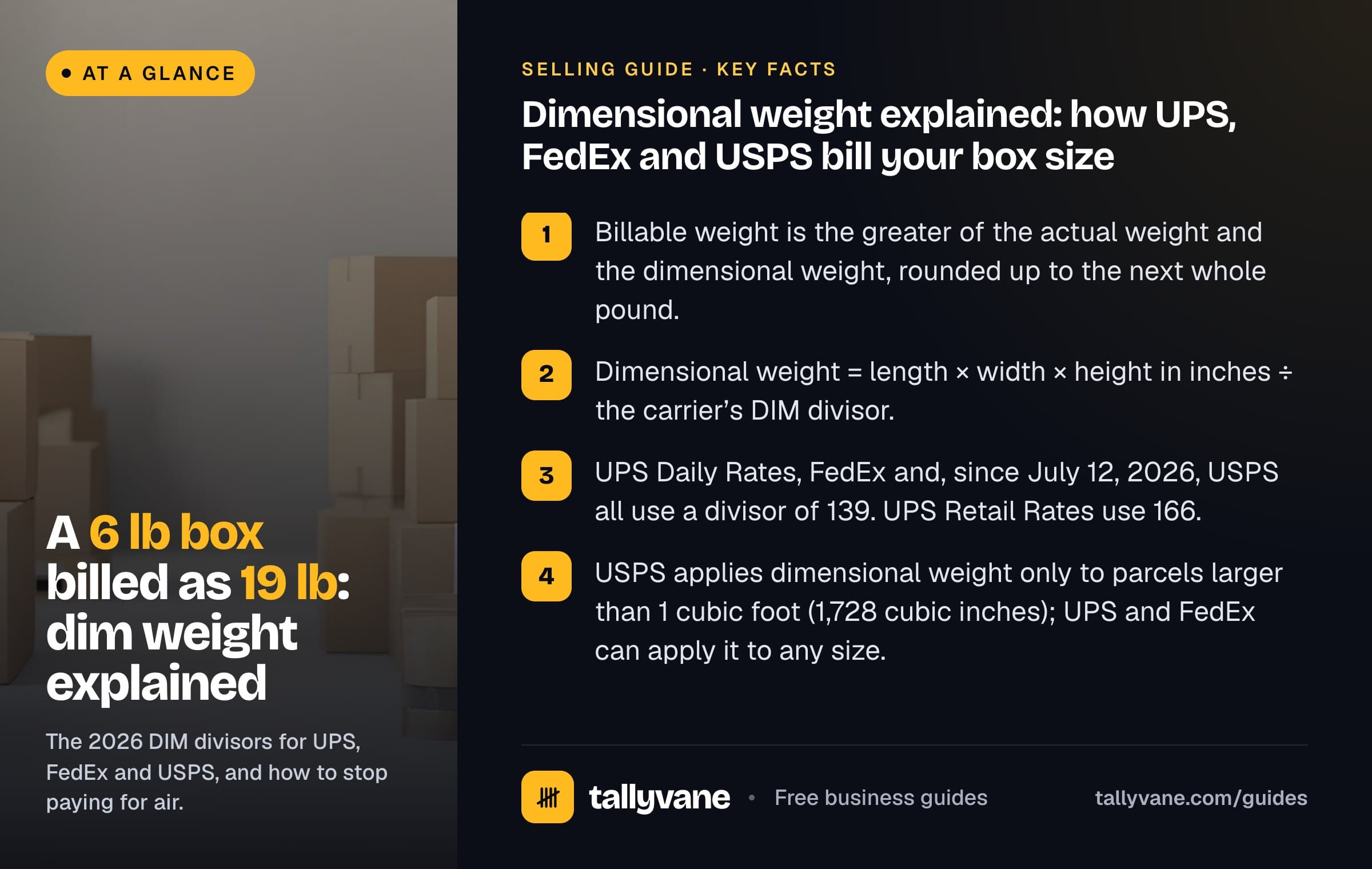
- Billable weight is the greater of the actual weight and the dimensional weight, rounded up to the next whole pound.
- Dimensional weight = length × width × height in inches ÷ the carrier’s DIM divisor.
- UPS Daily Rates, FedEx and, since July 12, 2026, USPS all use a divisor of 139. UPS Retail Rates use 166.
- USPS applies dimensional weight only to parcels larger than 1 cubic foot (1,728 cubic inches); UPS and FedEx can apply it to any size.
- The cheapest fix is the box: a smaller carton or a poly mailer often drops a parcel back to its actual weight.
Billable weight: why box size matters
A delivery van fills up by space long before it reaches its weight limit. If carriers charged only by weight, a 3 lb pillow in a large box would pay the same as 3 lb of books in a small one, while taking up five times the room. Dimensional weight fixes that from the carrier’s side by giving every parcel a weight based on its size.
The carrier then compares the two figures and charges for the greater one. That figure is the billable weight, and it is what your rate is looked up by. For small, dense items the actual weight usually wins. For anything light and bulky, such as bedding, lampshades, plush toys or clothing in a box, the dimensional weight usually wins.
Billable weight = the greater of Actual weight and Dimensional weight, each rounded up to the next whole pound
How to calculate dim weight
Measure the packed box, not the product, at its longest, widest and tallest points. Include any bulge: carriers measure parcels with automated scanners and will bill the real size. Round each side up to a whole inch, multiply the three, and divide by the carrier’s DIM divisor. Round the result up to the next whole pound.
The divisor is the key number. It is the cubic inches the carrier treats as one pound, so a smaller divisor means a higher DIM weight. When a carrier lowers its divisor it is raising prices on bulky parcels without changing its rate card.
Rounding each side up adds more than you might expect. A box measuring 12.25 × 9.5 × 6.1 inches is 709.9 cubic inches, or 5.11 lb at a 139 divisor. Rounded up to 13 × 10 × 7, it becomes 910 cubic inches and 6.55 lb, so it is billed as 7 lb instead of 6.
Cubic size = Length × Width × Height (each rounded up to a whole inch) DIM weight (lb) = Cubic size ÷ DIM divisor, rounded up to the next whole pound
Free toolDimensional weight calculatorUPS, FedEx and USPS divisors in 2026
All three big US carriers now divide by 139 for most small business shipping. The differences are in which rates use it, whether small parcels are exempt, and how sides are rounded. Negotiated contracts can use a higher divisor, so check your own agreement or shipping software if you have one.
- USPS changed its divisor from 166 to 139 on July 12, 2026, and at the same time started rounding fractional inches up instead of to the nearest inch. For bulky USPS parcels the DIM weight is now about 19% higher than before.
- USPS bills by actual weight for any parcel of 1,728 cubic inches or less, which is the main reason it is often cheapest for small, light boxes.
- USPS caps dimensional weight at 70 lb: if the DIM weight is higher, you pay the 70 lb price.
- USPS Cubic pricing is separate and is not based on weight at all. It prices small packages of up to 0.5 cubic feet and 20 lb by size and zone.
| Carrier | Divisor (in³ per lb) | Which parcels | Side rounding |
|---|---|---|---|
| UPS Daily Rates | 139 | All domestic and international package services | Each side rounded up to a whole inch |
| UPS Retail Rates | 166 | Parcels billed at UPS Retail Rates | Each side rounded up to a whole inch |
| FedEx | 139 | US, Puerto Rico and international shipments | Each side rounded to the nearest whole inch |
| USPS | 139 | Priority Mail Express, Priority Mail, Ground Advantage and Parcel Select over 1 cubic foot | Each side rounded up to a whole inch |
Worked example: five box sizes compared
A home goods seller ships five products in standard cartons. The table shows the dimensional weight at a 139 divisor and the billable weight at each carrier. The UPS Retail column uses 166.
- The 12-inch cube is exactly 1 cubic foot. USPS bills it at its 5 lb actual weight, while UPS and FedEx bill 13 lb. One more inch on any side would push it over the USPS threshold.
- Above 1 cubic foot, USPS and UPS Daily Rates give the same billable weight, because both divide by 139 and round sides up.
- The 18 × 14 × 10 box weighs 6 lb but is billed as 19 lb. Thirteen of the pounds you pay for are air and packing material.
| Box (inches) | Cubic inches | Actual weight | DIM weight at 139 | UPS Daily / FedEx | USPS | UPS Retail (166) |
|---|---|---|---|---|---|---|
| 10 × 8 × 6 | 480 | 3 lb | 3.45 lb | 4 lb | 3 lb | 3 lb |
| 12 × 12 × 12 | 1,728 | 5 lb | 12.43 lb | 13 lb | 5 lb | 11 lb |
| 16 × 12 × 10 | 1,920 | 4 lb | 13.81 lb | 14 lb | 14 lb | 12 lb |
| 18 × 14 × 10 | 2,520 | 6 lb | 18.13 lb | 19 lb | 19 lb | 16 lb |
| 24 × 18 × 12 | 5,184 | 15 lb | 37.29 lb | 38 lb | 38 lb | 32 lb |
Find the largest box billed at actual weight
Turn the formula around and you get the biggest box that costs nothing extra for its size. Multiply the actual weight, rounded up to a whole pound, by the divisor. A 3 lb item can go in a box of up to 417 cubic inches, such as 9 × 8 × 5 (360), before DIM weight takes over at a 139 divisor. A 5 lb item has 695 cubic inches to play with; a 10 lb item has 1,390.
This is the number to take to your packaging supplier. If most of your parcels are DIM-billed, check whether a box a size or two smaller still protects the item.
Largest cubic size at actual weight = Actual weight (rounded up) × DIM divisor
Free toolDimensional weight calculator
Practical ways to cut your billable weight
Most DIM charges come from boxes chosen for convenience. A few changes usually pay for themselves within a month of shipping.
- Right-size your boxes. Stock three or four sizes instead of one large carton, and pick the smallest that fits the item with enough cushioning.
- Use poly mailers or padded mailers for soft goods. A 2 lb hoodie in a 14 × 10 × 6 box is billed as 7 lb by UPS or FedEx; in a 14 × 12 × 2 inch mailer it is billed as 3 lb, and USPS bills it at 2 lb.
- Stay under 1 cubic foot for USPS. A box just under 1,728 cubic inches is billed at actual weight, so trimming one side can cut the price sharply.
- Fold or compress where it is safe. Vacuum-packed bedding and flat-packed items ship far smaller.
- Measure accurately before you buy labels. Carriers re-measure and add correction charges when the size on the label is too small.
- Ask about your divisor. High-volume shippers can sometimes negotiate a higher divisor, which lowers DIM weight on every bulky parcel.
- Build shipping into your prices. Use your real billable weight, not the product weight, when you work out profit per order.