
Key takeaways
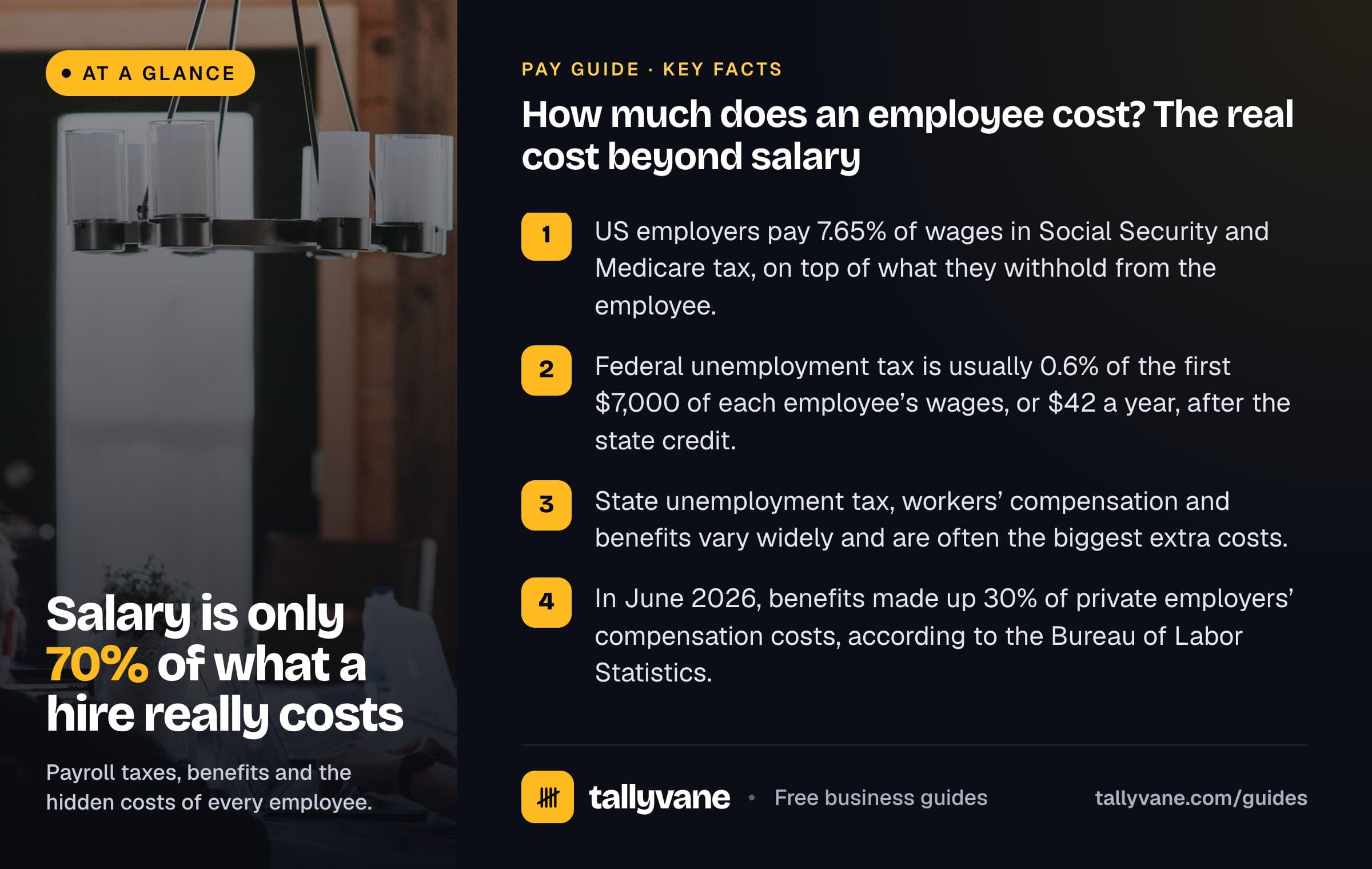
- US employers pay 7.65% of wages in Social Security and Medicare tax, on top of what they withhold from the employee.
- Federal unemployment tax is usually 0.6% of the first $7,000 of each employee’s wages, or $42 a year, after the state credit.
- State unemployment tax, workers’ compensation and benefits vary widely and are often the biggest extra costs.
- In June 2026, benefits made up 30% of private employers’ compensation costs, according to the Bureau of Labor Statistics.
- Budget on the fully loaded cost per productive hour, not the salary.
The short answer
The cost of an employee is their gross pay plus everything the law requires you to pay on top, plus anything you choose to offer. For many small businesses that comes to roughly 1.2 to 1.4 times salary, and more when health insurance and retirement matching are generous. The only reliable way to know is to add up your own numbers.
For a sense of scale, the Bureau of Labor Statistics reported that in June 2026 private industry employers spent an average of $46.89 per hour worked on compensation. Wages and salaries were $32.82 of that (70.0%) and benefits $14.07 (30.0%). The BLS counts legally required items such as Social Security, Medicare and unemployment insurance as benefits, along with paid leave, insurance and retirement.
Total employee cost = Gross pay + Employer payroll taxes + Insurance + Benefits + Equipment and other costs Cost multiplier = Total employee cost ÷ Gross pay
Employer payroll taxes: FICA
Social Security and Medicare taxes, together called FICA, are split between employer and employee. The employer pays 6.2% for Social Security and 1.45% for Medicare, 7.65% in total, and withholds the same amount from the employee’s pay. The employee’s half is not an extra cost to you; your half is.
Social Security tax only applies up to a yearly wage base, which the IRS gives as $184,500 for 2026. Medicare has no limit. The extra 0.9% Additional Medicare Tax on wages over $200,000 is withheld from the employee only; there is no employer match.
Employer Social Security = 6.2% × Wages up to $184,500 (2026) Employer Medicare = 1.45% × All wages
Unemployment taxes: FUTA and SUTA
Federal unemployment tax (FUTA) is 6.0% of the first $7,000 you pay each employee in a year. Most employers get a credit of up to 5.4% for state unemployment tax paid on time, which brings the net rate to 0.6%. That is $42 per employee per year once they have earned $7,000.
The credit is smaller in “credit reduction states”, ones that have not repaid federal loans used for unemployment benefits. The Department of Labor names those states each year, and employers there owe more FUTA.
State unemployment tax (SUTA) is set by each state. Rates and wage bases differ a lot, and new employers usually get a starting rate that later changes based on how many former employees claim benefits. Your state unemployment agency will tell you your rate when you register as an employer. A few states also charge employees, or employers, for disability or paid family leave programs.
Insurance, benefits and the costs people forget
Workers’ compensation insurance is required for most employers, with rules set by each state. Premiums depend on the type of work: an office job costs far less to insure than roofing.
Then come the benefits you offer. Health insurance is often the largest. Retirement matching, paid time off, bonuses, training and perks all add up. Paid time off does not raise the salary figure, but it reduces the hours you get for it, which raises the cost per productive hour.
- Recruiting: job ads, recruiter fees and the time spent interviewing.
- Equipment and software: a laptop, phone, licenses and seat-based subscriptions.
- Payroll service fees, often charged per employee per month.
- Space, if the employee needs a desk, a workshop or a vehicle.
- Onboarding time, when a new hire is paid but not yet fully productive.
Worked example: a $50,000 employee
A small business hires one full-time employee at $50,000 a year. The figures for SUTA, workers’ comp, health insurance and equipment below are assumptions for illustration only. Replace them with your own quotes and rates.
In this example the employee costs $64,667 a year, or 1.29 times salary. Spread over 2,080 paid hours (40 hours × 52 weeks), that is $31.09 an hour. If the employee takes 10 paid holidays and 10 days of paid time off, they work 1,920 hours, and the cost per productive hour rises to $33.68, against a $24.04 hourly wage.
Fully loaded hourly cost = Total annual cost ÷ Hours actually worked $64,667 ÷ 1,920 hours = $33.68 per hour
| Item | Basis | Annual cost |
|---|---|---|
| Salary | Gross pay | $50,000 |
| Employer Social Security and Medicare | 7.65% × $50,000 | $3,825 |
| FUTA | 0.6% × $7,000 | $42 |
| SUTA | Assumed 3% × $10,000 state wage base | $300 |
| Workers’ compensation | Assumed 1% of payroll | $500 |
| Health insurance, employer share | Assumed | $7,000 |
| 401(k) match | 3% of salary | $1,500 |
| Equipment, software and payroll fees | Assumed | $1,500 |
| Total | $64,667 |

Can you afford the hire?
Compare the fully loaded cost with what the employee will bring in or save. If a salesperson costs $65,000 a year and your gross margin is 40%, they need to generate about $162,500 in extra sales just to cover their cost ($65,000 ÷ 0.40). If an operations hire frees up 15 hours a week of your own time, ask what you will do with that time and what it is worth.
Also check cash, not just profit. Payroll goes out every week or two, but the extra revenue may take months to arrive. Run your cash runway with the new payroll included before you commit.
Contractors can look cheaper because you do not pay payroll taxes or benefits, but whether someone is an employee or a contractor is decided by how the work is controlled, not by what you call them. Misclassifying an employee can lead to back taxes and penalties, so check the IRS and Department of Labor guidance if you are unsure.
Free toolCash runway calculator