Key takeaways
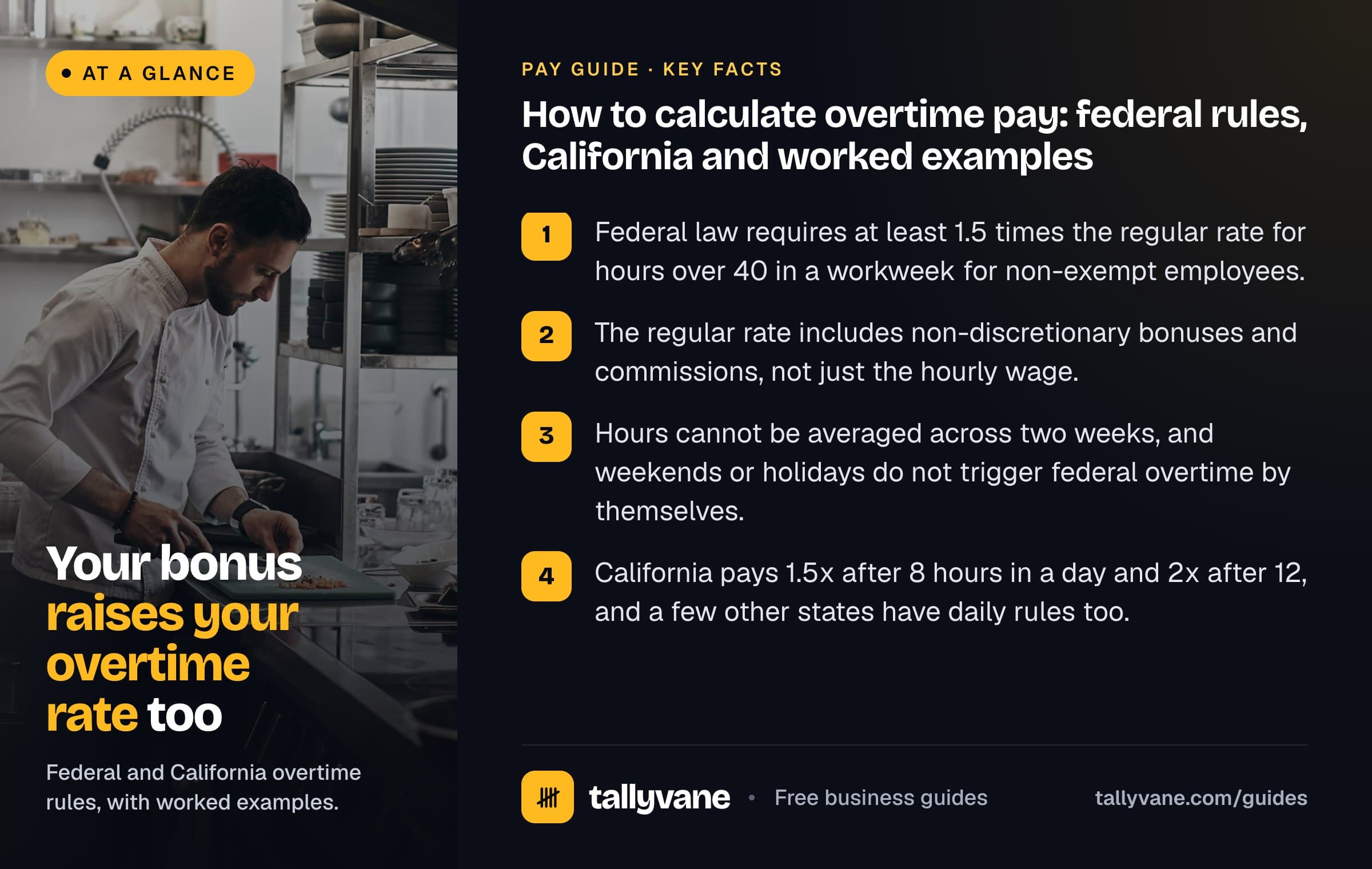
- Federal law requires at least 1.5 times the regular rate for hours over 40 in a workweek for non-exempt employees.
- The regular rate includes non-discretionary bonuses and commissions, not just the hourly wage.
- Hours cannot be averaged across two weeks, and weekends or holidays do not trigger federal overtime by themselves.
- California pays 1.5x after 8 hours in a day and 2x after 12, and a few other states have daily rules too.
- Where federal and state rules differ, the employee gets whichever is more generous.
The federal rule in one paragraph
The Fair Labor Standards Act (FLSA) says that covered, non-exempt employees must be paid at least one and a half times their regular rate of pay for every hour worked over 40 in a workweek. That is the “time and a half” most people know.
A workweek is a fixed, recurring period of 168 hours: seven consecutive 24-hour days. It can start on any day and at any hour, but it must stay the same. The Department of Labor is clear that hours cannot be averaged over two or more weeks. Working 30 hours one week and 50 the next means 10 overtime hours in the second week, not zero.
Federal law does not require extra pay for working on a Saturday, Sunday or holiday as such, or for working more than 8 hours in a day. Those only matter federally if total hours in the week go over 40. Some employers pay premiums for weekends or holidays by choice or under a contract, and some states have their own rules.
Overtime hours = Hours worked in the workweek − 40 Overtime pay = Overtime hours × Regular rate × 1.5 Total pay = 40 × Regular rate + Overtime pay
Worked example: hourly employee, 46 hours
An employee earns $20 an hour and works 46 hours in one workweek. The first 40 hours are paid at $20. The 6 hours over 40 are paid at $30, which is $20 × 1.5.
An easy check: the employee earned $920 in straight time ($20 × 46), plus a half-time premium of $10 on each of the 6 overtime hours ($60). $920 + $60 = $980, the same answer.
| Part | Hours | Rate | Pay |
|---|---|---|---|
| Regular time | 40 | $20.00 | $800.00 |
| Overtime | 6 | $30.00 | $180.00 |
| Total | 46 | $980.00 |
The regular rate is more than the hourly wage
Overtime is based on the “regular rate of pay”, not just the base hourly wage. The Department of Labor says the regular rate includes all pay for employment except certain payments the law excludes. Non-discretionary bonuses, such as a production bonus or an attendance bonus promised in advance, and most commissions must be included.
Excluded payments include expense reimbursements, true discretionary bonuses, gifts, overtime or holiday premiums already paid, and pay for time not worked such as vacation, holidays or sick days.
Example: an employee on $20 an hour works 45 hours and earns a $90 production bonus that week. Straight-time earnings are $900 for the hours plus $90 bonus, $990 in all. The regular rate is $990 ÷ 45 = $22. Each of the 5 overtime hours is owed an extra half of that rate, $11, so the overtime premium is $55. Total pay for the week is $990 + $55 = $1,045. Paying overtime on the $20 wage alone would have come to $1,040, $5 short.
Regular rate = (Hourly pay for all hours + Non-discretionary bonuses and commissions) ÷ Total hours worked Overtime premium = Overtime hours × Regular rate × 0.5 Total pay = Straight-time earnings + Overtime premium
Salaried employees who get overtime
Being paid a salary does not on its own make someone exempt from overtime. Exemption depends on the job duties and on meeting a minimum salary test, and many salaried workers are non-exempt.
For a non-exempt employee paid only a weekly salary, the Department of Labor says the regular rate is the salary divided by the number of hours the salary is meant to cover. If a $1,000 weekly salary is for a 40-hour week, the regular rate is $25. Any hours over 40 are then paid at $37.50 each. Four extra hours would add $150.
Other salary arrangements, such as a salary meant to cover a fixed schedule over 40 hours or a fluctuating workweek, follow different calculations. Check the Department of Labor’s overtime fact sheet or get payroll advice before using them.
Regular rate = Weekly salary ÷ Hours the salary is intended to cover
California daily overtime and double time
California is the best-known state with stricter rules. According to the state Labor Commissioner, non-exempt employees are owed 1.5 times the regular rate for hours over 8 in a workday, up to 12, and for hours over 40 in a workweek. Hours over 12 in a workday are paid at double time.
There is also a seventh-day rule: if someone works seven consecutive days in a workweek, the first 8 hours on the seventh day are paid at 1.5x and any hours over 8 that day at 2x.
Hours are not paid twice. In the example below, the week has 45 hours, but only 38 of them are regular hours, so weekly overtime does not add anything on top of the daily overtime already counted. The same week under federal rules alone would pay $950 (40 hours at $20 plus 5 at $30), so California’s daily rule is worth $30 more to this employee.
- Total for the week: $760 + $180 + $40 = $980.
| Day | Hours | Regular | Overtime (1.5x) | Double time (2x) |
|---|---|---|---|---|
| Monday | 10 | 8 | 2 | 0 |
| Tuesday | 13 | 8 | 4 | 1 |
| Wednesday | 8 | 8 | 0 | 0 |
| Thursday | 8 | 8 | 0 | 0 |
| Friday | 6 | 6 | 0 | 0 |
| Total hours | 45 | 38 | 6 | 1 |
| Pay | $760 | $180 | $40 |
Other states, and which rule wins
A few other states also have daily overtime. The Department of Labor’s state table lists premium pay after 8 hours a day in Alaska and after 12 hours a day in Colorado. In Nevada, employees who earn less than 1.5 times the state minimum wage get premium pay after 8 hours in a day. Each state has its own exemptions and exceptions, and some industries have special rules.
When federal and state law both apply, the employee is entitled to whichever gives more. So a California employer must follow the daily rules even though federal law has none.
Before running payroll, check your state labor department’s overtime page and any union or employment contract, which can promise more than the law requires.
Free toolTimesheet calculatorCommon overtime mistakes
Most overtime errors come from a short list of habits. Each one can lead to back pay claims.
- Averaging hours across a two-week pay period instead of counting each workweek separately.
- Leaving bonuses and commissions out of the regular rate.
- Treating every salaried employee as exempt.
- Giving time off later instead of overtime pay. Comp time in place of overtime is mainly a public-sector arrangement, so a private employer should check the rules before offering it.
- Not counting work done before or after a shift, such as setting up, closing down or answering messages.
- Applying only the federal rule in a state that pays daily overtime.