
Key takeaways
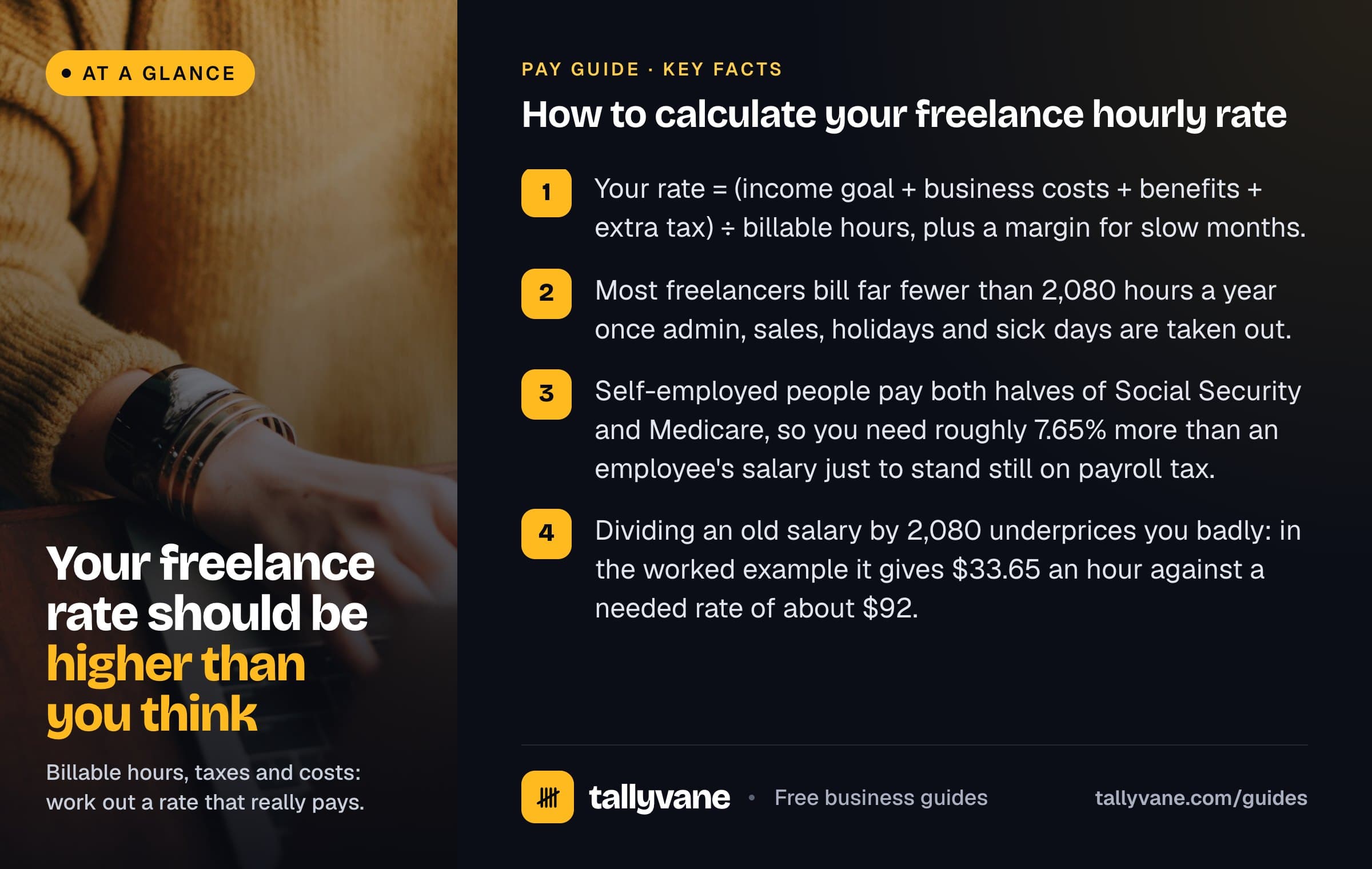
- Your rate = (income goal + business costs + benefits + extra tax) ÷ billable hours, plus a margin for slow months.
- Most freelancers bill far fewer than 2,080 hours a year once admin, sales, holidays and sick days are taken out.
- Self-employed people pay both halves of Social Security and Medicare, so you need roughly 7.65% more than an employee's salary just to stand still on payroll tax.
- Dividing an old salary by 2,080 underprices you badly: in the worked example it gives $33.65 an hour against a needed rate of about $92.
- Check the result against market rates, then use project or value pricing where you can.
Why a salary divided by 2,080 is too low
If you earned $70,000 as an employee, it is tempting to divide by 2,080 hours and charge $33.65 an hour. That rate would leave you far worse off than your old job.
An employer paid things you never saw on your paycheck: half of your Social Security and Medicare tax, part of your health insurance, retirement matching, paid holidays and vacation, your computer and software, and the time you spent in meetings or training. As a freelancer you pay all of that yourself, and you only get paid for hours a client is billed for.
Step 2: count your real billable hours
Start from 52 weeks. Take out the vacation, holidays and sick days you expect. Then decide what share of your working hours can be billed. Finding clients, writing proposals, invoicing, bookkeeping and learning all take time that no client pays for.
The billable share depends heavily on your field and on how steady your client base is. If you have no data yet, plan with a cautious figure such as 50% to 60%. Then track your time for a few weeks and replace the guess with your own number.
Billable hours = (52 − weeks off) × hours worked per week × billable share
Worked example
A freelance developer wants the equivalent of a $70,000 salary. They plan four weeks of vacation and two weeks for holidays and sick days, work 40 hours a week, and expect to bill 60% of that time.
Billable hours are (52 − 6) × 40 × 60% = 46 × 40 × 0.6 = 1,104 hours.
Dividing $92,055 by 1,104 hours gives $83.38 an hour. Adding a 10% margin for slow months and late payers brings it to about $91.72, so a quoted rate of $90 to $95 an hour is a sensible starting point. At 50% billable it would need to be about $100 before the margin; at 75%, about $67.
| Item | Annual amount |
|---|---|
| Income goal (salary equivalent) | $70,000 |
| Extra payroll tax (7.65% of $70,000) | $5,355 |
| Health insurance | $7,200 |
| Retirement savings | $3,500 |
| Business expenses | $6,000 |
| Total to cover | $92,055 |
| Billable hours (46 weeks × 40 × 60%) | 1,104 |
| Break-even hourly rate | $83.38 |
| With a 10% margin | $91.72 |
Step 3: check the rate against the market
Your cost-based rate is a floor, not a price tag. Compare it with what clients pay for similar work: look at rates published by peers, job boards, professional associations and agencies in your field, and ask other freelancers directly.
If the market pays well above your floor, charge closer to the market. If the market pays below it, you need to cut costs, raise your billable share, specialize in work that pays more, or reconsider the goal. Charging below your floor only works for a short time.
Some clients will weigh you against an agency rather than an employee. An agency rate includes overhead and profit, so a freelancer can often price well above an employee hourly wage and still be the cheaper option.

Day rates, project prices and retainers
Hourly billing punishes you for working fast. Once you know your hourly floor, you can turn it into other pricing models that are easier to sell.
- Day rate: your hourly rate × billable hours in a day. At $95 and 7.5 billable hours, $712.50, rounded to $700 or $750.
- Project price: estimate the hours, add a buffer of 15% to 25% for revisions and unknowns, then multiply by your rate. A 30-hour estimate at $95 is $2,850 before the buffer.
- Retainer: a fixed monthly fee for a set amount of availability or work. It smooths income and saves sales time, which raises your billable share.
- Value pricing: price on what the result is worth to the client, such as revenue gained or cost saved. Your hourly floor still tells you whether a deal is worth taking.
Do not forget tax payments
Freelancers have no withholding, so income tax and self-employment tax are paid during the year in quarterly estimated payments. A rate that looks fine before tax can leave you short in April if nothing was set aside. Move a share of every client payment into a separate account and pay the IRS on the 2026 due dates: April 15, June 15, September 15 and January 15, 2027.
Raise rates on a schedule. Review them at least once a year, and give existing clients notice before a change takes effect.
Free toolQuarterly tax calculator