
Key takeaways
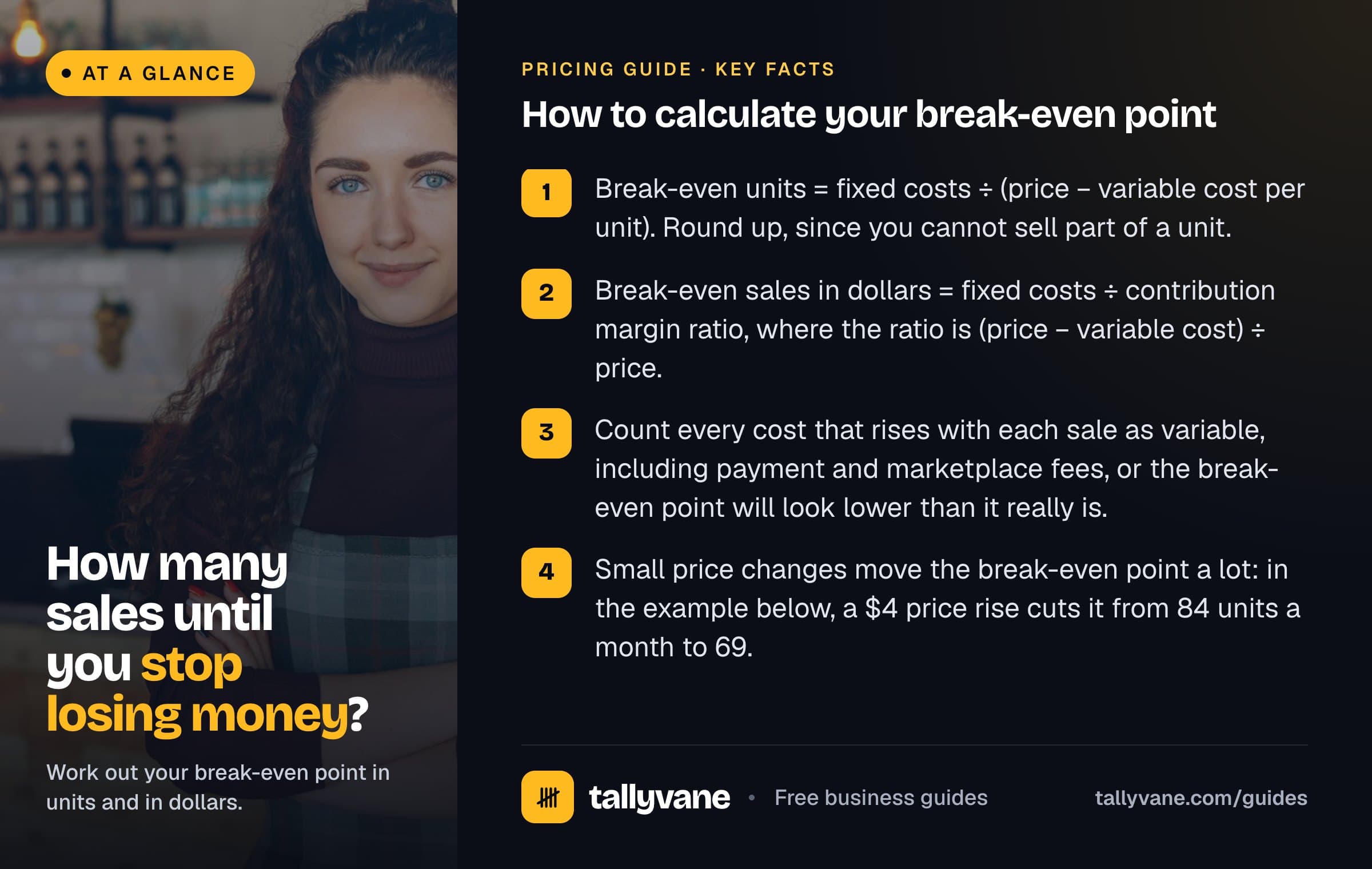
- Break-even units = fixed costs ÷ (price − variable cost per unit). Round up, since you cannot sell part of a unit.
- Break-even sales in dollars = fixed costs ÷ contribution margin ratio, where the ratio is (price − variable cost) ÷ price.
- Count every cost that rises with each sale as variable, including payment and marketplace fees, or the break-even point will look lower than it really is.
- Small price changes move the break-even point a lot: in the example below, a $4 price rise cuts it from 84 units a month to 69.
What the break-even point is
The break-even point is where total revenue equals total costs, so profit is exactly zero. Below it, each month loses money. Above it, every extra sale adds to profit.
It is most useful before a decision: opening, launching a product, signing a lease, hiring or changing prices. It turns “we will have $1,500 a month of overheads” into “we need to sell 84 candles a month, about 3 a day”, which you can test against what you know about demand.
Step 1: sort your costs into fixed and variable
Fixed costs stay the same whatever you sell in the period. Variable costs go up with each unit you sell. A quick test: if you sold one more unit, would this cost go up? If yes, it is variable.
Work in one period, usually a month. Convert costs paid less often to a monthly figure, for example by dividing a yearly insurance bill by 12. Some costs are partly fixed and partly variable, such as a phone plan with a base fee and usage charges. Split them into the two parts.
| Fixed costs (per month) | Variable costs (per unit sold) |
|---|---|
| Rent and utilities | Materials or stock |
| Salaries and your own pay | Packaging |
| Insurance | Payment processing fees |
| Software subscriptions | Marketplace or platform fees |
| Loan interest and equipment leases | Shipping you pay that the buyer does not |
| Regular advertising budget | Sales commissions |
Step 2: work out the contribution margin
The contribution margin per unit is the price minus the variable cost of that unit. It is the amount each sale contributes toward fixed costs, and then toward profit once fixed costs are covered.
The contribution margin ratio is the same figure as a share of the price. If it is zero or negative, you cannot break even at any volume: every sale loses money, and the price or the variable cost must change first.
Contribution margin per unit = Price − Variable cost per unit Contribution margin ratio = Contribution margin per unit ÷ Price
Step 3: divide fixed costs by the contribution margin
This is the formula the US Small Business Administration uses in its break-even calculator. Divide fixed costs by the contribution margin per unit to get the number of units, and by the contribution margin ratio to get the sales in dollars.
Use the units version if you sell one main product. Use the sales version if you sell many products at different prices, with an average contribution margin ratio across your sales mix.
Break-even units = Fixed costs ÷ (Price − Variable cost per unit) Break-even sales = Fixed costs ÷ Contribution margin ratio Units for a profit target = (Fixed costs + Target profit) ÷ Contribution margin per unit
Free toolBreak-even calculatorWorked example: a candle maker selling online
A candle maker sells candles for $28 each through her own website. The buyer pays shipping separately. Each candle costs $7.50 in wax, wick, fragrance and jar, plus $1.50 for packaging. Card processing is 2.9% + $0.30, which is $1.11 on a $28 sale. Monthly fixed costs are $900 studio rent, $120 software, $80 insurance and $400 advertising, so $1,500 in all.
- At 84 candles a month she covers every cost. Each candle beyond that adds $17.89 of profit.
- If she leaves out the card fee, the margin looks like $19.00 and the break-even point 79 candles. Forgetting a $1.11 fee hides 5 candles a month of real costs.
- If rent rose by $300, fixed costs would be $1,800 and break-even would rise to 101 candles.
| Item | Amount |
|---|---|
| Price | $28.00 |
| Variable cost ($7.50 + $1.50 + $1.11) | $10.11 |
| Contribution margin per candle | $17.89 |
| Contribution margin ratio | 63.9% |
| Fixed costs per month | $1,500.00 |
| Break-even units ($1,500 ÷ $17.89 = 83.8) | 84 candles |
| Break-even sales (84 × $28) | $2,352.00 |
| Candles for $2,000 monthly profit ($3,500 ÷ $17.89 = 195.6) | 196 candles |

Testing prices before you change them
Because price changes the contribution margin directly, a small price change moves the break-even point more than most people expect. Here is the same candle business at three prices, with the card fee recalculated for each.
- Cutting the price from $28 to $24 means selling 24 more candles a month just to stand still.
- Raising it to $32 lowers the break-even point to 69 candles, as long as sales do not fall by more than that.
| Price | Variable cost | Contribution margin | Break-even units | Break-even sales |
|---|---|---|---|---|
| $24 | $10.00 | $14.00 | 108 | $2,592 |
| $28 | $10.11 | $17.89 | 84 | $2,352 |
| $32 | $10.23 | $21.77 | 69 | $2,208 |
Margin of safety and the limits of the formula
Once you know your break-even point, compare it with what you actually sell. The gap is your margin of safety. If the candle maker sells 120 candles a month, sales could fall 30% before she makes a loss ((120 − 84) ÷ 120).
The formula assumes a fixed price and a constant variable cost per unit. In practice, discounts, bulk buying, returns and seasonal swings all shift those numbers. Treat the result as a target, recheck it whenever prices or costs change, and use your actual monthly figures once you have them.
Break-even is also about profit, not cash. Loan repayments, stock bought in advance and slow-paying customers can leave you short of cash even above break-even, so look at cash runway too.
Margin of safety % = (Actual sales − Break-even sales) ÷ Actual sales × 100
Free toolCash runway calculator