Key takeaways
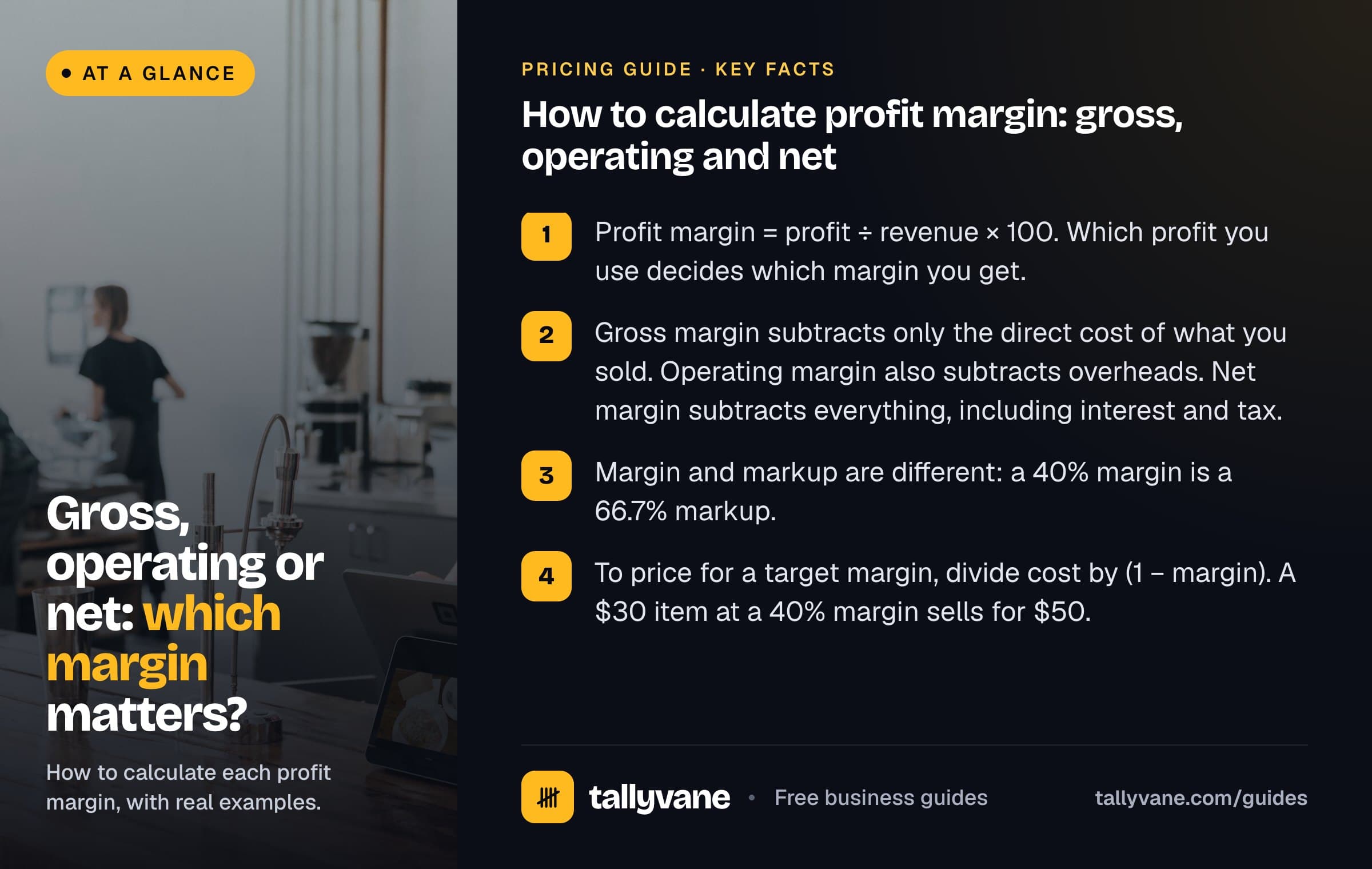
- Profit margin = profit ÷ revenue × 100. Which profit you use decides which margin you get.
- Gross margin subtracts only the direct cost of what you sold. Operating margin also subtracts overheads. Net margin subtracts everything, including interest and tax.
- Margin and markup are different: a 40% margin is a 66.7% markup.
- To price for a target margin, divide cost by (1 − margin). A $30 item at a 40% margin sells for $50.
The basic formula
Every profit margin is a profit figure divided by revenue, shown as a percentage. If you sell $100 of goods and keep $25 as profit, your margin is 25%.
The three common margins differ only in which costs come out before you divide. Each tells you something different, so most businesses track all three.
- Gross margin: is each sale priced well above what it costs you to make or buy?
- Operating margin: does the business make money from its day-to-day work, after rent, wages and other overheads?
- Net margin: what is left for the owners after every cost, including interest and tax?
Profit margin % = Profit ÷ Revenue × 100
Gross profit margin
Gross profit is revenue minus the cost of goods sold (COGS). COGS is the direct cost of the products you sold: what you paid to buy or make them, including materials, direct labor and inbound shipping. For a service business it is the direct cost of delivering the service, such as subcontractors.
COGS counts only the goods you actually sold in the period, not everything you bought. Stock still on the shelf at the end of the period is not part of it.
Gross margin is the number to watch when you set prices, choose suppliers or decide which products to push. A falling gross margin usually means costs rose and prices did not.
Gross profit = Revenue − Cost of goods sold Gross margin % = Gross profit ÷ Revenue × 100
Free toolProfit margin calculatorOperating margin
Operating profit, also called operating income or income from operations, is gross profit minus operating expenses. Operating expenses are the costs of running the business that are not tied to a single sale: rent, salaries, software, marketing, insurance, accounting fees and depreciation.
Operating margin shows whether the business model works before financing and tax. Two companies selling the same products at the same prices can have very different operating margins if one runs a much leaner operation.
Operating profit = Gross profit − Operating expenses Operating margin % = Operating profit ÷ Revenue × 100
Net profit margin
Net profit, also called net income or the bottom line, is what is left after every cost: operating expenses, interest on loans and income tax, plus any one-off gains or losses.
Net margin is the broadest measure of profitability. It is affected by how the business is financed and taxed, so it is less useful than operating margin for comparing how well two businesses are run, but it is the number that tells you what the owners actually earn.
Net profit = Operating profit − Interest − Taxes (± other items) Net margin % = Net profit ÷ Revenue × 100
Worked example: all three margins from one profit and loss statement
A small online homeware shop has $250,000 of sales in a year. The products it sold cost $140,000. Rent, wages, software and advertising come to $75,000. It pays $5,000 of interest on a loan and $6,000 of income tax.
The shop keeps 44 cents of each sales dollar after paying for the goods, 14 cents after running the business, and 9.6 cents at the end. If its gross margin slipped by 4 points to 40%, gross profit would fall by $10,000, and with the same overheads, interest and tax, net profit would drop from $24,000 to $14,000. That is why small changes in gross margin matter so much.
| Line | Amount | Margin |
|---|---|---|
| Revenue | $250,000 | |
| Cost of goods sold | −$140,000 | |
| Gross profit | $110,000 | 44.0% gross margin |
| Operating expenses | −$75,000 | |
| Operating profit | $35,000 | 14.0% operating margin |
| Interest | −$5,000 | |
| Income tax | −$6,000 | |
| Net profit | $24,000 | 9.6% net margin |

Margin vs markup
Markup is profit as a share of cost. Margin is profit as a share of the selling price. The same sale always has a higher markup than margin. An item that costs $30 and sells for $50 has a $20 profit: that is a 40% margin ($20 ÷ $50) but a 66.7% markup ($20 ÷ $30).
Confusing the two is a common pricing mistake. If you want a 40% margin and add 40% to a $30 cost, you charge $42 and get a margin of only 28.6%.
Markup % = (Price − Cost) ÷ Cost × 100 Markup needed for a margin = Margin ÷ (1 − Margin)
| Gross margin | Markup on cost | Price of a $30 item |
|---|---|---|
| 20% | 25% | $37.50 |
| 25% | 33.3% | $40.00 |
| 30% | 42.9% | $42.86 |
| 40% | 66.7% | $50.00 |
| 50% | 100% | $60.00 |
| 60% | 150% | $75.00 |
Pricing for a target margin, and ways to improve it
To set a price that gives a chosen gross margin, divide the cost by one minus the margin as a decimal. For a 40% margin on a $30 cost, divide $30 by 0.6 to get $50.
There are only two levers on gross margin: price and cost. On the $30 item selling for $50, raising the price 5% to $52.50 lifts the margin from 40% to 42.9%. Cutting the cost by $1.50 to $28.50 at the original price lifts it to 43%. Fees count as costs too: if you sell through a marketplace or take cards, include those fees in cost when you work out the margin on each sale.
Operating and net margins improve when revenue grows faster than overheads. Many overheads stay roughly fixed as sales rise, so the same business at higher volume usually has a better operating margin.
Price = Cost ÷ (1 − Target margin % ÷ 100)