Key takeaways
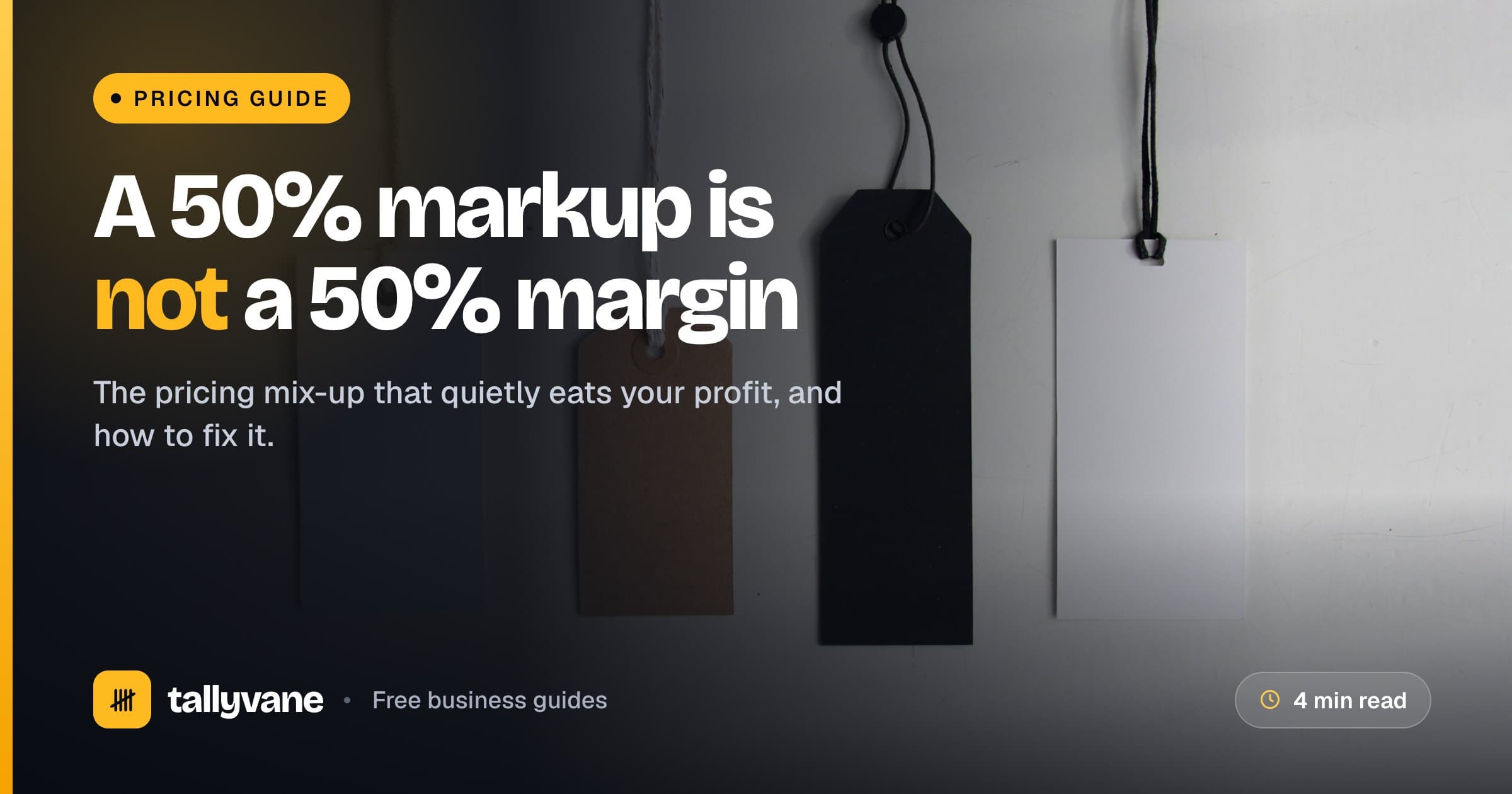
- Markup divides profit by cost; margin divides profit by price, so markup is always the bigger number for the same sale.
- A 50% markup gives a 33.3% margin, and a 100% markup gives a 50% margin.
- To hit a target margin, divide cost by (1 − margin), do not add the margin percentage to cost.
- Margin can never reach 100%, but markup has no upper limit.
The one-line difference
Markup and margin both start with the same profit: the selling price minus what the item cost you. The only difference is what you divide that profit by.
Markup divides profit by cost. It answers “how much did I add on top of what I paid?” Margin divides profit by the selling price. It answers “how much of each sale do I keep?”
Take a lamp you buy for $60 and sell for $100. Profit is $40. The markup is $40 ÷ $60 = 66.7%. The margin is $40 ÷ $100 = 40%. Same lamp, same $40, two different percentages.
Profit = Price − Cost Markup % = Profit ÷ Cost × 100 Margin % = Profit ÷ Price × 100
Why mixing them up costs money
The most common mistake is wanting a certain margin and adding that percentage to cost. Suppose you need a 40% margin to cover your overheads. You take the $60 cost, add 40%, and charge $84.
At $84 your profit is $24, and $24 ÷ $84 is a 28.6% margin, not 40%. On every sale you are $16 short of the price you meant to charge. Across 500 sales a year that is $8,000 of profit that never arrived.
The reverse mistake happens too. A supplier quotes a “40% margin” on a product you resell, and you assume you can discount it by 40% and still break even. You cannot: a 40% margin only leaves 40% of the price to give away, and any overheads come out of that first.
It also matters when you talk to other people. Accountants, lenders and most financial statements talk about margin. Many wholesalers and retailers price using markup. Always ask which one someone means.
Converting markup to margin and back
You do not need the price or cost to convert between the two. If you know one percentage, you can work out the other.
A 25% markup becomes 25 ÷ 125 × 100 = 20% margin. A 30% margin becomes 30 ÷ 70 × 100 = 42.9% markup.
Margin % = Markup % ÷ (100 + Markup %) × 100 Markup % = Margin % ÷ (100 − Margin %) × 100
| Markup | Margin | Price on a $10 cost |
|---|---|---|
| 10% | 9.1% | $11.00 |
| 20% | 16.7% | $12.00 |
| 25% | 20.0% | $12.50 |
| 30% | 23.1% | $13.00 |
| 33.3% | 25.0% | $13.33 |
| 40% | 28.6% | $14.00 |
| 50% | 33.3% | $15.00 |
| 60% | 37.5% | $16.00 |
| 75% | 42.9% | $17.50 |
| 100% | 50.0% | $20.00 |
| 150% | 60.0% | $25.00 |
| 200% | 66.7% | $30.00 |
| 300% | 75.0% | $40.00 |
Pricing from a target margin
If you know the margin you need, divide the cost by one minus that margin written as a decimal. For a 40% margin on a $60 cost, that is $60 ÷ 0.60 = $100.
If you think in markup instead, multiply cost by one plus the markup. A 66.7% markup on $60 is $60 × 1.667 = $100, the same price.
Choose the margin first, based on what the business needs to cover. Your gross margin has to pay for rent, wages, software, marketing, payment fees and your own pay before any of it is profit. If those costs add up to 30% of sales and you want 10% left over, you need roughly a 40% gross margin.
Price = Cost ÷ (1 − Target margin) Price = Cost × (1 + Markup)
Free toolProfit margin calculatorWorked example: a small retailer setting prices
A gift shop buys candles for $8, mugs for $6 and notebooks for $4.50. It wants a 50% gross margin on all three.
Using the target margin formula, each price is the cost divided by 0.5, which is the same as doubling it. That is a 100% markup. If the owner had instead added 50% to each cost, the candles would sell for $12 and earn only 33.3% margin.
| Item | Cost | Price for 50% margin | Price with 50% markup | Margin at 50% markup |
|---|---|---|---|---|
| Candle | $8.00 | $16.00 | $12.00 | 33.3% |
| Mug | $6.00 | $12.00 | $9.00 | 33.3% |
| Notebook | $4.50 | $9.00 | $6.75 | 33.3% |
Working backwards from a retail price
Makers who sell wholesale often need to work from the retail price down. A shop that wants a 50% margin will only pay up to half of the retail price. So if a candle should sell for $30 in stores, the wholesale price can be no more than $15.
Now check your own margin at that wholesale price. If the candle costs you $6 to make, selling it for $15 leaves $9 profit, a 60% margin and a 150% markup. If it costs $10, your margin falls to 33.3%, which may not cover your own overheads once wholesale orders grow.
The same logic works for any chain of sellers. Each one takes its margin from the price it sells at, so start from the price the end customer will pay and subtract each margin in turn.
Max wholesale price = Retail price × (1 − Retailer margin) Example: $30 × (1 − 0.50) = $15
Discounts, fees and other things that change the picture
Discounts come off the price, so they hit margin harder than they look. A $100 item that costs $60 has a 40% margin. Take 20% off and it sells for $80, profit falls to $20, and margin drops to 25%. Half the profit is gone from a 20% discount.
Marketplace and payment fees also come off the price. If a platform takes 13% of a $100 sale, your $40 margin before fees becomes $27, a 27% margin. When you work out margin for an online sale, include fees and shipping in the cost, or use a calculator built for that platform.
Margin can never reach 100%, because that would mean the item cost nothing. Markup has no ceiling: an item that costs $2 and sells for $20 has a 900% markup but a 90% margin. That is one reason margins are easier to compare across products and businesses.
Free toolDiscount calculator