Key takeaways
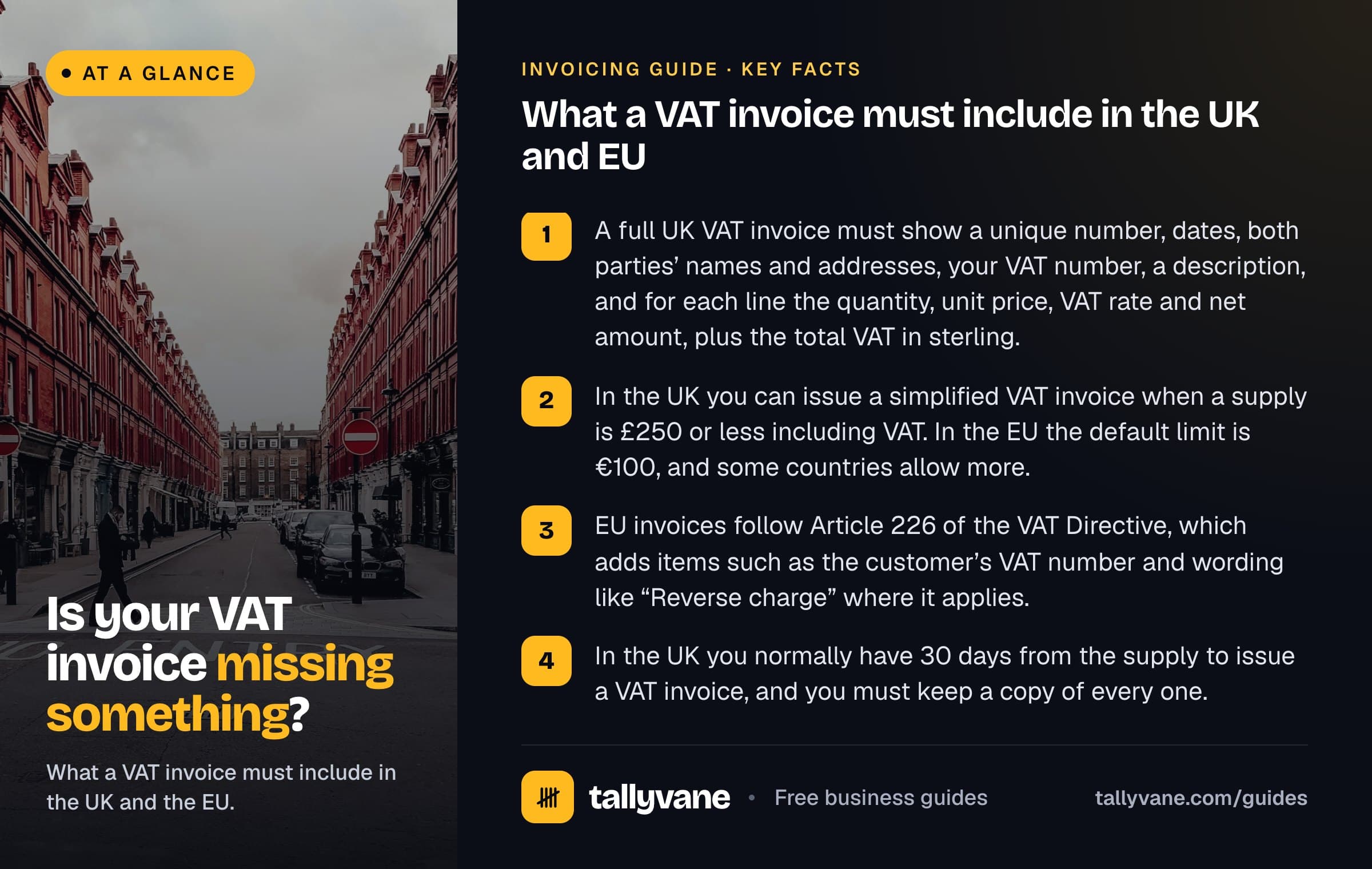
- A full UK VAT invoice must show a unique number, dates, both parties’ names and addresses, your VAT number, a description, and for each line the quantity, unit price, VAT rate and net amount, plus the total VAT in sterling.
- In the UK you can issue a simplified VAT invoice when a supply is £250 or less including VAT. In the EU the default limit is €100, and some countries allow more.
- EU invoices follow Article 226 of the VAT Directive, which adds items such as the customer’s VAT number and wording like “Reverse charge” where it applies.
- In the UK you normally have 30 days from the supply to issue a VAT invoice, and you must keep a copy of every one.
When you need to issue a VAT invoice
Only businesses registered for VAT issue VAT invoices. If you are not registered, you cannot charge VAT, so your invoices should not show any.
In the UK, if you are VAT registered you must give a VAT invoice to any VAT-registered customer when you make a standard-rated or reduced-rated supply to them. HMRC says you normally have to issue it within 30 days of the date of supply. You do not need to issue a VAT invoice if the invoice covers only exempt or zero-rated sales within the UK.
The invoice matters more to your customer than to you. A VAT-registered buyer generally needs a valid VAT invoice to reclaim the VAT they paid you, so a missing detail can mean an awkward request to reissue it.
Retailers selling to the public do not have to issue a VAT invoice unless the customer asks for one.
What a full UK VAT invoice must include
HMRC’s VAT Notice 700/21 sets out the details a full VAT invoice must show. Use this list for any supply over £250, and for any invoice where you are not sure a shorter version is allowed.
- A unique sequential number, from one or more series, that identifies the invoice.
- The time of supply (the tax point), and the date of issue if it is different.
- Your business name, address and VAT registration number.
- Your customer’s name and address.
- A description that identifies the goods or services.
- For each line: the quantity or extent, the unit price, the VAT rate and the amount excluding VAT.
- The total amount excluding VAT.
- The rate of any cash discount offered.
- The total VAT charged, shown in sterling.
Simplified and modified invoices in the UK
When the charge for a supply is £250 or less including VAT, you can issue a simplified VAT invoice instead. It must show your name, address and VAT registration number, the time of supply, a description of the goods or services, and for each VAT rate, the total payable including VAT and the rate charged.
A simplified invoice cannot include exempt supplies. If you sold a mix of exempt and taxable items, use a full invoice.
For supplies over £250, a retailer can issue a modified VAT invoice, which shows VAT-inclusive amounts for each line instead of VAT-exclusive ones. It still needs the other details of a full invoice.
To find the VAT inside a VAT-inclusive price at 20%, divide by 6. A £96 sale on a simplified invoice contains £16 of VAT and £80 net.
VAT in a price including 20% VAT = Price ÷ 6 VAT in a price including 5% VAT = Price ÷ 21
Free toolVAT calculatorWorked example: a UK invoice with two VAT rates
A VAT-registered design studio invoices a publisher for 12 hours of design work at £55 an hour, standard-rated at 20%, and 40 printed copies of a book at £8.50 each. Printed books are zero-rated in the UK, so that line carries 0% VAT.
Each line shows its own rate and net amount, and the VAT total is worked out from the lines. The invoice also carries the studio’s VAT number, an invoice number, the tax point and the publisher’s name and address.
| Line | Quantity × unit price | VAT rate | Net | VAT |
|---|---|---|---|---|
| Design work | 12 × £55.00 | 20% | £660.00 | £132.00 |
| Printed books | 40 × £8.50 | 0% | £340.00 | £0.00 |
| Total | £1,000.00 | £132.00 | ||
| Amount due | £1,132.00 |
What an EU VAT invoice must include
Across the EU, the minimum content of a VAT invoice is set by Article 226 of the VAT Directive (2006/112/EC). Each country writes it into national law and may add its own practical rules, such as e-invoicing formats.
- Date of issue and a unique sequential number.
- The supplier’s VAT identification number.
- The customer’s VAT identification number, where the customer pays the VAT under the reverse charge or receives an intra-EU supply of goods.
- Full name and address of the supplier and the customer.
- The quantity and nature of the goods, or the extent and nature of the services.
- The date of supply or payment on account, where it differs from the invoice date.
- The taxable amount per rate or exemption, the unit price excluding VAT, and any discounts not already in the unit price.
- The VAT rate applied and the VAT amount payable.
- For an exempt supply, a reference to the exemption that applies.
- Set wording where it applies: “Reverse charge”, “Self-billing”, “Cash accounting”, or the margin scheme wording for travel agents or second-hand goods.
- Where a tax representative is liable for the VAT, their VAT number, name and address.
Simplified invoices and deadlines in the EU
Under Article 220a, EU countries must allow a simplified invoice when the invoice amount is no more than €100 or the local currency equivalent. A simplified invoice needs at least the date of issue, the supplier’s identity, the type of goods or services, and the VAT payable or the information needed to calculate it.
Some EU countries allow simplified invoices above €100, so check the national limit where you charge VAT. A simplified invoice is not allowed for intra-EU supplies of goods, or where a supplier not established in the country makes a supply on which the customer pays the VAT.
For intra-EU supplies of goods, and for services where the customer accounts for VAT under the reverse charge, Article 222 says the invoice must be issued no later than the 15th day of the month after the supply. For other supplies, each country sets its own time limit.
For a reverse-charge supply, leave the VAT at zero on the invoice, show both VAT numbers, and add the words “Reverse charge”. The customer then accounts for the VAT in their own return.
Common mistakes that make an invoice invalid
Most rejected invoices fail on small, avoidable details. Check each one before it goes out.
- Missing or wrong VAT registration number.
- Duplicated or skipped invoice numbers. Numbers must be unique and follow a sequence.
- A single VAT figure with no rate shown, or no breakdown when lines are taxed at different rates.
- A simplified invoice used for a supply above the limit, or for exempt items.
- Showing the VAT in a foreign currency only. In the UK the total VAT must be shown in sterling.
- No “Reverse charge” wording or customer VAT number on a cross-border B2B invoice.