Key takeaways
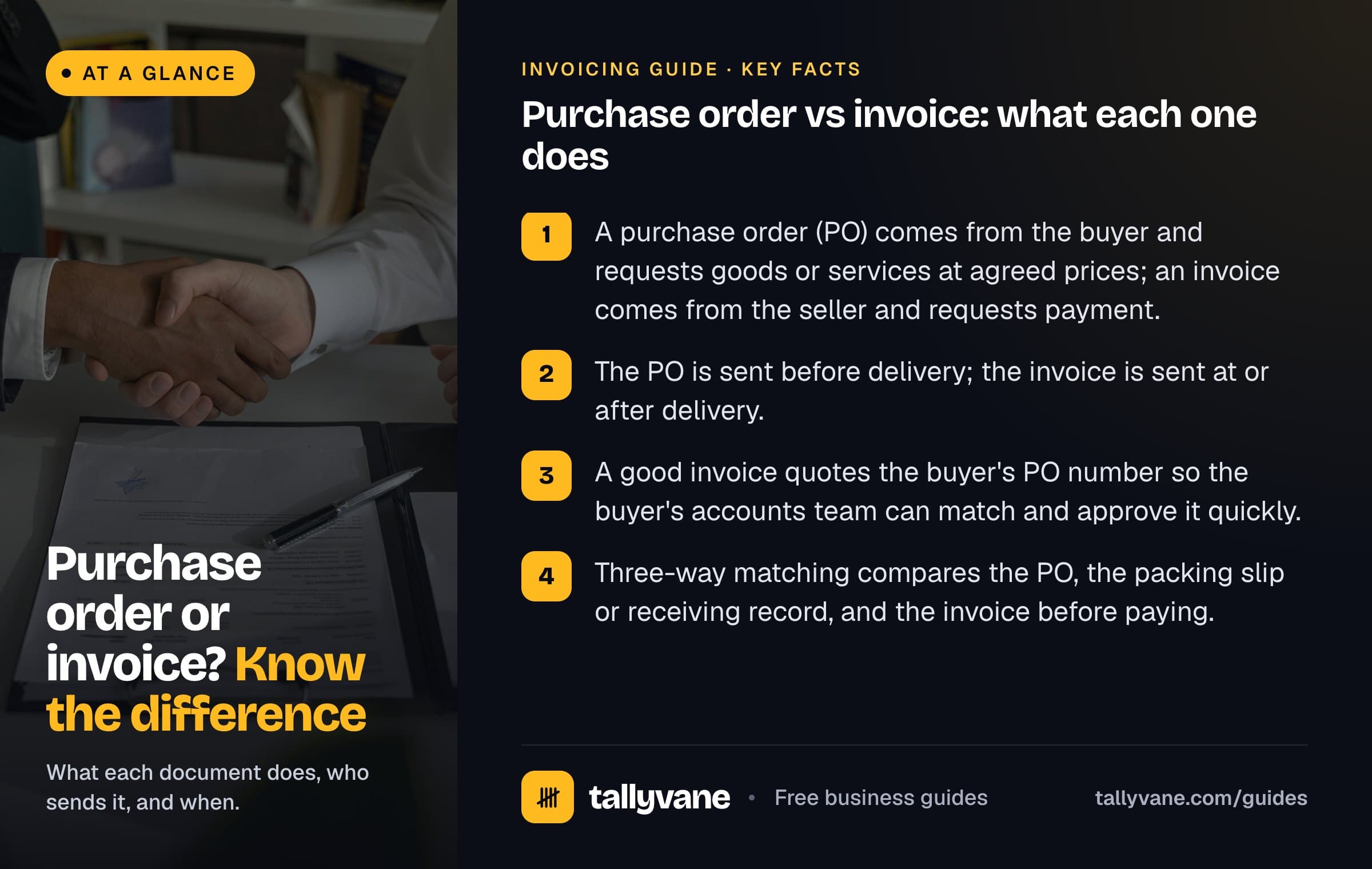
- A purchase order (PO) comes from the buyer and requests goods or services at agreed prices; an invoice comes from the seller and requests payment.
- The PO is sent before delivery; the invoice is sent at or after delivery.
- A good invoice quotes the buyer's PO number so the buyer's accounts team can match and approve it quickly.
- Three-way matching compares the PO, the packing slip or receiving record, and the invoice before paying.
- Keep both: invoices and receipts are among the records the IRS lists for supporting business income and purchases.
The short answer
A purchase order and an invoice describe the same deal from opposite sides and at different times. The buyer writes the purchase order to say "we want to buy this, at this price, on these terms." The seller writes the invoice to say "we delivered this, and here is what you owe."
Small businesses often skip purchase orders and rely on email. That works until there is a dispute over price, quantity or delivery date. A PO puts the agreement in one document both sides can point to.
| Purchase order | Invoice | |
|---|---|---|
| Created by | Buyer | Seller |
| Sent | Before goods or services are supplied | At or after delivery, or per agreed billing schedule |
| Purpose | Request and authorize a purchase | Request payment |
| Key number | PO number | Invoice number (and the buyer's PO number) |
| Shows | Items, quantities, agreed prices, delivery date and address, terms | Items delivered, quantities, prices, tax, shipping, total due, due date, payment details |
| In the buyer's books | A commitment, not yet a bill | A bill to pay (accounts payable) |
| In the seller's books | An order to fulfill | Money owed to them (accounts receivable) |
What a purchase order is and what goes on it
A purchase order is the buyer's formal offer to buy. Once the supplier accepts it, in writing or by shipping, it often forms the basis of the contract for that order. Larger companies usually require a PO for any purchase above a set amount so spending is approved before it happens.
- A unique PO number and the date
- Buyer's business name, billing address and contact
- Supplier's name and contact
- Ship-to address and requested delivery date
- Each item: description, SKU or part number, quantity, unit price and line total
- Shipping method, payment terms such as Net 30, and any discounts
- Subtotal, expected tax and shipping, and total
- Who approved it
What an invoice is and what goes on it
An invoice is the seller's request for payment for goods or services supplied. It is the document the buyer's accounts payable team actually pays from, so missing details slow down payment.
If the buyer issued a PO, put its number on the invoice. Many companies will not pay an invoice they cannot match to a PO, so leaving the number off can hold up your payment.
- The word "Invoice", a unique invoice number and the issue date
- Your business name, address and contact details
- The customer's name and billing address, and their PO number
- Each item or service, quantity, rate and line total
- Sales tax where it applies, shipping and discounts
- Total due, due date and payment terms
- How to pay: bank details, payment link or mailing address
- Late fee terms, if you charge them and they are allowed where you operate
Where packing slips, quotes and receipts fit
A typical business-to-business order uses up to five documents in order. Not every sale needs all of them, but each answers a different question.
| Step | Document | From | Answers |
|---|---|---|---|
| 1 | Quote or estimate | Seller | What would it cost? |
| 2 | Purchase order | Buyer | What exactly are we buying, and on what terms? |
| 3 | Packing slip | Seller, in the box | What is in this shipment? |
| 4 | Invoice | Seller | What do you owe, and by when? |
| 5 | Receipt | Seller | What was paid? |
Three-way matching, with a worked example
Before paying, a careful buyer compares three documents: the purchase order (what was ordered), the packing slip or receiving record (what arrived), and the invoice (what is being billed). If all three agree, the invoice is approved. If not, the difference is resolved first.
Example: a café orders 500 bags of coffee at $4.20 each on PO-1042, total $2,100, terms 2/10 Net 30. The shipment arrives with 480 bags; the packing slip notes 20 on back order.
The supplier's invoice should bill 480 × $4.20 = $2,016, not the full $2,100. If the invoice shows $2,100, the café disputes it before paying. The remaining 20 bags are billed when they ship.
The terms 2/10 Net 30 mean 2% off if paid within 10 days, otherwise the full amount within 30 days. Paying within 10 days saves 2% of $2,016, which is $40.32, so the café pays $1,975.68.
| Document | Quantity | Unit price | Amount |
|---|---|---|---|
| Purchase order | 500 | $4.20 | $2,100.00 |
| Packing slip (received) | 480 | ||
| Correct invoice | 480 | $4.20 | $2,016.00 |
| Paid within 10 days (2% off) | $1,975.68 |
Do you need purchase orders?
As a seller, you do not create purchase orders; your customers do. But if a business customer sends you one, treat it as the contract: ship what it lists, bill what it lists, and quote its number.
As a buyer, purchase orders are worth using once more than one person orders stock or spends money, or once you buy regularly from suppliers. They let you approve spending before it happens, track what is on order, and check invoices quickly. For one-off small purchases, a receipt and a card statement are usually enough.
Record keeping
The IRS lists invoices, receipts, sales slips, deposit slips and canceled checks among the supporting documents a business should keep to back up its income and expenses. A purchase record should show who was paid, the amount, the date, proof of payment and what was bought; you may need more than one document to show all of that.
Keep POs, packing slips, invoices and receipts together for each order, digitally or on paper, so you can trace any figure in your books back to the documents behind it.