Key takeaways
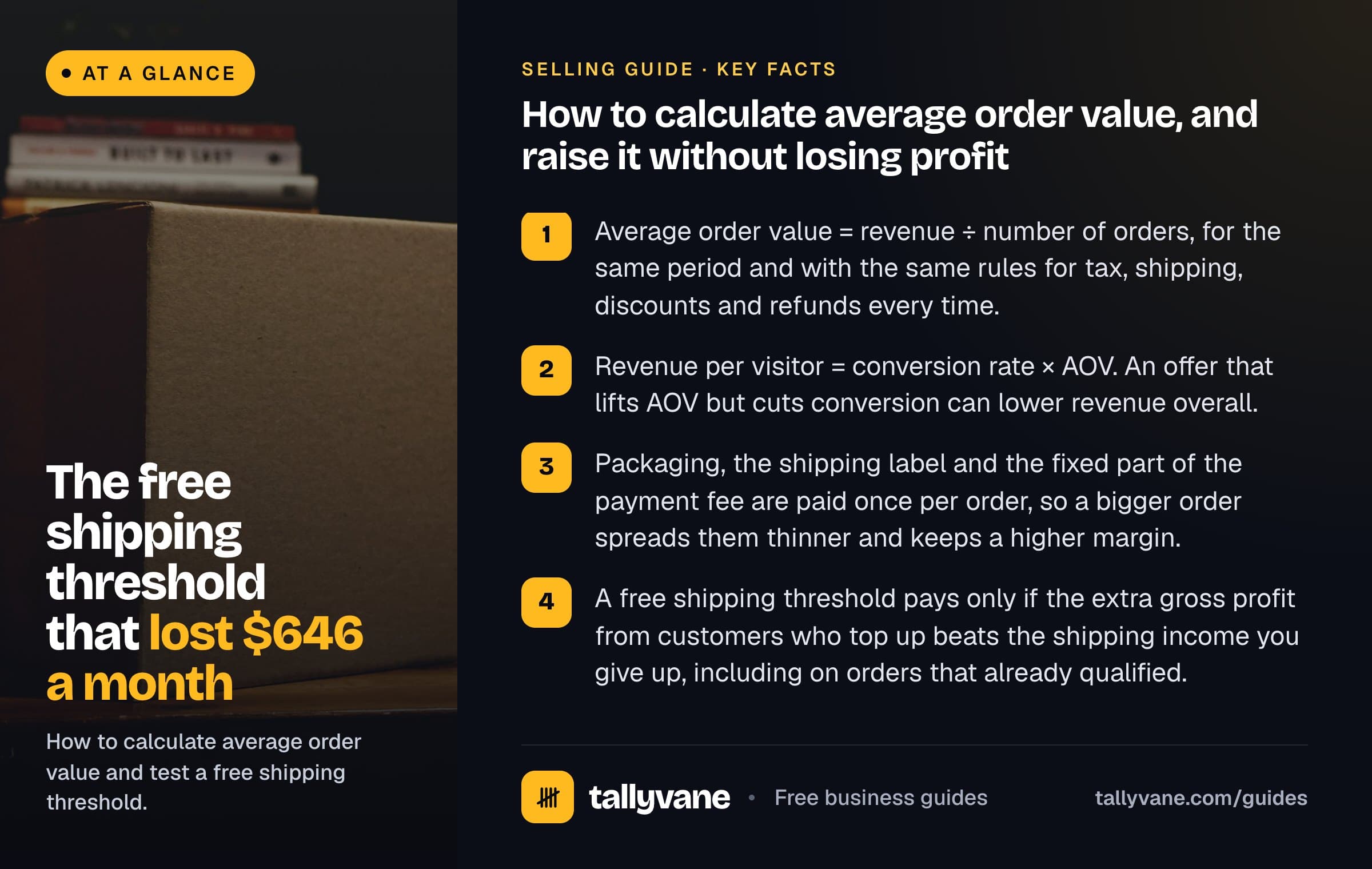
- Average order value = revenue ÷ number of orders, for the same period and with the same rules for tax, shipping, discounts and refunds every time.
- Revenue per visitor = conversion rate × AOV. An offer that lifts AOV but cuts conversion can lower revenue overall.
- Packaging, the shipping label and the fixed part of the payment fee are paid once per order, so a bigger order spreads them thinner and keeps a higher margin.
- A free shipping threshold pays only if the extra gross profit from customers who top up beats the shipping income you give up, including on orders that already qualified.
The average order value formula
Add up your revenue for a period and divide by the number of orders in the same period. If you took 1,240 orders in October worth $47,120, your AOV is $38.00.
The division is easy. The decisions are in the top line. Sales tax and VAT are never your money, so leave them out. Discounts should come off, because the customer never paid them. Shipping charged and refunds are a choice, and both are common. What matters is that you use the same rules every month, or a change in AOV may just be a change in what you counted.
If you sell on Shopify, its analytics calculate AOV as gross sales minus discounts, divided by orders. Gross sales there exclude tax, shipping, duties and fees, and the figure ignores returns and edits made after the order was placed. Matching that definition in your own spreadsheet lets you check your numbers against the dashboard.
Average order value = Revenue ÷ Number of orders Product AOV = (Gross product sales − Discounts) ÷ Orders
Worked example: one month, four AOVs
A small online stationery shop took 1,240 orders in October. Gross product sales were $49,600 before $2,480 of discount codes. Every order paid $5.95 shipping, it collected $2,950 in sales tax, and it refunded $1,170 for returned items.
- The same month gives an AOV anywhere from $37.06 to $46.33. None is wrong; mixing them is.
- Use product AOV for marketing comparisons and dashboards. For profit per order, use the price plus shipping charged, without tax, because that is what the ecommerce profit calculator treats as order revenue.
- Never include tax. A change in tax rates or in where your customers live would move your AOV without any change in the business.
| Definition | Working | AOV |
|---|---|---|
| Product sales after discounts (Shopify style) | ($49,600 − $2,480) ÷ 1,240 | $38.00 |
| Also net of refunds | ($47,120 − $1,170) ÷ 1,240 | $37.06 |
| Including shipping charged | ($47,120 + $7,378) ÷ 1,240 | $43.95 |
| Including shipping and tax (what customers paid) | ($54,498 + $2,950) ÷ 1,240 | $46.33 |
AOV vs revenue per visitor
AOV only looks at people who bought. Revenue per visitor (RPV) looks at everyone who came to the site, so it captures both how often visitors buy and how much they spend. It is the better figure for judging a change to your store.
The stationery shop had 50,000 sessions in October. With 1,240 orders, its conversion rate was 2.48% and its revenue per visitor was $0.94. Suppose a test version of the product page pushes a bundle so hard that AOV rises to $44, but conversion falls to 2.0%. Revenue per visitor falls to $0.88. AOV went up 16% and the shop made less money from the same traffic.
If you pay for traffic, revenue per visitor is roughly what each click is worth to you, so a higher RPV lets you pay more per click. Watch AOV and conversion together, and judge the result on revenue or profit per visitor.
Revenue per visitor = Revenue ÷ Sessions Revenue per visitor = Conversion rate × AOV
Why AOV matters: costs you pay once per order
Some costs grow with the order: the product itself, and the percentage part of card fees. Others are paid once per order however much is in the box: packaging, the shipping label, the fixed part of the payment fee and any pick-and-pack fee from a fulfilment service. A bigger order spreads those fixed costs over more revenue.
The table uses the same sums as our ecommerce profit calculator. The stationery shop has a 55% gross margin on products, charges $5.95 shipping, pays $6.80 for a label and $1.20 for packaging, and pays 2.9% + $0.30 on everything the customer pays.
- Packaging, label and the $0.30 fee take 18.9% of a $43.95 order but only 13.6% of a $60.95 one.
- Break-even ROAS is revenue ÷ profit before ads. A bigger order can carry more ad spend, so the same ads become profitable at a lower return. Enter the margin before ads in the ROAS calculator as the margin and it shows the same break-even figure.
- This only holds while the bigger order still fits the same box and label. If extra items push the parcel into a heavier rate, add that cost back.
| Line | $38 order | $55 order |
|---|---|---|
| Revenue (products + $5.95 shipping) | $43.95 | $60.95 |
| Product cost (45% of product sales) | −$17.10 | −$24.75 |
| Packaging and label | −$8.00 | −$8.00 |
| Payment fee (2.9% + $0.30) | −$1.57 | −$2.07 |
| Profit before ads | $17.28 | $26.13 |
| Margin before ads | 39.3% | 42.9% |
| Break-even ROAS | 2.54x | 2.33x |
Ways to raise AOV, and what each one costs
Every AOV tactic gives the customer a reason to add more. Each one also costs something, so check the profit on the extra items, not just the bigger total.
- Bundles: sell items that go together at a set price, such as a notebook, pen and refills. You give away some margin on the bundle but save a second box, label and fixed fee compared with separate orders.
- Free shipping thresholds: the most common tactic, and the easiest to get wrong. See the break-even check below.
- Tiered discounts, such as 10% off orders over $75: the discount applies to the whole basket, not just the added items. A customer who would have spent $60 and tops up to $75 pays $67.50, and at a 55% margin you keep $33.75 of gross profit instead of $33. A customer already spending $90 gets $9 off for doing nothing.
- A fixed amount off above a minimum spend, such as $10 off $75, caps your cost per order and is easier to model than a percentage.
- Upsells and add-ons: suggest a refill, a larger size or a related item at checkout. They cost nothing to offer, but keep them relevant or they slow checkout and hurt conversion.
- Quantity breaks: a lower unit price for buying three or more suits consumables that customers would reorder anyway.
The break-even check for a free shipping threshold
A threshold changes two groups of orders. Customers who top up to qualify spend more, and you gain the gross profit on what they add but lose the shipping charge they would have paid. Customers who were already above the threshold now get free shipping for nothing, so you lose their shipping charge too. The second group is the one most stores forget.
At a 55% gross margin, with 2.9% card fees, the stationery shop keeps $0.521 of each extra dollar spent and gives up $5.78 of every $5.95 shipping charge it waives. So a customer who tops up must add at least $11.09 just to cover their own lost shipping, before you count the orders that already qualified.
Gain per top-up order = Added spend × (Gross margin − Payment %) − Shipping charge × (1 − Payment %) Cost of orders already above = Orders already above × Shipping charge × (1 − Payment %) Break-even top-ups = Cost of orders already above ÷ Gain per top-up order
Worked example: a $50 or a $60 threshold
Of the shop’s 1,240 monthly orders, 200 are already $50 or more and 70 are already $60 or more. The owner estimates that at $50, 250 customers would top up by $15 on average. At $60, fewer would bother, about 150, but each would add around $22.
- The $50 threshold raises AOV more, from $38.00 to $41.02, and still loses $646 a month. Too many orders already qualified, and a $15 top-up barely covers the shipping it replaces.
- The $60 threshold raises AOV less but adds $448 a month. It needs only 72 customers to top up before it pays.
- Neither figure counts extra orders from shoppers who buy because shipping is free. That can only help, but measure it before you rely on it.
- Set the threshold above most of your current orders and close enough that a top-up is one sensible extra item. Then check the real numbers after a month.
| Figure | $50 threshold | $60 threshold |
|---|---|---|
| Orders already above | 200 | 70 |
| Shipping given up on those orders | −$1,155.49 | −$404.42 |
| Gain per top-up order | $2.04 | $5.68 |
| Expected top-ups | 250 | 150 |
| Gain from top-ups | +$509.39 | +$852.68 |
| Net change in profit per month | −$646.10 | +$448.26 |
| Top-ups needed to break even | 568 | 72 |
| New product AOV | $41.02 | $40.66 |