Key takeaways
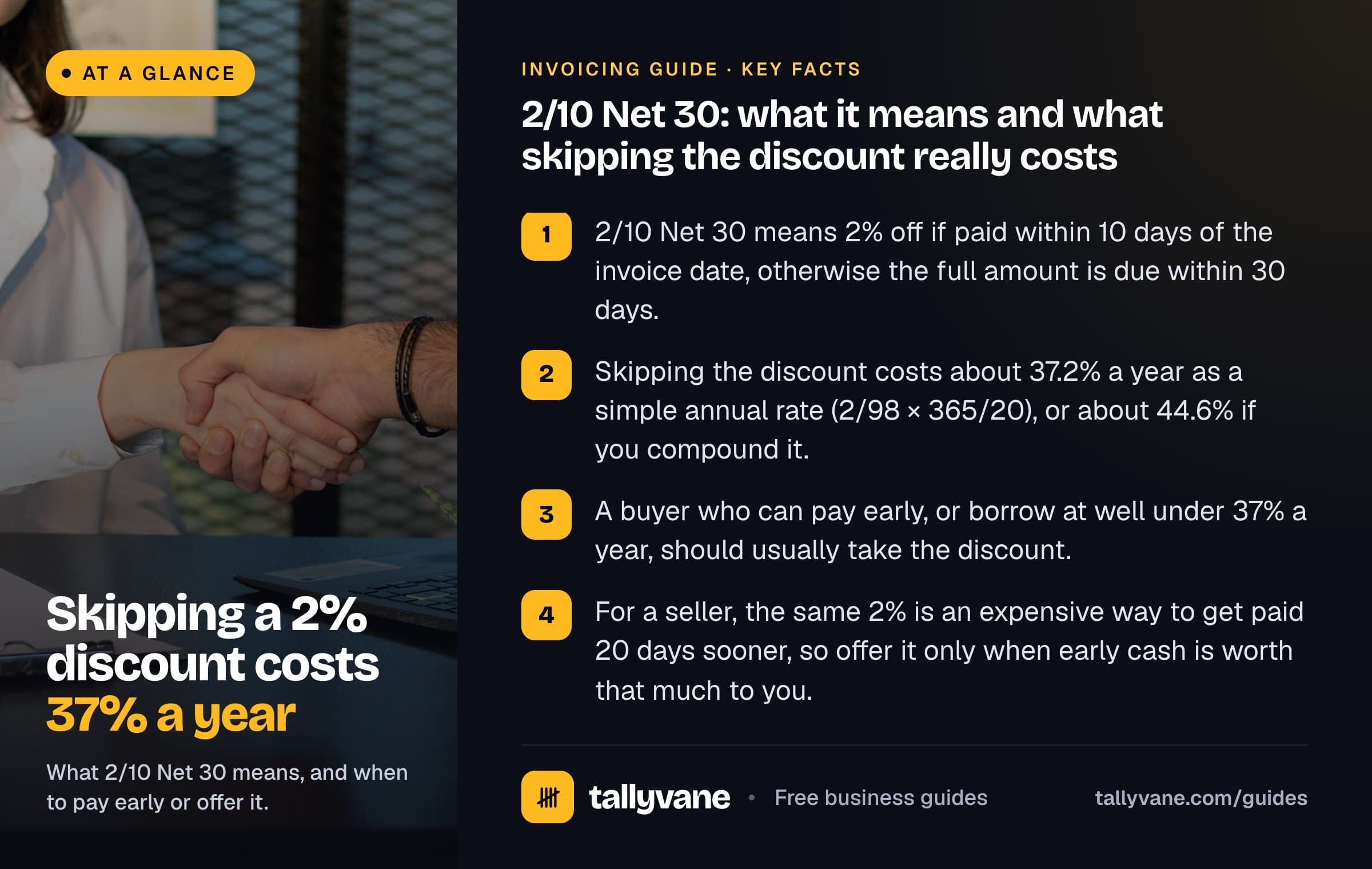
- 2/10 Net 30 means 2% off if paid within 10 days of the invoice date, otherwise the full amount is due within 30 days.
- Skipping the discount costs about 37.2% a year as a simple annual rate (2/98 × 365/20), or about 44.6% if you compound it.
- A buyer who can pay early, or borrow at well under 37% a year, should usually take the discount.
- For a seller, the same 2% is an expensive way to get paid 20 days sooner, so offer it only when early cash is worth that much to you.
- On the invoice, print both amounts and both dates, and agree the terms before the sale.
What 2/10 Net 30 means
The terms have two parts. "2/10" means a 2% discount if the buyer pays within 10 days. "Net 30" means the full, undiscounted amount is due within 30 days. Both periods usually count from the invoice date, so on an invoice dated November 5, 2026 the discount runs to November 15 and the full amount is due by December 5.
The same pattern works with other numbers. "1/10 Net 30" offers 1% for payment within 10 days; "2/10 Net 60" gives the same 2% but a longer period to pay in full. The first number is always the discount, the second the discount period, and the Net figure the final due date. If a supplier uses a variation you have not seen, ask how they count the days.
For payment terms in general, including plain Net 30, see our guide on how to write an invoice.
The real cost of skipping the discount
If you do not pay by day 10, you keep your money for another 20 days, until day 30. The price of that is the 2% you gave up. In effect, the supplier is lending you $98 for 20 days and charging $2 for it.
$2 on $98 is 2.04% for 20 days. There are 18.25 periods of 20 days in a year, so the simple annual rate is 2.04% × 18.25 = 37.2%. That is the figure most textbooks quote, and it is the one to compare with a loan’s APR, which is also a simple annual rate. Some textbooks use a 360-day year, which gives 36.7%.
If you could repeat that trade every 20 days and reinvest the savings, the rate compounds to 44.6% a year. That is the effective annual rate, the like-for-like comparison with a savings account’s APY. Both numbers describe the same terms; just be clear which one you are using.
Simple annual cost = Discount % ÷ (100% − Discount %) × 365 ÷ (Net days − Discount days) 2/10 Net 30: 2 ÷ 98 × 365 ÷ 20 = 37.2% Compounded (effective) cost = (1 + Discount % ÷ (100% − Discount %))^(365 ÷ (Net days − Discount days)) − 1 2/10 Net 30: (1 + 2 ÷ 98)^18.25 − 1 = 44.6%
| Terms | Simple annual cost | Compounded annual cost |
|---|---|---|
| 1/10 Net 30 | 18.4% | 20.1% |
| 2/10 Net 30 | 37.2% | 44.6% |
| 2/15 Net 30 | 49.7% | 63.5% |
| 2/10 Net 45 | 21.3% | 23.5% |
| 2/10 Net 60 | 14.9% | 15.9% |
| 3/10 Net 30 | 56.4% | 74.4% |
Worked example: a restaurant paying a food supplier
A restaurant receives an $8,500 invoice from its food supplier on 2/10 Net 30 terms. Paying within 10 days costs $8,330; paying on day 30 costs $8,500. It does not have spare cash on day 10, but it has a business line of credit. Should it borrow to take the discount?
Borrowing $8,330 for the 20 days between day 10 and day 30 costs simple interest of $8,330 × rate × 20 ÷ 365. At 12% a year that is $54.77, so taking the discount saves $115.23 even after interest. At 25% a year the interest is $114.11 and the saving shrinks to $55.89. Only above 37.2% would borrowing to pay early cost more than the discount saves.
- The restaurant saves $170 on every $8,500 invoice it pays early from cash. Twelve such invoices a year is $2,040.
- Interest here is simple interest on a 365-day year. Check your lender’s fees too.
- For a term loan rather than a credit line, our loan payment calculator shows the full cost of borrowing at a given rate.
| Option | Paid to supplier | Interest for 20 days | Total cost | Saving vs day 30 |
|---|---|---|---|---|
| Pay in full on day 30 | $8,500.00 | $0.00 | $8,500.00 | $0.00 |
| Pay day 10 from cash | $8,330.00 | $0.00 | $8,330.00 | $170.00 |
| Borrow at 12% a year, pay day 10 | $8,330.00 | $54.77 | $8,384.77 | $115.23 |
| Borrow at 25% a year, pay day 10 | $8,330.00 | $114.11 | $8,444.11 | $55.89 |
When a buyer should take the discount
Take it whenever you can pay early from cash you will not need in the next 20 days, or borrow for less than the annual cost of skipping it. Cash in the bank rarely earns anything close to 37% a year.
- Take it if your line of credit or overdraft costs less than about 37% a year, after fees.
- Skip it if paying early would leave you short and force you into more expensive borrowing, such as a merchant cash advance or late fees elsewhere.
- Do not take the discount after day 10 unless the supplier agrees. Deducting 2% from a late payment is a common cause of disputes and short-paid invoices.
- Paying late does lower the annual cost on paper (paying on day 45 instead of day 30 brings it down to about 21%), but it breaks the agreement and can bring late fees and stricter terms.
When a seller should offer it
From the seller’s side, the 2% is the price of getting paid 20 days sooner, and it comes straight out of profit. On the $8,500 invoice above, a supplier with a 25% gross margin makes $2,125 of gross profit. The $170 discount takes 8% of that.
Compare that with your other ways of getting cash. If your own line of credit charges 12% a year, borrowing $8,330 for 20 days costs about $55, a third of the discount. Offering 2/10 Net 30 makes sense when early cash is worth more to you than that, for example when you cannot borrow, when your other option is costly invoice financing, or when the discount wins a large customer who would otherwise pay late.
If customers take the discount and still pay late, or would have paid on time anyway, you are giving away margin for nothing. Our days sales outstanding guide shows how to measure whether discounts are actually speeding up payment. A smaller discount, such as 1/10 Net 30, costs half as much and may be enough.
How to show 2/10 Net 30 on an invoice
Agree the terms in your quote or contract first, then repeat them on every invoice. Do not rely on "2/10 Net 30" alone: write out both dates and both amounts, so nobody has to work anything out. Say what the 2% applies to, for example the goods total before shipping.
In our invoice generator, leave the Discount field empty. That field takes an amount off the total for everyone, but an early payment discount only applies if the customer pays in time. Set the due date to 30 days after the invoice date and put the discount terms in the Notes box.
- Terms: 2/10 Net 30.
- Pay $8,330.00 by November 15, 2026 (2% early payment discount).
- Otherwise pay $8,500.00 by December 5, 2026.
- Discounts are only available on payments received by the discount date.
Early payment discount vs late fee
An early payment discount rewards customers for paying sooner. A late fee charges them for paying after the due date. You can use both on the same invoice, for example "2/10 Net 30, then 1.5% per month on overdue balances", as long as the customer agreed to the terms in advance and any late charge is allowed where you do business.
The two are not the same size. The discount is worth about 37% a year to a customer who takes it. A 1.5% monthly late fee is 18% a year: on the $8,500 invoice, paying 15 days late would add $62.88. So a discount usually moves payment behaviour more than a late fee does, and it costs you more too. Our late payment fees guide covers what you can charge and how.
Late fee = Overdue balance × Annual rate × Days late ÷ 365 Example: $8,500 × 18% × 15 ÷ 365 = $62.88
Free toolLate payment fee calculatorBookkeeping and sales tax basics
For US tax purposes, the IRS describes a cash discount as a reduction in the invoice or purchase price for paying within a set time. If you are the buyer and the discount is on goods you hold as inventory, IRS Publication 538 says you can either deduct cash discounts or include them in income, as long as you treat them the same way every year.
Sales tax treatment depends on the state. Virginia, for example, says cash discounts taken on sales, including discounts for early payment, are not part of the taxable sales price, and the discount has to be split between the price and the tax. Other states have their own rules on discounts taken after the sale, so check your state’s guidance before you adjust tax on a discounted invoice, or ask your accountant.