Key takeaways
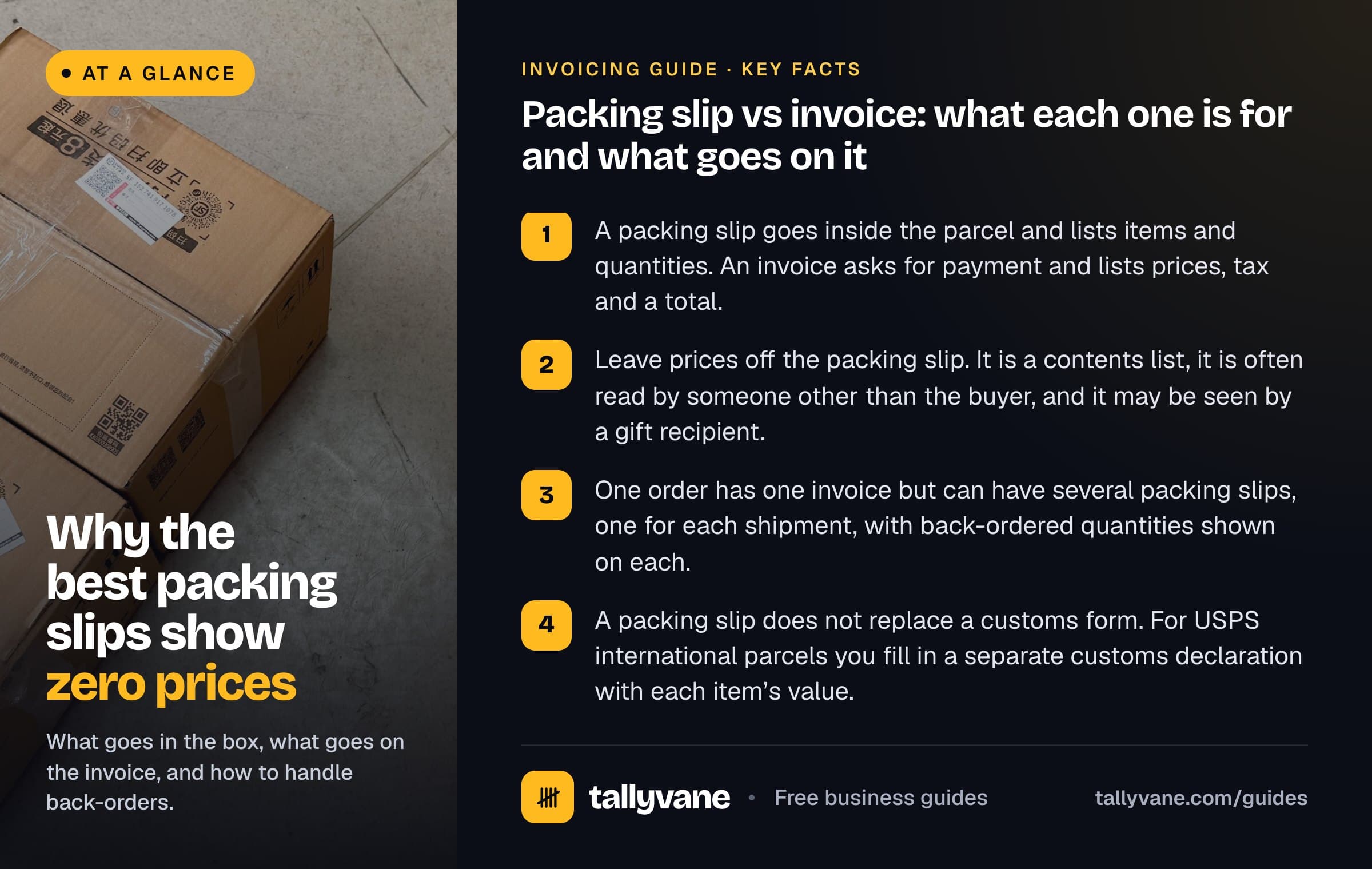
- A packing slip goes inside the parcel and lists items and quantities. An invoice asks for payment and lists prices, tax and a total.
- Leave prices off the packing slip. It is a contents list, it is often read by someone other than the buyer, and it may be seen by a gift recipient.
- One order has one invoice but can have several packing slips, one for each shipment, with back-ordered quantities shown on each.
- A packing slip does not replace a customs form. For USPS international parcels you fill in a separate customs declaration with each item’s value.
The short answer
The two documents answer different questions. The packing slip answers "what is in this box?". The invoice answers "how much do I owe, and by when?". If you sell online and customers pay at checkout, the packing slip is usually the only paper in the parcel, and the order confirmation or receipt email covers the money side.
| Packing slip | Invoice | |
|---|---|---|
| Main job | Lists what was packed in one shipment | Requests payment for goods or services |
| Who reads it | Whoever opens the parcel, plus your packer | The buyer or their accounts team |
| Where it goes | Inside the box | By email, post or your billing system |
| Prices and tax | Usually none | Unit prices, tax, total due |
| Quantities | Ordered, shipped and back-ordered | Billed |
| Per order | One per shipment | Usually one per order |
| Kept for | Checking deliveries, handling returns | Bookkeeping and tax records |
What a packing slip is for, and who uses it
A packing slip, also called a packing list or delivery note, is printed when the order is packed and goes in the box with the goods. Three people use it.
Your packer uses it as a checklist. Ticking each line as it goes in the box catches most wrong-item and missing-item mistakes before the parcel leaves.
The person who receives the parcel uses it to check that everything arrived. In a business, that is often a receiving clerk who compares it with the purchase order. At home, it is the customer, or the friend they bought a gift for.
You use your copy later. When a customer says something was missing, the slip shows what you packed and in which shipment. When an item comes back, the SKU and order number on the slip make it quick to find the original order.
What goes on a packing slip
Keep it to what helps someone check the contents and contact you. A useful slip has:
- Your business name, logo if you have one, and a contact email or phone number.
- The delivery name and address, so the slip matches the label.
- The order number, order date and ship date.
- The shipping method and tracking number, if you have one.
- One line per item with the SKU or product code, a plain description, the quantity ordered and the quantity in this box.
- Anything still to come, marked as back-ordered.
- A short note: how to return an item, and when back-ordered items will follow.
Why prices are usually left off
Prices belong on the invoice or receipt, which the buyer already has. Putting them on the slip as well adds nothing for the person checking the box, and it causes problems in three common cases.
Gift orders are the obvious one: the recipient should not see what was paid. In business orders, the slip is often handled by warehouse staff who do not need to see your pricing. And with partial shipments, a priced slip makes the box look like a short invoice, which can confuse whoever pays the bills.
If a customer asks for prices with the goods, send an invoice or receipt as a separate document. Our packing slip generator has no price fields for this reason.
Sample packing slip with a back-order
A small candle shop packs order 2187, placed on 3 November and shipped on 5 November by standard shipping. The fig candle has sold out after one unit and the matches are waiting on a delivery from the supplier, so part of the order ships now and the rest follows.
- The customer can see at a glance that 4 of 6 units are in the box and that 2 are on their way, so nothing looks missing.
- The note under the table says: "1 fig candle and 1 pack of matches will ship separately within 7 days. To return an item, email us within 30 days quoting order 2187."
- There are no prices anywhere on the slip. The customer already has the order total in their order confirmation email.
| SKU | Item | Ordered | Shipped | Back-ordered |
|---|---|---|---|---|
| CND-CED-8 | Cedar candle, 8 oz | 2 | 2 | 0 |
| CND-FIG-8 | Fig candle, 8 oz | 2 | 1 | 1 |
| WCK-TRIM | Wick trimmer, brass | 1 | 1 | 0 |
| MTC-BOX-3 | Safety matches, 3 boxes | 1 | 0 | 1 |
| Total | 6 | 4 | 2 |
Partial shipments and back-orders
When you cannot ship an order in one go, send what you have and say clearly what is still to come. On each line, enter the quantity ordered and the quantity in this box. The difference is the back-order.
When the rest ships, make a second slip for the same order number, showing the remaining quantities. Label the slips "shipment 1 of 2" and "shipment 2 of 2" if you can. The invoice does not change: the order was billed once, at the full amount, or billed per shipment if that is what you agreed with a business customer.
Keep both slips with the order. "Where is the rest of my order?" is far easier to answer when you can see exactly what went in each box and when.
Back-ordered = Quantity ordered − Quantity shipped Units in this box = Sum of quantity shipped on every line
Free toolPacking slip generatorGift orders and returns information
For a gift, put the recipient’s name and address on the slip and leave prices off, as you would anyway. Add the gift message in the note if the buyer left one, and say who it is from.
The note is also the best place for return instructions, because the slip is the one document the recipient is sure to have. Give the time limit, how to start a return (an email address, a returns page or a label request), and ask them to quote the order number. For gifts, say what happens to the money: a refund to the buyer or store credit for the recipient. Return rules differ between countries, so write your own policy and check the consumer rules where your customers live.
When you need both, and shipping abroad
You need an invoice whenever a customer pays after delivery, which is normal between businesses on terms such as net 30. The invoice goes to their accounts team and the packing slip goes in the box, and their receiving team uses the slip to confirm the goods arrived before the invoice is paid. Business buyers often ask for an invoice even when they paid at checkout, because it is the document their bookkeeping needs. The IRS lists invoices among the records that support business income and purchases; it does not list packing slips.
For international parcels, the packing slip is not enough. USPS requires a customs form on everything sent abroad except First-Class Mail International letters and large envelopes under 15.994 oz that hold only documents. The USPS form, PS Form 2976-R, needs a specific description and a value for each item, the total value and the gross weight. You can complete it online with Click-N-Ship or Customs Form Online, or at a Post Office. Other carriers have their own paperwork, so check their requirements for each destination. A packing slip inside the box is still useful for the customer.
Free toolInvoice generator