Key takeaways
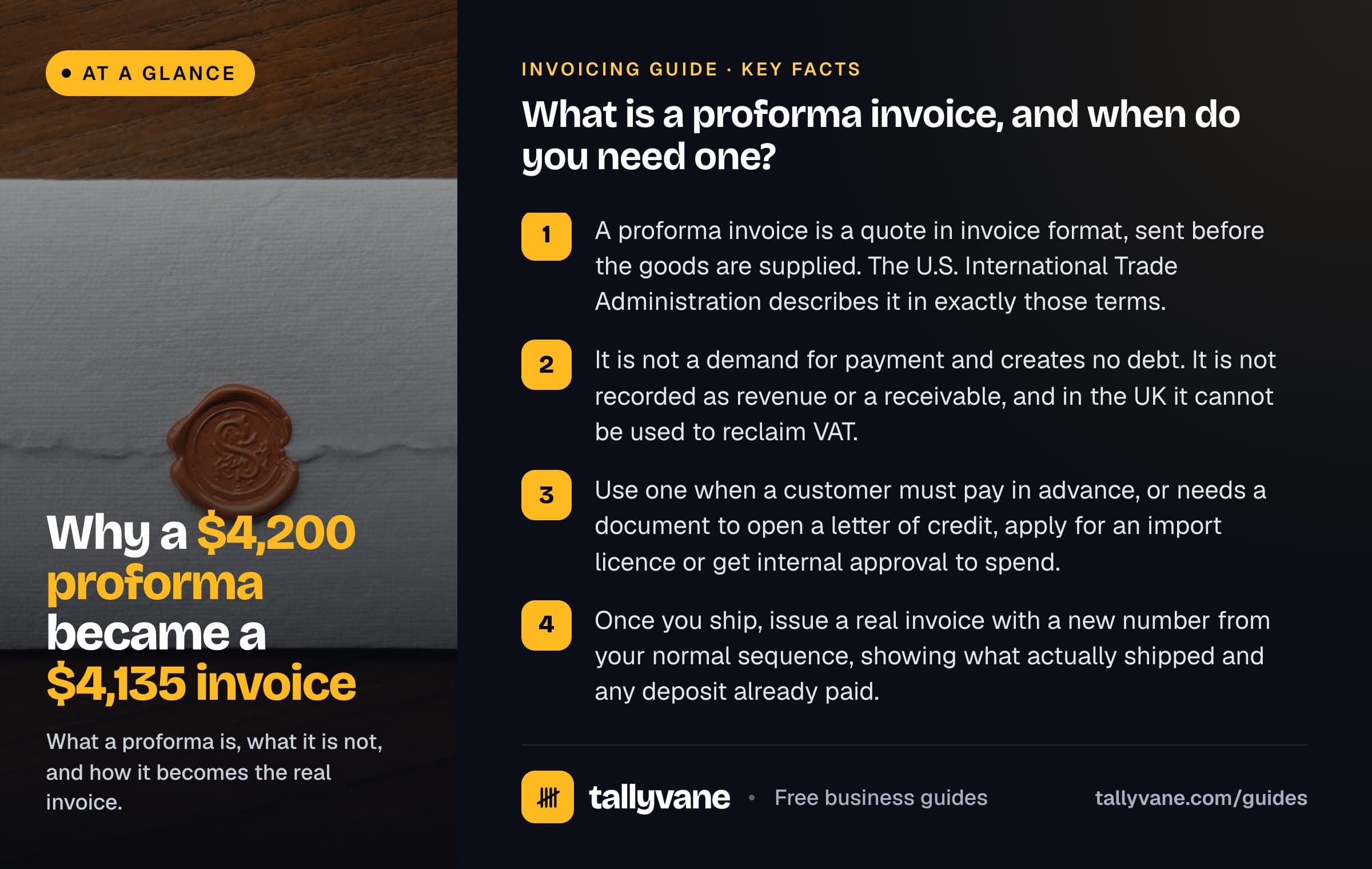
- A proforma invoice is a quote in invoice format, sent before the goods are supplied. The U.S. International Trade Administration describes it in exactly those terms.
- It is not a demand for payment and creates no debt. It is not recorded as revenue or a receivable, and in the UK it cannot be used to reclaim VAT.
- Use one when a customer must pay in advance, or needs a document to open a letter of credit, apply for an import licence or get internal approval to spend.
- Once you ship, issue a real invoice with a new number from your normal sequence, showing what actually shipped and any deposit already paid.
What a proforma invoice is
A proforma invoice (also written pro forma or pro-forma) is a document that looks like an invoice but is sent before the sale is complete. It lists the goods or services, quantities, prices, delivery terms and payment terms, so the buyer knows exactly what they would receive and pay. The International Trade Administration calls it a quote in an invoice format.
HMRC, the UK tax authority, defines it in a similar way: a commercial document that contains some or all of the details of an invoice but does not confirm that a supply has taken place. That is the key point. An invoice records a sale that happened. A proforma describes a sale that is proposed.
What a proforma invoice is not
Because it looks like an invoice, a proforma is easy to treat as one. Mixing the two causes problems in your books and with tax authorities.
- It is not a demand for payment. The buyer owes you nothing until they accept and the sale goes ahead. It can invite payment in advance, but no debt exists until then.
- It is not revenue or a receivable. HMRC says that a proforma normally has no place in the books of either the business issuing it or the one receiving it. Do not post it to your sales ledger.
- It is not a tax invoice. In the UK it cannot support a VAT reclaim, and HMRC says it should be clearly marked as a proforma, preferably with the words "This is not a VAT invoice".
- It is not a final price if things change. If quantities or costs change before shipping, issue a revised proforma rather than editing the old one, and do not change it without the buyer’s agreement.
When proforma invoices are used
Most proformas exist because the buyer needs a formal, priced document before money or goods move.
- Payment in advance. Suppliers often ask new customers, or customers whose credit they cannot check, to pay before goods are made or shipped. The proforma tells the buyer exactly what to pay and what it covers.
- International sales. The International Trade Administration lists the buyer’s uses: applying for an import licence, arranging pre-shipment inspection, opening a letter of credit and arranging the transfer of foreign currency.
- Letters of credit. The buyer’s bank drafts the letter of credit from the agreed terms, which often come straight from your proforma. When you ship, your bank checks your documents against the credit and any error has to be corrected and resubmitted, so keep your final invoice consistent with what was agreed.
- Internal approvals. A buyer’s purchasing or finance team may need a proforma to approve spending or raise a purchase order before they will commit.
Proforma invoices and US customs
Many guides say a proforma can be used to clear customs. For goods entering the US, that is only true in narrow cases. US Customs and Border Protection (CBP) generally requires a commercial invoice for each shipment. The term pro forma invoice in CBP rules (19 CFR 141.85) means a substitute invoice the importer files when the commercial invoice is not available, giving the price or value, the parties, a description of the goods, the charges included and the country of origin.
Even then there are conditions. Under 19 CFR 141.91, the importer must show CBP that the missing invoice is due to a cause beyond their control, file a bond for one and a half times the invoice value, and produce the required invoice, generally within 120 days of filing the entry summary. A proforma can also stand in where no commercial invoice is required, such as some goods not intended for sale.
In practice, send the buyer a proforma before the sale, then ship with a proper commercial invoice and a packing list. Other countries and carriers set their own rules, so ask the buyer’s customs broker or your carrier.
Free toolPacking slip generatorWhat to include on a proforma invoice
Start from the International Trade Administration’s checklist and add a clear label, so nobody mistakes the document for a bill.
Our invoice generator has a proforma option. Choose "Proforma invoice" as the document type and it prints that heading, a valid-until date instead of a due date, an optional deposit and a line saying it is not a demand for payment or a tax invoice. Enter a number such as PF-2026-014, and put the Incoterm and the payment terms in the notes. If a bank or import authority has its own requirements, check that what you send meets them.
- The words "Proforma invoice" at the top, and a number from a separate series, such as PF-2026-014.
- Your name and address, and the buyer’s name and address.
- The buyer’s reference, such as their enquiry or request number.
- Each item with a description, quantity, unit price and line total.
- Weights and dimensions of the goods, and any discounts.
- The terms of sale, such as an Incoterms rule with its named place (for example CPT Toronto, Incoterms 2020), so it is clear who pays freight, insurance and import duties.
- Payment terms, the currency, the estimated shipping date and a validity date.
- For a UK business registered for VAT, the words "This is not a VAT invoice".
Worked example: an export order paid partly in advance
A small US enamelware maker receives an order from an outdoor shop in Toronto. It has never sold to this shop before, so it asks for a 50% deposit before production and the balance within 7 days of shipment. The price includes freight to Toronto under CPT (Incoterms 2020), so the shop pays Canadian import duties and taxes itself. The proforma is dated November 5, 2026 and valid until December 5, 2026.
- The shop uses the proforma to approve the purchase and send the $2,100 deposit. Nothing is owed until it accepts.
- In the seller’s books, the $2,100 deposit is a customer deposit, a liability, not a sale. It becomes part of revenue when the goods ship and the final invoice is issued.
- Ten white mugs fail inspection, so only 230 ship. The final invoice bills 230 × $6.50 = $1,495.00 for that line, making the subtotal $3,730.00 and the total $4,135.00. After the $2,100 deposit, the balance due is $2,035.00, not $2,100.
| Line | Quantity | Unit price | Amount |
|---|---|---|---|
| Enamel mug, 12 oz, white | 240 | $6.50 | $1,560.00 |
| Enamel mug, 12 oz, navy | 120 | $6.50 | $780.00 |
| Enamel plate, 10 in, white | 150 | $8.20 | $1,230.00 |
| Gift box for 2 mugs | 60 | $3.75 | $225.00 |
| Subtotal | $3,795.00 | ||
| Freight to Toronto (CPT Toronto, Incoterms 2020) | 1 | $405.00 | $405.00 |
| Total | $4,200.00 | ||
| Deposit to confirm the order (50%) | $2,100.00 | ||
| Balance, due within 7 days of shipment | $2,100.00 |
Proforma vs quote vs commercial invoice vs final invoice
The four documents follow a sale from offer to payment. A quote and a proforma come before the sale; a commercial invoice and a final invoice come after. For domestic sales, the final invoice is simply your normal invoice. For exports, it is usually called a commercial invoice and also serves as the customs document.
- For when a quote becomes binding and how long it should stay valid, see our quote vs estimate guide.
- If the buyer replies with a purchase order, check it against the proforma before you start. Our purchase order vs invoice guide explains how buyers match orders, deliveries and invoices.
| Quote | Proforma invoice | Commercial invoice | Final invoice | |
|---|---|---|---|---|
| When | Before the sale | Before the sale, often after a quote is accepted | When goods ship abroad | At or after delivery |
| Purpose | Offer a price | Set out the exact deal so the buyer can pay or arrange finance | Bill the buyer and declare the goods to customs | Bill the customer |
| Creates a debt? | No | No | Yes | Yes |
| In your sales records? | No | No | Yes | Yes |
| Numbering | Quote series | Separate proforma series | Main invoice series | Main invoice series |
| Shows | Items, prices, validity | Items, prices, Incoterm, payment terms, weights, validity | What actually shipped, value, origin, Incoterm | What was supplied, tax, total due |
Turning the proforma into the final invoice
When the goods ship or the work is done, do not resend the proforma with a new title. Issue a new invoice from your normal invoice sequence and follow these steps.
- Give the invoice the next number in your main sequence, and quote the proforma number and the buyer’s purchase order number, if any.
- Bill what actually shipped, not what the proforma listed. Note anything short-shipped or back-ordered.
- Show the deposit already received and the balance due, with the due date and how to pay. In our invoice generator, enter the deposit under "Already paid" and the invoice shows the balance due.
- Add tax only if it applies to the final sale, as its own line.
- Match the descriptions, values and Incoterm to the proforma and any letter of credit, and send a packing list in the box.
- Keep the proforma with the order file, but outside your sales records. Our guide to writing an invoice covers numbering and credit notes if you later need to correct the final invoice.