Key takeaways
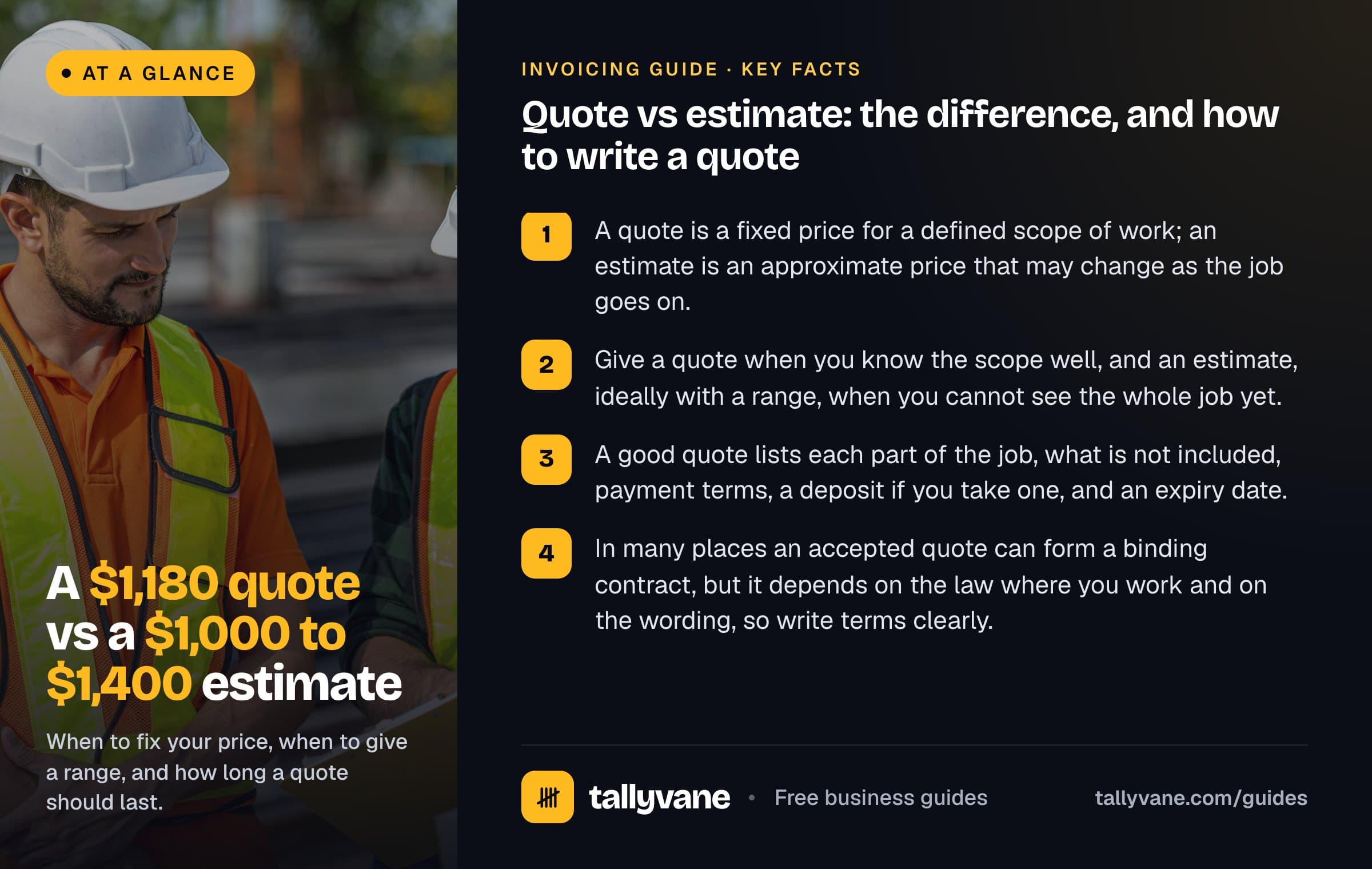
- A quote is a fixed price for a defined scope of work; an estimate is an approximate price that may change as the job goes on.
- Give a quote when you know the scope well, and an estimate, ideally with a range, when you cannot see the whole job yet.
- A good quote lists each part of the job, what is not included, payment terms, a deposit if you take one, and an expiry date.
- In many places an accepted quote can form a binding contract, but it depends on the law where you work and on the wording, so write terms clearly.
Quote vs estimate in plain terms
A quote says: for this exact work, the price is this. You have seen the job, you know what it involves, and you commit to the number. If the job takes longer than you expected, that is usually your cost, not the customer’s.
An estimate says: based on what I know now, it will probably cost about this. It is a guide, and the final bill can be higher or lower once the real work is done. Business Queensland, an Australian government site, describes an estimate as a rough guide that usually carries a note saying the price may change.
People often use the words loosely, and some businesses call every price a quote. What matters is what the document says. Label it clearly as a quote or an estimate, and if it is an estimate, say what could change the price.
| Point | Quote | Estimate |
|---|---|---|
| Price | Fixed for the work described | Approximate, may change |
| When to use it | Scope is clear and costs are known | Scope is unclear or costs depend on what you find |
| How it is shown | One total, broken into lines | A figure or a range, with what could change it |
| If the job grows | Extra work needs a new quote or written change | Final bill reflects the actual work |
| Typical uses | Printing, product orders, set-scope projects | Repairs, renovations, early-stage projects |
When to give a quote and when to give an estimate
Give a quote when you can describe the work precisely and price every part of it: an order of 200 printed mugs, a five-page website with a fixed list of features, or painting a room you have measured. Customers prefer quotes because they know what they will pay, and a quote is easier to compare against a competitor’s.
Give an estimate when you cannot know the full job until you start: a repair where the damage may be worse behind the wall, or a project whose requirements are still being worked out. A range, such as $1,000 to $1,400, is more honest than a single number and sets expectations better.
A common approach is to start with an estimate, then turn it into a quote once you have inspected the job or agreed the scope. You can also quote the parts you are sure of and estimate the rest, as long as the document makes clear which is which.
What a good quote includes
The Australian government’s business.gov.au lists the core details a written quote should have: who you are, who the customer is, what the work is, itemised and total costs with tax, payment terms, dates, an expiry date and space for the customer to accept.
- Your business name, contact details and any tax or business registration number.
- The customer’s name and contact details.
- A quote number and the date you issued it.
- A clear description of the work, broken into lines with quantity and price, rather than one lump sum.
- What is not included, such as permits, extra visits or materials the customer will choose later.
- Tax, if you charge it, shown separately.
- Payment terms: the deposit, when the balance is due and how to pay.
- Expected start and finish dates.
- A "valid until" date.
- How to accept, such as signing and returning the quote or confirming by email.
Sample quote: repainting a living room
A painter has measured a living room and knows its condition, so she can give a fixed quote. She charges $50 an hour for painting, prices the prep work as a fixed job, and passes on paint and supplies at cost plus her usual margin. She takes a 25% deposit to book the dates.
- The notes would say: "Fixed price for the work listed. Does not include moving furniture, woodwork or repairs to plaster beyond minor cracks. Any extra work will be quoted separately before it starts."
- No sales tax is shown. Whether labour or materials are taxable depends on your state or country, so check before you send a quote.
- If she could not inspect the room first, she might instead give an estimate of $1,000 to $1,400 and explain that the final price depends on the condition of the walls.
| Line | Quantity × price | Amount |
|---|---|---|
| Prep: fill cracks, sand, mask and protect floors | 1 × $180 | $180 |
| Paint walls and ceiling, two coats | 14 hours × $50 | $700 |
| Paint, washable matt | 5 gallons × $48 | $240 |
| Supplies: tape, dust sheets, filler | 1 × $60 | $60 |
| Total | $180 + $700 + $240 + $60 | $1,180 |
| Deposit to book (25%) | $1,180 × 25% | $295 |
| Balance on completion | $1,180 − $295 | $885 |
How long should a quote be valid?
There is no single legal period, which is why you should always state one. Thirty days is a common choice and is what our quote generator starts with. Use a shorter period, such as 7 or 14 days, if your material or supplier prices move quickly, and a longer one for large projects where the customer needs time to get approval or arrange finance.
Business Queensland makes the point directly: without an expiry date, you may have to honour an old quote that now loses you money. If a customer comes back after the date has passed, check your costs and either confirm the price or issue a new quote with a new number.

Deposits and payment terms
A deposit protects you when you buy materials or turn down other work to keep dates free. Put the amount, or the percentage, on the quote, along with when it is due and whether it is refundable if the customer cancels. Then give a receipt when it arrives.
Spell out when the rest is due: on completion, in stages for longer jobs, or within a set number of days of your invoice. Once the job is done, the invoice should match the accepted quote, plus any changes the customer agreed to in writing. Our quote generator and invoice generator use the same layout, so the lines carry over easily.
Deposit = Quote total × Deposit % Balance = Quote total − Deposit
Free toolInvoice generatorIs a quote legally binding?
In many places, a quote is treated as an offer, and once the customer accepts it, the two of you have an agreement on the price and the work described. Business.gov.au, for example, says an accepted quote becomes a legally binding contract, and Business Queensland says estimates, unlike quotes, are not binding. Whether that holds where you work depends on local law and on what the document says.
This is general information, not legal advice. Wording matters: a document labelled as an estimate, or one that says it is subject to a site visit or to final measurements, may not commit you in the same way. For large or unusual jobs, have your terms checked by a lawyer or adviser where you trade.
Whatever the rules, a few habits keep you protected. Get acceptance in writing, with a signature or a reply by email. Record any change to the scope, and its price, before you do the extra work. If a business customer sends you a purchase order in response to your quote, check that it matches the quote before you start.
Free toolPurchase order generator