Key takeaways
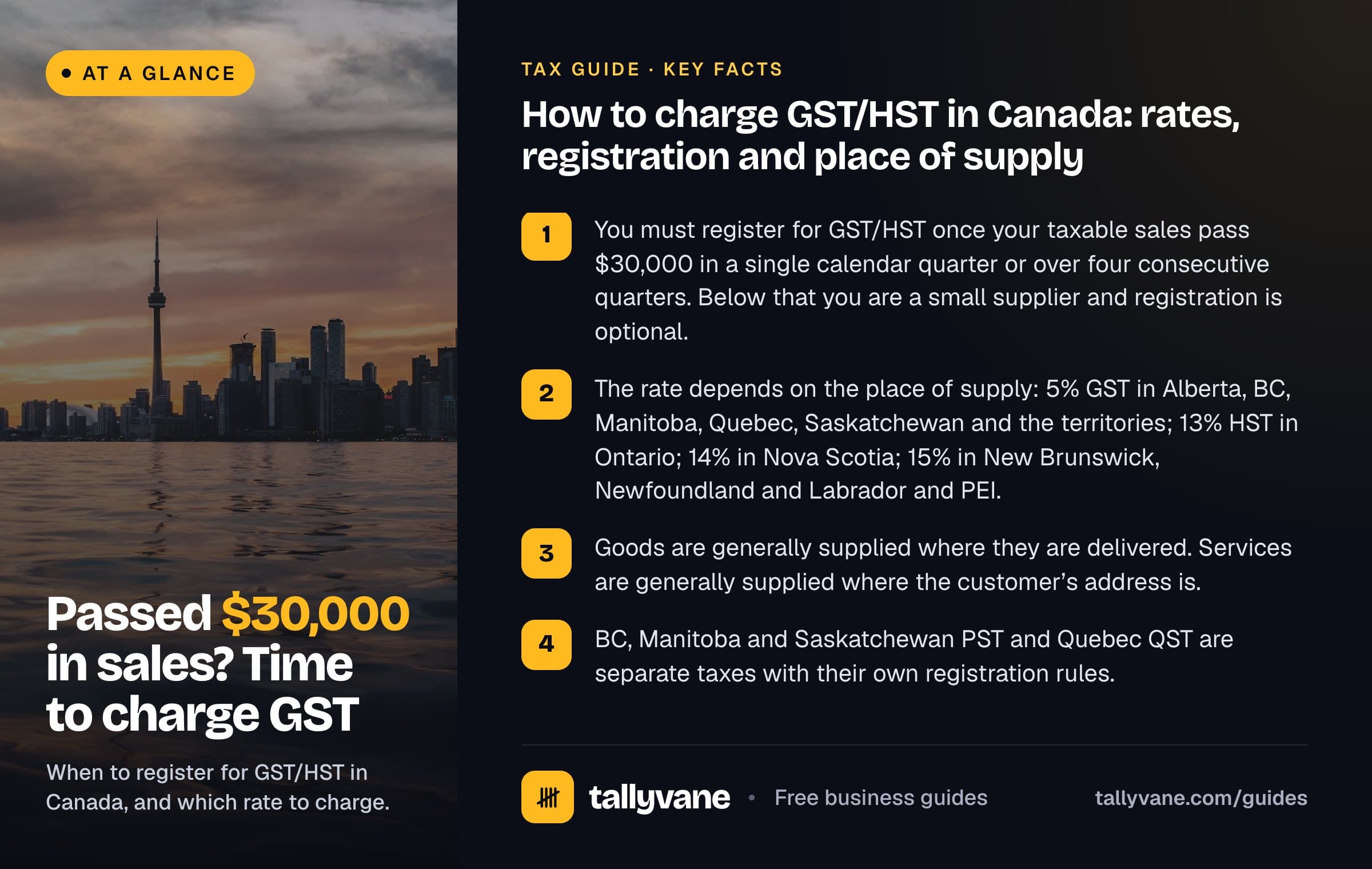
- You must register for GST/HST once your taxable sales pass $30,000 in a single calendar quarter or over four consecutive quarters. Below that you are a small supplier and registration is optional.
- The rate depends on the place of supply: 5% GST in Alberta, BC, Manitoba, Quebec, Saskatchewan and the territories; 13% HST in Ontario; 14% in Nova Scotia; 15% in New Brunswick, Newfoundland and Labrador and PEI.
- Goods are generally supplied where they are delivered. Services are generally supplied where the customer’s address is.
- BC, Manitoba and Saskatchewan PST and Quebec QST are separate taxes with their own registration rules.
GST, HST, PST and QST in one paragraph
The federal Goods and Services Tax (GST) is 5% across Canada. Five provinces have merged their provincial sales tax with the GST into a single Harmonized Sales Tax (HST), collected by the Canada Revenue Agency (CRA). The other provinces either charge their own separate provincial tax (BC, Manitoba and Saskatchewan charge PST or RST; Quebec charges QST) or none at all (Alberta and the three territories).
If you are registered for GST/HST, you charge either 5% GST or the HST rate on taxable sales, depending on where the sale is made. Provincial taxes in the non-harmonized provinces are a separate obligation, with their own registration and rules.
- Nova Scotia’s HST fell from 15% to 14% on April 1, 2025.
- In BC, Manitoba, Saskatchewan and Quebec, the provincial tax is worked out on the price before GST, so the two rates simply add up.
| Province or territory | Tax | Combined rate |
|---|---|---|
| Alberta | GST | 5% |
| British Columbia | GST 5% + PST 7% | 12% |
| Manitoba | GST 5% + RST 7% | 12% |
| New Brunswick | HST | 15% |
| Newfoundland and Labrador | HST | 15% |
| Northwest Territories | GST | 5% |
| Nova Scotia | HST | 14% |
| Nunavut | GST | 5% |
| Ontario | HST | 13% |
| Prince Edward Island | HST | 15% |
| Quebec | GST 5% + QST 9.975% | 14.975% |
| Saskatchewan | GST 5% + PST 6% | 11% |
| Yukon | GST | 5% |
When you have to register: the $30,000 small supplier test
Most businesses do not have to register for GST/HST while they are a small supplier. You are a small supplier if your taxable sales are $30,000 or less over four consecutive calendar quarters. Public service bodies such as charities, municipalities and hospitals have a $50,000 threshold instead.
There are two ways to stop being a small supplier. If you go over $30,000 in a single calendar quarter, you stop being one on the sale that takes you over, and you must charge GST/HST on that sale. If you go over $30,000 across four quarters without passing it in any one quarter, you stop being a small supplier at the end of the month after the quarter in which you went over.
Once you are no longer a small supplier, you have 29 days from your effective date of registration to register. Some businesses must register from their first sale whatever their sales, including self-employed taxi and commercial ride-sharing drivers.
You can also register voluntarily below $30,000. That lets you claim back the GST/HST you pay on business purchases, but you must then charge it on your sales and file returns.
| Quarter | Sales in quarter | Last four quarters |
|---|---|---|
| Jan–Mar | $6,000 | $6,000 |
| Apr–Jun | $8,000 | $14,000 |
| Jul–Sep | $9,000 | $23,000 |
| Oct–Dec | $10,000 | $33,000 |
Worked example: the small supplier test in practice
In the table above, the freelancer passes $30,000 during October to December, when the four-quarter total reaches $33,000. No single quarter went over $30,000, so the four-quarter rule applies. The freelancer stops being a small supplier at the end of January, the month after that quarter, and must charge GST/HST from the effective date of registration, no later than the first sale after that point.
If instead one large contract brought $31,000 of sales in a single quarter, the freelancer would stop being a small supplier on the sale that took the quarter over $30,000, and would have to charge GST/HST on that sale.
Which rate to charge: place of supply basics
The rate depends on the province or territory where the sale is considered to be made, called the place of supply. It is not based on where your business is.
- Goods: generally the province where the goods are delivered or made available to the customer. If you ship by mail or courier, it is the province you send them to.
- Services: generally the province of the customer’s address, if you get that address in the ordinary course of business. If you have more than one address for the customer, use the one most closely connected with the service.
- Intangible property, such as digital downloads and licences: generally where the property can mainly be used, with a set of fallback rules.
- Real property: the province where the property is located.
Worked example: one Ontario business, three customers
A registered web developer based in Toronto invoices $2,000 of design services to each of three business clients. Because these are services, the rate follows each client’s address, not the developer’s.
- The developer would also charge 5% GST to a client in Vancouver. Whether BC PST applies is a separate question under BC’s own rules, which expanded PST to some professional services from October 1, 2026.
- Zero-rated supplies, such as basic groceries, are taxed at 0% wherever they are supplied.
| Client’s address | Rate charged | Tax | Invoice total |
|---|---|---|---|
| Ottawa, Ontario | 13% HST | $260.00 | $2,260.00 |
| Halifax, Nova Scotia | 14% HST | $280.00 | $2,280.00 |
| Calgary, Alberta | 5% GST | $100.00 | $2,100.00 |

What to put on your invoices
GST/HST-registered customers need certain details on your invoice to claim input tax credits. The rules set three levels depending on the total sale, including tax.
- If the invoice covers taxable and non-taxable items, show which items are taxable.
- Show GST/HST as a separate line with the rate, so the customer can claim it.
| Total sale | Information required |
|---|---|
| Under $100 | Your business name, the invoice date, and the total amount paid or payable |
| $100 to $499.99 | All of the above, plus your GST/HST registration number and the tax charged (or a statement that tax is included and the rate) |
| $500 or more | All of the above, plus the customer’s name, the payment terms and a description of each supply |