
Key takeaways
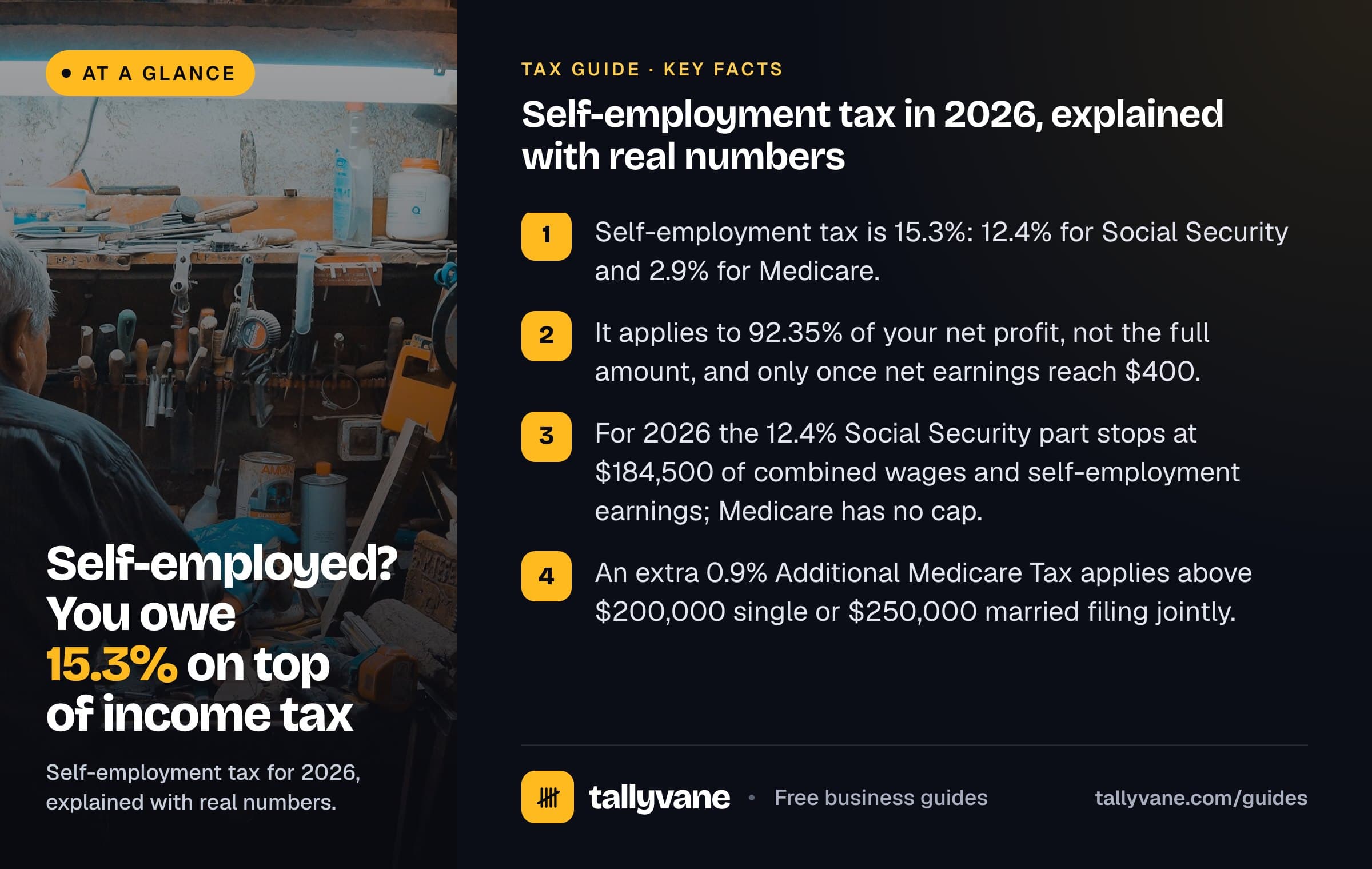
- Self-employment tax is 15.3%: 12.4% for Social Security and 2.9% for Medicare.
- It applies to 92.35% of your net profit, not the full amount, and only once net earnings reach $400.
- For 2026 the 12.4% Social Security part stops at $184,500 of combined wages and self-employment earnings; Medicare has no cap.
- An extra 0.9% Additional Medicare Tax applies above $200,000 single or $250,000 married filing jointly.
- You deduct half of your self-employment tax when figuring adjusted gross income, which lowers income tax but not the SE tax itself.
What self-employment tax is
Employees and employers each pay half of Social Security and Medicare tax. On a paycheck you see 6.2% for Social Security and 1.45% for Medicare, and your employer quietly pays the same again.
When you work for yourself, you are both the employee and the employer, so you pay both halves. That combined amount is self-employment (SE) tax. It is separate from income tax: you can owe SE tax even in a year when your income tax is zero.
You owe it if your net earnings from self-employment are $400 or more. It is figured on Schedule SE and reported with your Form 1040. Sole proprietors and single-member LLC owners usually start from the net profit on Schedule C; general partners use their share of partnership earnings.
The 2026 rates and limits
The rates themselves have not changed for years. What changes each year is the Social Security wage base, the maximum amount of earnings that the 12.4% part applies to. For 2026 the Social Security Administration set it at $184,500, up from $176,100 in 2025.
The Additional Medicare Tax thresholds depend on filing status and, unlike the wage base, are fixed dollar amounts rather than annual figures that move with average wages.
| Item | 2026 figure |
|---|---|
| Social Security (OASDI) rate | 12.4% |
| Medicare (HI) rate | 2.9% |
| Combined SE tax rate | 15.3% |
| Share of net profit that is taxed | 92.35% |
| Social Security wage base | $184,500 |
| Medicare wage base | No limit |
| Additional Medicare Tax rate | 0.9% |
| Additional Medicare threshold, single or head of household | $200,000 |
| Additional Medicare threshold, married filing jointly | $250,000 |
| Additional Medicare threshold, married filing separately | $125,000 |
| Minimum net earnings to owe SE tax | $400 |
Why only 92.35% of profit is taxed
An employee's 7.65% share is figured on wages, and the employer's matching 7.65% is a business expense that never shows up as wages. To put self-employed people on similar footing, the law first reduces net profit by 7.65% before applying the tax. What is left is 92.35% of profit, called net earnings from self-employment.
In practice this means the effective SE tax on each dollar of profit, below the wage base, is 15.3% × 0.9235, or about 14.13%.
SE tax = Net profit × 0.9235 × 15.3% (Social Security part capped at the wage base)
Free toolSelf-employment tax calculatorWorked example: $60,000 of net profit
A designer has $60,000 of net profit on Schedule C in 2026 and no W-2 job.
Net earnings from self-employment are $60,000 × 0.9235 = $55,410. That is well under the $184,500 wage base, so the full 15.3% applies.
Social Security tax is $55,410 × 12.4% = $6,870.84. Medicare tax is $55,410 × 2.9% = $1,606.89. Total SE tax is $8,477.73.
Half of that, $4,238.87, is deducted on Schedule 1 of Form 1040, which lowers adjusted gross income and so lowers income tax. The SE tax itself stays $8,477.73.
| Step | Amount |
|---|---|
| Net profit | $60,000.00 |
| × 92.35% = net earnings from self-employment | $55,410.00 |
| Social Security at 12.4% | $6,870.84 |
| Medicare at 2.9% | $1,606.89 |
| Total SE tax | $8,477.73 |
| Deductible half | $4,238.87 |
Worked example: high earners and the wage base
A single consultant has $250,000 of net profit and no wages. Net earnings from self-employment are $250,000 × 0.9235 = $230,875.
The Social Security part stops at the wage base: $184,500 × 12.4% = $22,878. The Medicare part applies to everything: $230,875 × 2.9% = $6,695.38. SE tax on Schedule SE is $29,573.38, and the deductible half is $14,786.69.
Because self-employment income is over the $200,000 single threshold, the Additional Medicare Tax also applies: ($230,875 − $200,000) × 0.9% = $277.88. This is figured on Form 8959, not Schedule SE, and it is not part of the deductible half.
Notice the effective rate drops above the wage base. Each extra dollar of profit past that point costs 2.9% plus 0.9% in Medicare-related tax, rather than 15.3%.

If you also have a W-2 job
The Social Security wage base is shared between wages and self-employment income. Wages count first. If your employer paid you $150,000 in 2026, Social Security tax was already withheld on that, leaving only $34,500 of room under the $184,500 base for your side business. Above that, your side profit pays only the 2.9% Medicare part.
The Additional Medicare Tax works the same way. Your wages are compared with the threshold first, the threshold is reduced by those wages, and SE income above the reduced threshold is taxed at 0.9%. Employers withhold the 0.9% only on wages over $200,000 paid by them, regardless of filing status, so married couples and people with side income often owe more at filing time.
Schedule SE handles the wage base interaction for you, as long as you enter your Social Security wages from Form W-2.
Ways to lower self-employment tax legally
SE tax is figured on net profit, so every legitimate business expense lowers it. Track mileage, software, equipment, a home office if you qualify, and professional fees. The deduction for half of SE tax and deductions for health insurance or retirement contributions lower income tax, but they do not reduce the profit that SE tax is figured on.
Some owners with steady, higher profits elect S corporation tax treatment and pay themselves a reasonable salary, with payroll taxes on the salary but not on remaining profit distributions. It adds payroll, bookkeeping and a separate tax return, and the salary must be reasonable for the work. Get advice from a tax professional before making the election.
Paying SE tax is not all cost. It builds Social Security work credits and the earnings record your future retirement and disability benefits are based on.
Free toolQuarterly tax calculator