Key takeaways
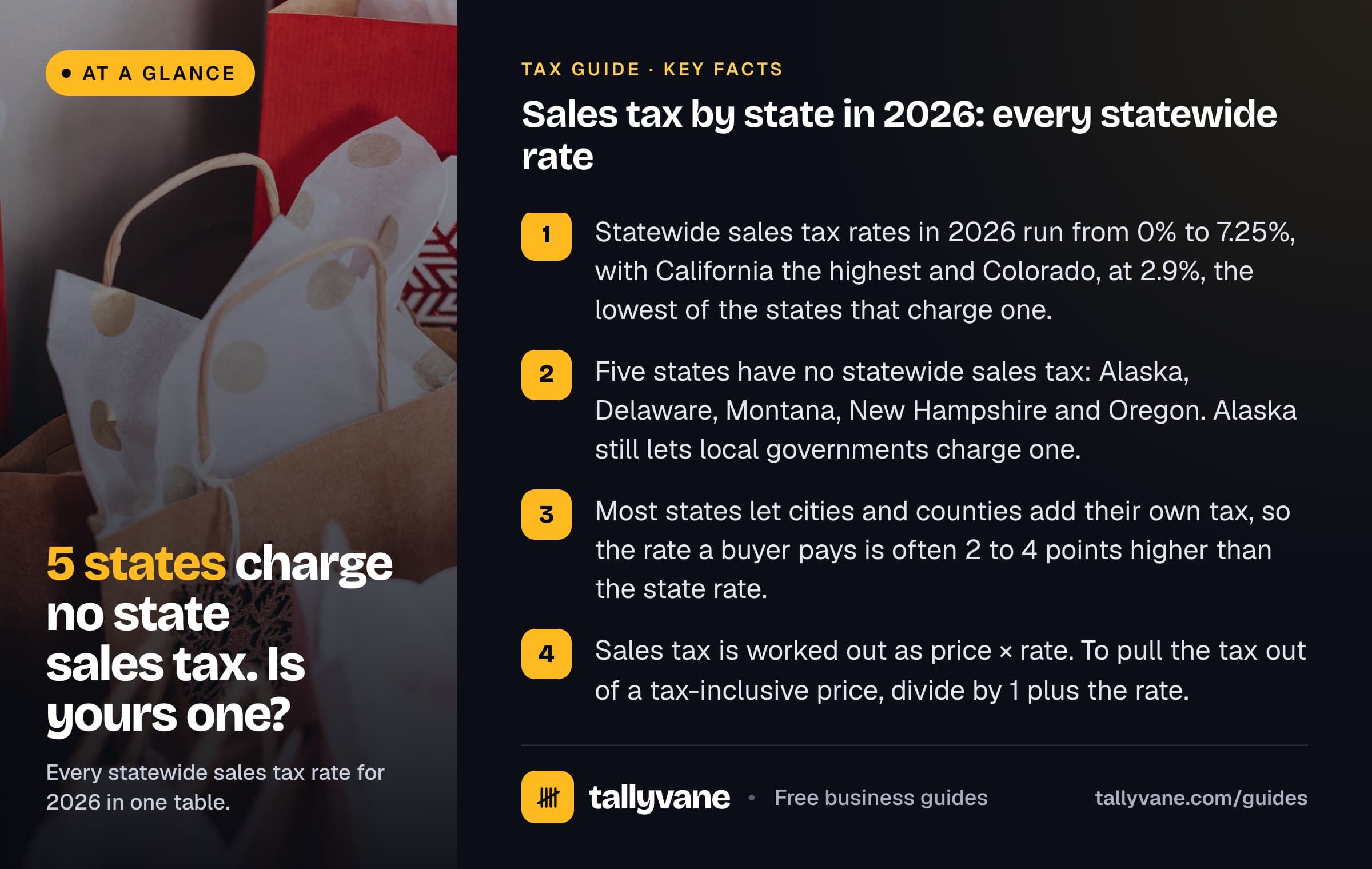
- Statewide sales tax rates in 2026 run from 0% to 7.25%, with California the highest and Colorado, at 2.9%, the lowest of the states that charge one.
- Five states have no statewide sales tax: Alaska, Delaware, Montana, New Hampshire and Oregon. Alaska still lets local governments charge one.
- Most states let cities and counties add their own tax, so the rate a buyer pays is often 2 to 4 points higher than the state rate.
- Sales tax is worked out as price × rate. To pull the tax out of a tax-inclusive price, divide by 1 plus the rate.
The short answer
Forty-five states and the District of Columbia charge a statewide sales tax. In 2026 the state rates range from 2.9% in Colorado to 7.25% in California. Indiana, Mississippi, Rhode Island and Tennessee are next at 7%.
The state rate is only part of the story. In 38 states, cities, counties and special districts can add their own sales tax on top, according to the Tax Foundation’s midyear 2026 figures. That is why a state with a modest state rate, such as Louisiana at 5%, can end up with one of the highest rates buyers actually pay.
The table below lists the statewide rate for every state and DC. It shows whether local sales taxes also apply, but not the local rates themselves, because those change by address.
Statewide sales tax rates for all 50 states and DC
These are the general state rates as of mid-2026. “Local taxes” shows whether cities, counties or districts in that state add their own sales tax. Many states charge different rates on groceries, prepared food, lodging or vehicles, which the table does not cover.
- California’s 7.25% includes a 1.25% local add-on that applies everywhere in the state. Utah’s 6.1% and Virginia’s 5.3% also include a statewide local portion.
- Arizona, Hawaii and New Mexico tax the seller rather than the sale (a transaction privilege tax, general excise tax and gross receipts tax). Businesses there usually pass the cost on to buyers.
- New York’s state rate is 4%, but the combined rate in New York City is 8.875%.
- DC’s general rate is 6%. A planned rise to 7% has been postponed, and DC’s Office of Tax and Revenue says 6% applies through September 30, 2027.
| State | State rate | Local taxes |
|---|---|---|
| Alabama | 4% | Yes |
| Alaska | 0% | Yes |
| Arizona | 5.6% | Yes |
| Arkansas | 6.5% | Yes |
| California | 7.25% | Yes |
| Colorado | 2.9% | Yes |
| Connecticut | 6.35% | No |
| Delaware | 0% | No |
| District of Columbia | 6% | No |
| Florida | 6% | Yes |
| Georgia | 4% | Yes |
| Hawaii | 4% | Yes |
| Idaho | 6% | Yes |
| Illinois | 6.25% | Yes |
| Indiana | 7% | No |
| Iowa | 6% | Yes |
| Kansas | 6.5% | Yes |
| Kentucky | 6% | No |
| Louisiana | 5% | Yes |
| Maine | 5.5% | No |
| Maryland | 6% | No |
| Massachusetts | 6.25% | No |
| Michigan | 6% | No |
| Minnesota | 6.875% | Yes |
| Mississippi | 7% | Yes |
| Missouri | 4.225% | Yes |
| Montana | 0% | No |
| Nebraska | 5.5% | Yes |
| Nevada | 6.85% | Yes |
| New Hampshire | 0% | No |
| New Jersey | 6.625% | No |
| New Mexico | 4.875% | Yes |
| New York | 4% | Yes |
| North Carolina | 4.75% | Yes |
| North Dakota | 5% | Yes |
| Ohio | 5.75% | Yes |
| Oklahoma | 4.5% | Yes |
| Oregon | 0% | No |
| Pennsylvania | 6% | Yes |
| Rhode Island | 7% | No |
| South Carolina | 6% | Yes |
| South Dakota | 4.2% | Yes |
| Tennessee | 7% | Yes |
| Texas | 6.25% | Yes |
| Utah | 6.1% | Yes |
| Vermont | 6% | Yes |
| Virginia | 5.3% | Yes |
| Washington | 6.5% | Yes |
| West Virginia | 6% | Yes |
| Wisconsin | 5% | Yes |
| Wyoming | 4% | Yes |
The five states with no statewide sales tax
Alaska, Delaware, Montana, New Hampshire and Oregon do not charge a general statewide sales tax. That does not always mean a sale there is tax-free.
- Alaska is the only one of the five that lets local governments charge a sales tax. Some boroughs and cities do, at rates up to about 7.85%.
- Delaware has no sales tax but charges businesses a gross receipts tax instead.
- Montana has no general sales tax, but some resort areas charge a local resort tax.
- New Hampshire has no general sales tax, but charges a meals and rooms tax on restaurant meals, lodging and car rentals.
- Oregon has no sales tax at state or local level.
How local taxes change the real rate
In most states, the rate a buyer pays is the state rate plus a county rate, a city rate and sometimes one or more special district rates. Two addresses a few miles apart can have different totals.
The Tax Foundation’s midyear 2026 figures put the highest average combined state and local rates in Louisiana (10.13%), Tennessee (9.61%), Washington (9.57%), Arkansas (9.48%) and Alabama (9.46%). None of these has the highest state rate; local taxes push them to the top.
Other states keep it simple. Connecticut, Indiana, Kentucky, Maine, Maryland, Massachusetts, Michigan, New Jersey and Rhode Island, along with DC, have no general local sales taxes, so the state rate is the rate. Some still have local taxes on meals or lodging.
Some states cap local add-ons. In Texas, local sales taxes can add at most 2%, so the highest combined rate is 8.25%. Pennsylvania’s local add-ons are limited to Allegheny County (1%) and Philadelphia (2%).
For any sale where the exact rate matters, look up the full rate for the delivery address on the state revenue department’s website. Most offer a rate lookup by address.
How to calculate sales tax on a sale
Multiply the price by the combined rate as a decimal, then add the result to the price. In Indiana, where the rate is 7% everywhere, an $80 order has $5.60 of sales tax ($80 × 0.07), for a total of $85.60.
Where local taxes apply, use the combined rate, not the state rate. A $200 order delivered in New York City at 8.875% carries $17.75 of tax, for a total of $217.75. At New York’s 4% state rate alone you would have charged only $8, and the $9.75 difference would come out of your own pocket.
If a price already includes sales tax, divide by 1 plus the rate to find the pre-tax price. A $107 tax-inclusive total in a 7% state is $100 before tax ($107 ÷ 1.07), with $7 of tax.
Sales tax = Price × Combined rate ÷ 100 Total = Price + Sales tax Price before tax = Tax-inclusive total ÷ (1 + Combined rate ÷ 100)
| Where | Combined rate | Tax | Total |
|---|---|---|---|
| Oregon | 0% | $0.00 | $200.00 |
| Colorado (state only) | 2.9% | $5.80 | $205.80 |
| Indiana | 7% | $14.00 | $214.00 |
| California (state minimum) | 7.25% | $14.50 | $214.50 |
| Texas (maximum) | 8.25% | $16.50 | $216.50 |
| New York City | 8.875% | $17.75 | $217.75 |
Which sales you have to collect tax on
You generally have to collect sales tax in a state where your business has a connection, called nexus. A shop, office, warehouse or staff in a state usually creates nexus there.
Since the Supreme Court’s 2018 decision in South Dakota v. Wayfair, states can also require remote sellers to collect tax based on sales volume alone. The law upheld in that case applied to sellers with more than $100,000 of sales into South Dakota, or 200 or more separate transactions, in a year. Most states with a sales tax now have a similar economic nexus rule, but the thresholds and what counts toward them differ, so check each state where you have meaningful sales.
If you sell through a marketplace such as eBay or Etsy, the marketplace usually collects and pays the sales tax on those orders for you under state marketplace facilitator rules. Sales on your own website are your responsibility.
What is taxable also varies. Many states exempt or reduce tax on groceries and prescription drugs, and some tax services while others do not. Illinois, for example, ended its 1% state tax on groceries on January 1, 2026, though many of its cities and counties now charge their own. Check the state’s list of taxable goods and services before you set up checkout.
Pricing when sales tax is added at checkout
In the US, prices are normally shown before sales tax, and the tax is added at checkout. The tax you collect is not your income. You hold it for the state and pay it over on your sales tax return, so keep it separate from your revenue when you work out margins.
If you quote a price that includes tax, for example at a market stall where you want round numbers, work backward to find your real revenue. A $25 tax-inclusive price in a 6% state leaves you $23.58 before tax ($25 ÷ 1.06), with $1.42 going to the state.
Free toolRetail price calculator