Key takeaways
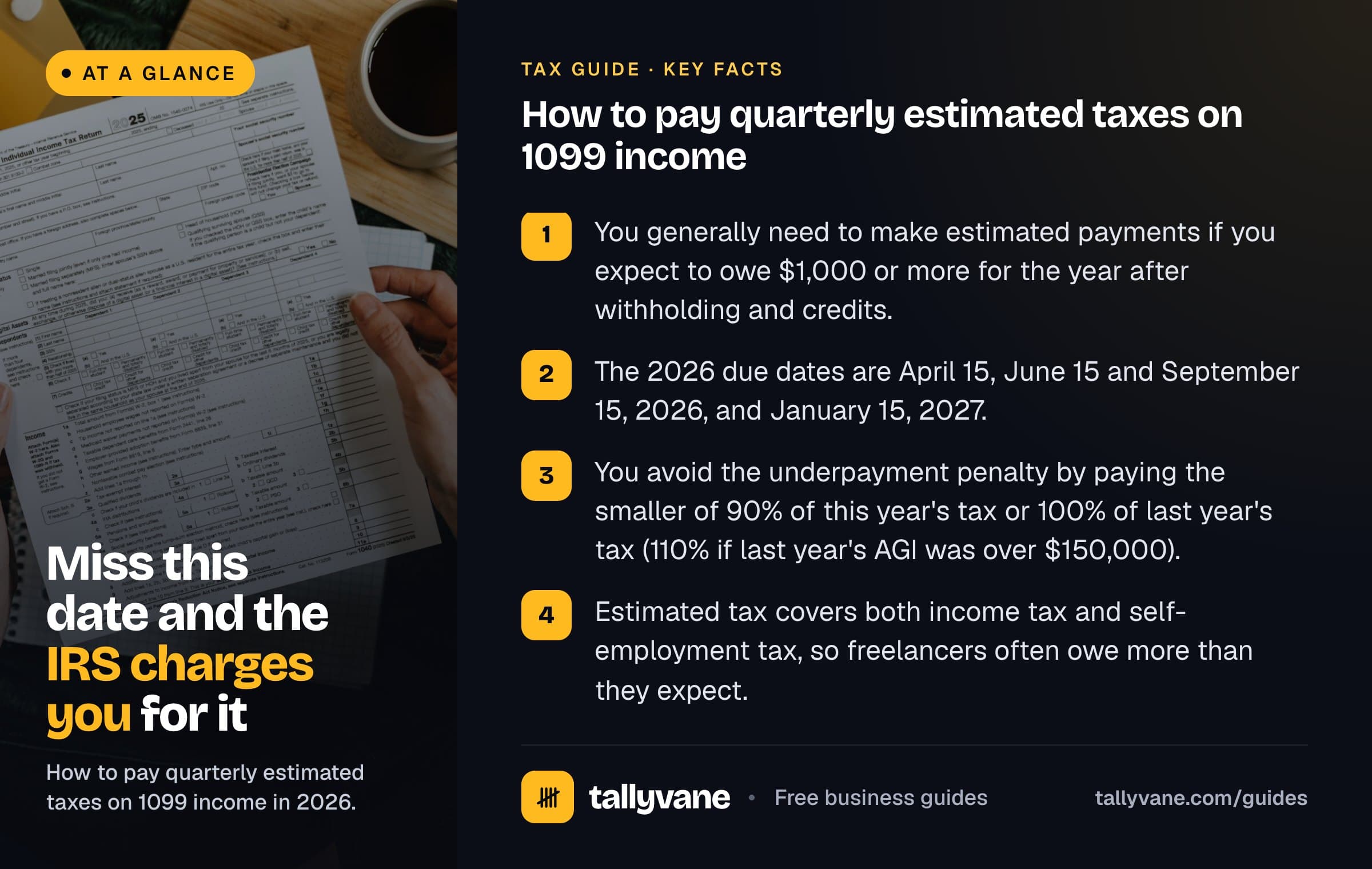
- You generally need to make estimated payments if you expect to owe $1,000 or more for the year after withholding and credits.
- The 2026 due dates are April 15, June 15 and September 15, 2026, and January 15, 2027.
- You avoid the underpayment penalty by paying the smaller of 90% of this year's tax or 100% of last year's tax (110% if last year's AGI was over $150,000).
- Estimated tax covers both income tax and self-employment tax, so freelancers often owe more than they expect.
- The simplest way to pay is IRS Direct Pay or your IRS online account, choosing "estimated tax" and the 2026 tax year.
Who has to pay estimated tax
The US tax system is pay-as-you-go. Employees pay through withholding on every paycheck. If you earn money that nobody withholds tax from, such as freelance or 1099 income, profit from a small business, rental income, or large investment gains, you are expected to pay that tax during the year yourself.
The IRS rule of thumb for individuals, including sole proprietors, partners and S corporation shareholders, is that you generally must make estimated payments if you expect to owe $1,000 or more when you file, after subtracting withholding and refundable credits.
If you also have a W-2 job, you have a choice. You can make estimated payments, or you can ask your employer to withhold more by filing a new Form W-4. Withholding counts as if it were paid evenly through the year, which can help if you start paying late.
- Freelancers, contractors and gig workers paid on Form 1099-NEC or 1099-K
- Sole proprietors and single-member LLC owners
- Landlords and investors with income that has no withholding
- Retirees whose pension or IRA withholding does not cover their full tax
2026 estimated tax due dates
The year is split into four payment periods of unequal length. The "quarters" are not calendar quarters: the second period covers only two months and the fourth covers four.
If a due date falls on a Saturday, Sunday or legal holiday, a payment made on the next business day is on time. None of the 2026 dates fall on a weekend.
You can skip the January 15, 2027 payment if you file your 2026 return by January 31, 2027 and pay the full balance with it.
| Income earned | Payment due |
|---|---|
| January 1 to March 31, 2026 | April 15, 2026 |
| April 1 to May 31, 2026 | June 15, 2026 |
| June 1 to August 31, 2026 | September 15, 2026 |
| September 1 to December 31, 2026 | January 15, 2027 |
How much to pay: the safe harbor rules
You do not have to predict your tax perfectly. To avoid the underpayment penalty, your withholding plus estimated payments need to reach the smaller of two amounts, paid in on time across the four dates.
The prior-year option is the easiest to use, because the number is already on last year's return. Take the "total tax" line from your 2025 Form 1040, divide by four, and pay that amount on each date. If your income jumps in 2026, you will owe the difference in April 2027, but you will not be penalized for it.
The current-year option is better when your income drops. If you expect to earn much less in 2026 than in 2025, paying 90% of this year's expected tax means sending less money now.
- 90% of the tax you expect to owe for 2026, or
- 100% of the total tax on your 2025 return (the 2025 return must cover a full 12 months), or
- 110% of your 2025 tax instead of 100% if your 2025 adjusted gross income was over $150,000 ($75,000 if married filing separately)
Worked example: a freelancer with $80,000 profit
Say you are single, have no other job, and expect $80,000 of net profit from freelance work in 2026 (income minus business expenses). You take the standard deduction. For simplicity this example leaves out the qualified business income deduction and any credits, which would lower the tax for many people.
First comes self-employment tax, the Social Security and Medicare tax for people who work for themselves. It applies to 92.35% of net profit at 15.3%: $80,000 × 0.9235 × 0.153 = $11,303.64. Half of that, $5,651.82, is deducted when figuring income tax.
Adjusted gross income is $80,000 − $5,651.82 = $74,348.18. Subtract the 2026 standard deduction for a single filer, $16,100, to get taxable income of $58,248.18.
Using the 2026 single brackets, income tax is 10% of the first $12,400 ($1,240), plus 12% of the next $38,000 ($4,560), plus 22% of the $7,848.18 above $50,400 ($1,726.60). That is $7,526.60.
Total tax is $7,526.60 + $11,303.64 = $18,830.24. Paying 90% of that would be $16,947.22, or about $4,237 per quarter. If last year's total tax was lower, say $14,000, and your AGI was under $150,000, you could instead pay $3,500 each quarter and settle the rest when you file.
| Line | Amount |
|---|---|
| Net profit | $80,000.00 |
| Self-employment tax (15.3% of 92.35%) | $11,303.64 |
| Deduction for half of SE tax | −$5,651.82 |
| Standard deduction (single, 2026) | −$16,100.00 |
| Taxable income | $58,248.18 |
| Federal income tax | $7,526.60 |
| Total federal tax | $18,830.24 |
| Quarterly payment at 100% of expected tax | $4,707.56 |
How to pay the IRS
Most people pay online. IRS Direct Pay takes payments straight from a checking or savings account with no fee and no sign-up. Choose "Estimated Tax" as the reason, "1040ES" as the form and 2026 as the tax year. Save the confirmation number.
Your IRS online account at IRS.gov/account does the same and shows a history of what you have paid, which is useful at filing time. You can also pay by debit or credit card through an IRS-approved processor (they charge a fee), through EFTPS, by phone, or with the IRS2Go app.
To pay by mail, use a payment voucher from Form 1040-ES and a check made out to "United States Treasury". Write your Social Security number, "2026 Form 1040-ES" and your phone number on the check. Mailing addresses depend on your state and are listed in the form instructions.
You can pay more often than four times. Some freelancers send a payment each time a client pays them. What matters is that enough has been paid by each due date.

What happens if you pay late or too little
If you underpay for a period, the IRS charges a penalty that works like interest on the shortfall, from the due date until it is paid or until the April filing deadline. It applies per period, so paying everything in the fourth quarter does not erase the penalty for the first three. You can owe it even if you end up getting a refund.
Form 2210 works out whether you owe the penalty and how much. If your income came unevenly, for example most of it in the fall, the annualized income method on Form 2210 can lower or remove the penalty because it matches what you owed to when you earned it.
The IRS can waive the penalty in some cases, such as a casualty, disaster or other unusual circumstance, or if you retired after age 62 or became disabled and the underpayment had a reasonable cause.
State estimated taxes
Most states with an income tax have their own estimated payment system, with their own forms, thresholds and penalty rules. Many use dates close to the federal ones, but not all do. Check your state revenue department's website for its rules and payment portal, and budget for state tax on top of the federal amount.