
Key takeaways
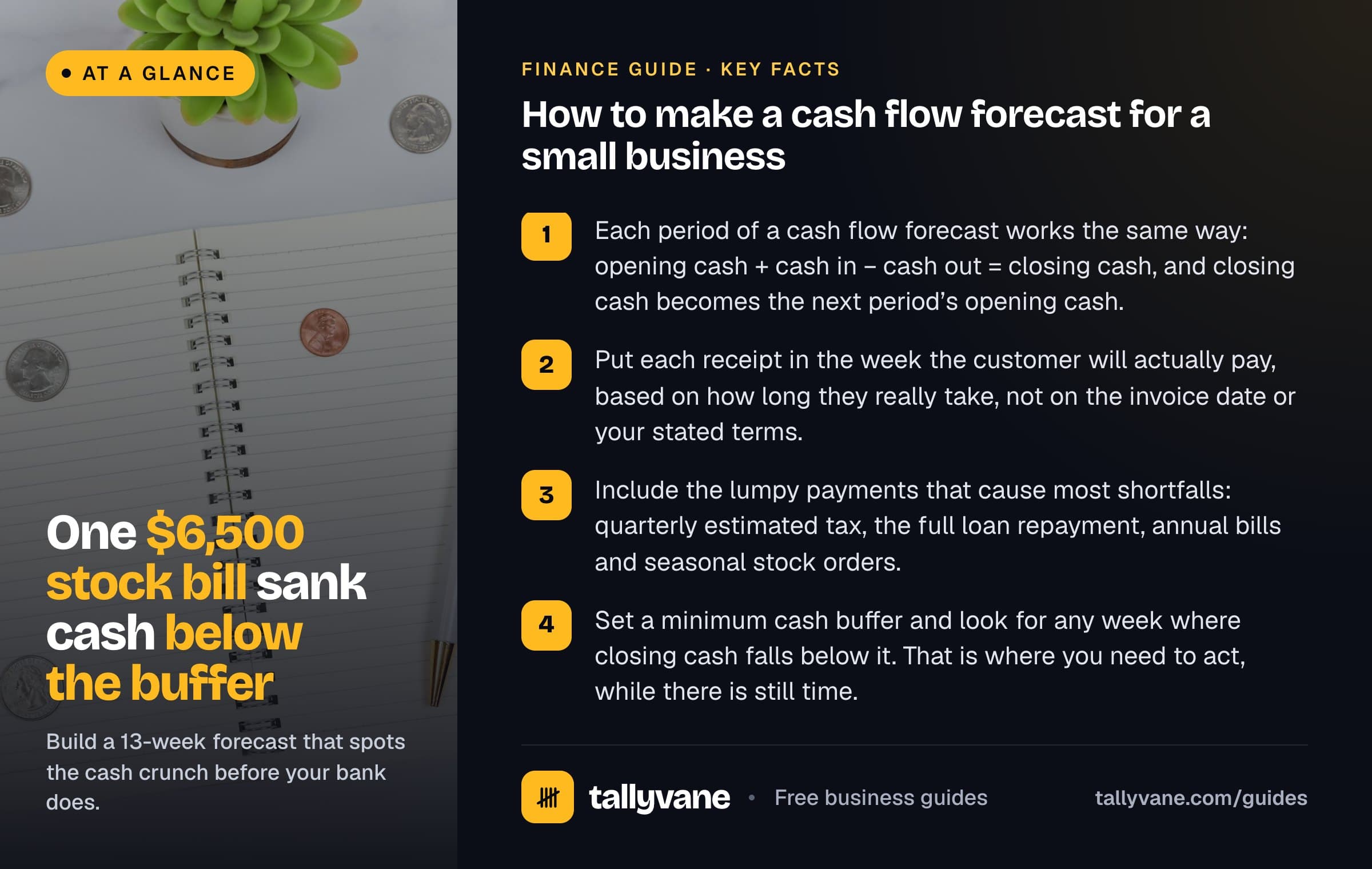
- Each period of a cash flow forecast works the same way: opening cash + cash in − cash out = closing cash, and closing cash becomes the next period’s opening cash.
- Put each receipt in the week the customer will actually pay, based on how long they really take, not on the invoice date or your stated terms.
- Include the lumpy payments that cause most shortfalls: quarterly estimated tax, the full loan repayment, annual bills and seasonal stock orders.
- Set a minimum cash buffer and look for any week where closing cash falls below it. That is where you need to act, while there is still time.
- Update the forecast every week: replace the week just gone with actual figures, add a new week at the end, and learn from the differences.
What a cash flow forecast is
A cash flow forecast, also called a cash flow projection, estimates the cash that will move in and out of your bank account over the coming weeks or months. The training guide on managing cash flow published by the FDIC and the SBA puts the difference simply: a cash flow statement is a backward-looking record of actual cash movements, while a projection is a forward-looking estimate of your future cash position.
This guide uses the direct method: you list each expected receipt and payment on the date the money will move. The indirect method starts from projected profit and adjusts for stock, receivables and payables. For a few months ahead, the direct method is easier to build and check.
A forecast is not the same as a runway figure. Runway divides your cash by an average monthly burn and tells you how long the money lasts if nothing changes; our cash runway guide covers that. A forecast shows when, in which week, cash gets tight, and which payment causes it.
Closing cash = Opening cash + Cash in − Cash out Next period’s opening cash = This period’s closing cash
Weekly for 13 weeks, or monthly for 12 months
A 13-week forecast covers one quarter in weekly steps. It is the right choice when cash is tight, when big payments and receipts land in particular weeks, or when payroll runs every week or two. A monthly total can hide a week where rent, payroll and a tax payment all fall together.
A 12-month forecast in monthly steps is better for planning: seasonal stock buying, hiring, a loan application or a price change. Lenders often ask for a monthly projection when you apply for a loan. Many businesses keep both, a rolling 13-week forecast for running the bank account and a 12-month one for decisions.
Step 1: opening cash and a minimum buffer
Start with the cash actually in your business bank accounts on the first day of the forecast. Use the bank balance, not the figure in your accounting software, which may include payments that have not cleared. Leave out an unused credit line; if you plan to draw on it, show the draw as a receipt in the week you take it.
Then set a minimum cash buffer: the lowest closing balance you are willing to see. A practical floor covers your biggest regular outflows that can land in the same week, such as a payroll run plus rent, with some room to spare. Any week that closes below the buffer is a warning, even if the balance is still positive.
Step 2: receipts, by when customers actually pay
List cash sales, card payouts, payments from customers on account, and any loan money, owner contributions or tax refunds you expect. Put each one in the week it will reach your bank, not the week you make the sale.
For invoices, use your own payment history. If your terms are net 30 but your wholesale customers pay 41 days after the invoice date on average, put October’s invoices in the weeks they will really arrive, which may be well into December. Card processors and marketplaces also pay out a few days after the sale, and some hold funds longer.
Be more cautious with receipts than with payments. If a customer is already late, push their payment back or leave it out until it arrives. An optimistic receipt hides the very shortfall the forecast is meant to show.
Expected receipt date = Invoice date + Average days that customer takes to pay
Step 3: list every payment
Go through the last three months of bank statements and list every regular payment: wages and payroll taxes, rent, suppliers, software, insurance, utilities, fees, and sales tax you must pay over. Put each one in the week you will actually pay it.
Include the full loan repayment, not just the interest. Your profit and loss statement shows only the interest, but the whole payment leaves the bank. Include owner’s draws too, if you take them from the business account. The FDIC and SBA guide lists debt payments, taxes and owner’s draws alongside operating expenses and payroll as cash going out.
Free toolLoan payment calculator
Step 4: do not miss the lumpy payments
Most cash surprises come from payments that do not happen every month. Go through the year and put each one in its week.
- Quarterly estimated tax. If you are self-employed and expect to owe $1,000 or more, the IRS expects four payments, due April 15, June 15 and September 15, and January 15 of the following year. The last 2026 payment is due Friday, January 15, 2027. Dates on a weekend or holiday move to the next business day.
- Seasonal stock. Stock for a busy season is usually paid for weeks before customers pay you for it. Show the deposit and the balance in the weeks the supplier wants them.
- Annual and quarterly bills: insurance, software subscriptions, licences, professional fees and equipment servicing.
- Payroll months with an extra pay day. A business paying every two weeks usually has two months a year with three pay days.
- One-off purchases you are planning, such as equipment or a vehicle deposit.
Worked example: 13 weeks for a small candle wholesaler
A two-person candle business sells online and to gift shops on net 30 terms. On Monday, November 9, 2026 it has $14,000 in the bank. It sets an $8,000 buffer, roughly one payroll ($3,000), one month’s rent ($1,500) and two weeks of running costs ($2,400), rounded up. Payroll is $3,000 every two weeks, rent of $1,500 is paid on the 1st, and a $623 loan repayment is taken on the 15th. Running costs are $1,200 a week through mid-December and $700 a week after. A $6,500 bill for holiday stock is due in week 1, the owner’s estimated tax payment of $4,800 is due January 15, and a $5,000 deposit on spring stock is due in late January. Online payouts are $1,500 a week until Christmas and $800 after. Wholesale receipts follow when the shops have historically paid.
- Over the 13 weeks, $52,300 comes in and $55,769 goes out, so cash falls by $3,469 to $10,531. That total alone would not show a problem.
- The weekly view does: closing cash falls below the $8,000 buffer in weeks 1 and 3, because the holiday stock is paid for before the shops pay for their orders.
- If the owner asks the supplier for net 30 and moves the $6,500 payment to the week of December 7, every week stays above the buffer, and the lowest balance becomes $10,531 at the end of the forecast.
- Cash falls in each of the last four weeks, from $22,054 to $10,531, as wholesale receipts slow after the holidays. The next few weekly updates will show whether February needs action.
| Week starting | Opening cash | Cash in | Cash out | Closing cash | Main payments |
|---|---|---|---|---|---|
| Nov 9 | $14,000 | $3,500 | $11,323 | $6,177 | Holiday stock $6,500, payroll, loan |
| Nov 16 | $6,177 | $4,000 | $1,200 | $8,977 | Running costs |
| Nov 23 | $8,977 | $3,000 | $4,200 | $7,777 | Payroll |
| Nov 30 | $7,777 | $4,500 | $2,700 | $9,577 | Rent |
| Dec 7 | $9,577 | $6,500 | $4,200 | $11,877 | Payroll |
| Dec 14 | $11,877 | $7,500 | $1,823 | $17,554 | Loan |
| Dec 21 | $17,554 | $6,000 | $3,700 | $19,854 | Payroll |
| Dec 28 | $19,854 | $3,800 | $2,200 | $21,454 | Rent |
| Jan 4 | $21,454 | $4,300 | $3,700 | $22,054 | Payroll |
| Jan 11 | $22,054 | $3,300 | $6,123 | $19,231 | Estimated tax $4,800, loan |
| Jan 18 | $19,231 | $2,300 | $3,700 | $17,831 | Payroll |
| Jan 25 | $17,831 | $1,800 | $5,700 | $13,931 | Spring stock deposit $5,000 |
| Feb 1 | $13,931 | $1,800 | $5,200 | $10,531 | Payroll, rent |
Update it weekly and compare forecast with actual
A forecast is only useful if it stays current. Once a week, replace the week just gone with what actually happened, roll the actual closing balance into the next week, and add a new week at the end so you always see 13 weeks ahead.
Then look at the differences. Here is week 1 of the example after it closed: one shop’s $900 payment did not arrive, and packaging cost $157 more than planned.
- Find out why each difference happened. A late payment is a timing difference: move it to the week the customer now promises, and chase it. A cost that keeps coming in higher is a forecasting error: raise it in every future week.
- If the same customers are always late, change the payment delay you assume for them rather than hoping they improve.
- For a quick monthly sense check, the cash runway calculator takes one monthly figure for cash in and one for cash out, with optional growth, and shows cash at the end of each month. It cannot show lumpy one-off payments, so keep those in your own forecast.
| Line | Forecast | Actual | Difference |
|---|---|---|---|
| Opening cash | $14,000 | $14,000 | $0 |
| Cash in | $3,500 | $2,600 | −$900 |
| Cash out | $11,323 | $11,480 | $157 more paid out |
| Closing cash | $6,177 | $5,120 | −$1,057 |