Key takeaways
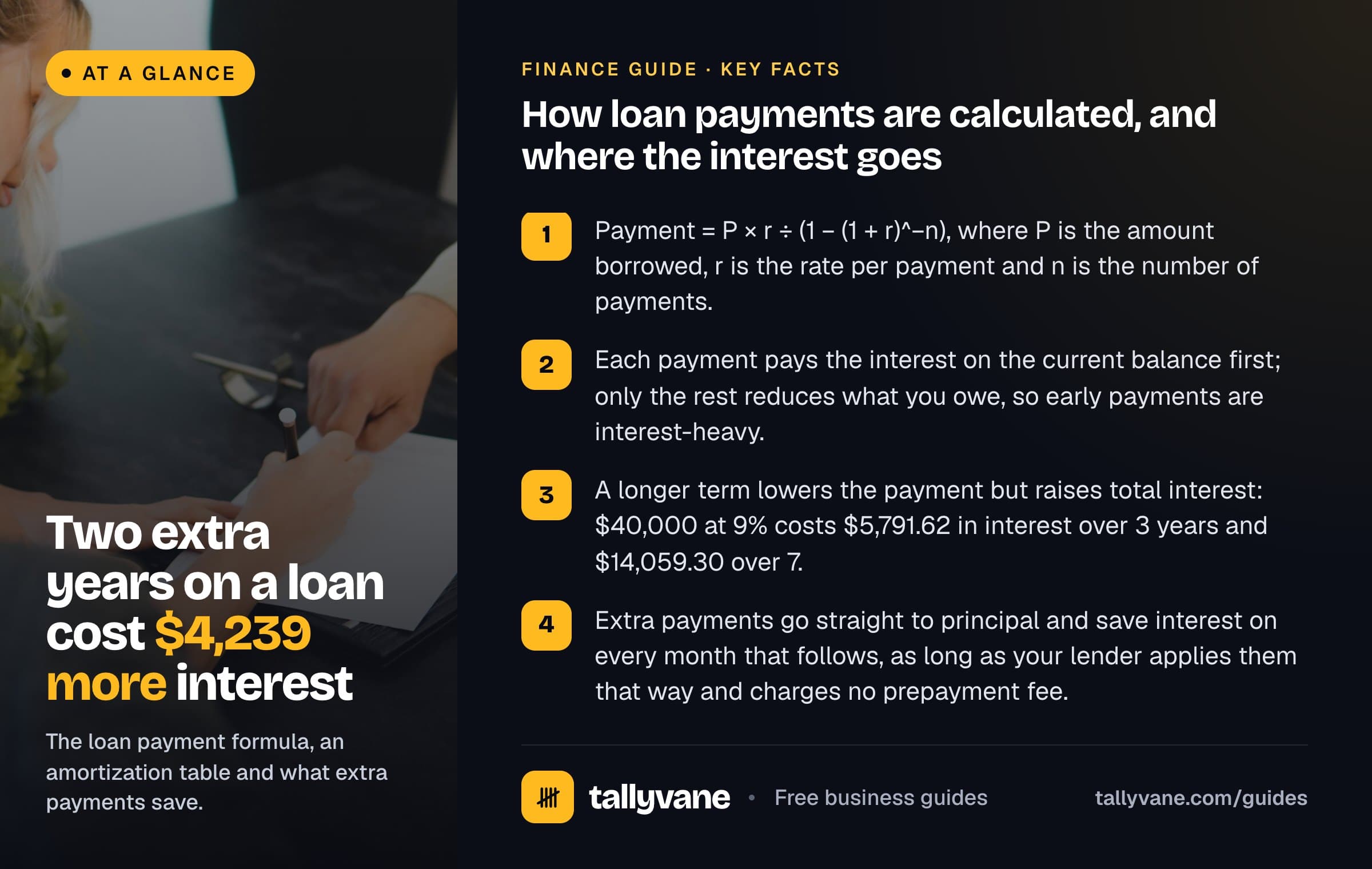
- Payment = P × r ÷ (1 − (1 + r)^−n), where P is the amount borrowed, r is the rate per payment and n is the number of payments.
- Each payment pays the interest on the current balance first; only the rest reduces what you owe, so early payments are interest-heavy.
- A longer term lowers the payment but raises total interest: $40,000 at 9% costs $5,791.62 in interest over 3 years and $14,059.30 over 7.
- Extra payments go straight to principal and save interest on every month that follows, as long as your lender applies them that way and charges no prepayment fee.
- APR adds most fees to the interest rate, so it is the fairer number for comparing offers.
What a loan payment pays for
Most business, equipment and vehicle loans are amortizing loans. You pay the same amount every period, and each payment does two jobs: it pays the interest that built up since the last payment, and it pays back part of the money you borrowed, the principal.
Interest is charged on the balance you still owe. At the start that balance is the full loan, so interest takes a large slice of each payment. As the balance falls, the interest slice shrinks and the principal slice grows, even though the payment never changes.
The loan payment formula
The payment is the one fixed amount that, paid every period, brings the balance to exactly zero on the last payment. To use the formula, convert the annual rate to a rate per payment by dividing it by the number of payments a year, and count the total number of payments.
For a $40,000 loan at 9% a year, paid monthly over 5 years: r = 0.09 ÷ 12 = 0.0075 and n = 60. The formula gives a monthly payment of $830.33. If the rate is 0%, the formula does not apply: you simply divide the loan by the number of payments.
Payment = P × r ÷ (1 − (1 + r)^−n) r = annual rate ÷ payments per year n = years × payments per year
Free toolLoan payment calculatorWorked example: the first six months of an equipment loan
A bakery borrows $40,000 at 9% over 5 years to buy a new oven and mixer. Each month the lender works out interest as the opening balance × 0.75%, takes that from the $830.33 payment, and uses the rest to reduce the balance.
- Month 1 interest is $40,000 × 0.75% = $300. The other $530.33 reduces the balance.
- Every month the interest falls by about $4 and the principal rises by the same amount.
- Over the first year the bakery pays $3,330.81 in interest and owes $33,366.80 at the end of it.
- Over the full 60 months it pays $9,820.05 in interest, so the oven and mixer cost $49,820.05 in all.
Interest = Opening balance × r Principal = Payment − Interest New balance = Opening balance − Principal
| Month | Payment | Interest | Principal | Balance |
|---|---|---|---|---|
| 1 | $830.33 | $300.00 | $530.33 | $39,469.67 |
| 2 | $830.33 | $296.02 | $534.31 | $38,935.35 |
| 3 | $830.33 | $292.02 | $538.32 | $38,397.04 |
| 4 | $830.33 | $287.98 | $542.36 | $37,854.68 |
| 5 | $830.33 | $283.91 | $546.42 | $37,308.25 |
| 6 | $830.33 | $279.81 | $550.52 | $36,757.73 |
Interest vs principal: why the split matters
The split is not just a curiosity. For a business, loan interest is generally a deductible expense, while repaying principal is not an expense at all: it is paying back money you were lent. Your profit and loss statement should show only the interest part of each payment.
The split also tells you what you would save by paying off early. Paying off the bakery loan after one year means clearing the $33,366.80 balance, not the $39,855.84 of payments still scheduled (48 × $830.33). The difference is interest you no longer owe.
An amortization schedule lists this split for every payment. Our calculator shows it payment by payment or summed by year, which is the view most bookkeepers want at year end.
Free toolLoan payment calculatorHow term and rate change the total interest
The two levers on any loan are the interest rate and the term. A longer term spreads the principal over more payments, so each one is smaller, but the balance stays high for longer and interest keeps building. A higher rate raises the cost on every month the balance is outstanding.
- Stretching from 5 to 7 years cuts the payment by $186.77 a month but adds $4,239.25 of interest.
- Two points of rate on a 5-year loan are worth roughly $2,300 to $2,400 of interest either way. Shopping for a better rate often saves more than haggling over fees.
- A shorter term only helps if you can afford the higher payment every month. A payment that squeezes your cash flow is a bigger risk than the extra interest.
| Rate | Term | Monthly payment | Total interest | Total paid |
|---|---|---|---|---|
| 9% | 3 years | $1,271.99 | $5,791.62 | $45,791.62 |
| 9% | 5 years | $830.33 | $9,820.05 | $49,820.05 |
| 9% | 7 years | $643.56 | $14,059.30 | $54,059.30 |
| 7% | 5 years | $792.05 | $7,522.88 | $47,522.88 |
| 11% | 5 years | $869.70 | $12,181.82 | $52,181.82 |
What extra payments do
Any amount you pay above the scheduled payment goes to principal, as long as your lender applies it that way. A lower balance means less interest every month after, so the loan ends early. The earlier you pay extra, the more it saves.
Our calculator shows the standard schedule without extra payments. The figures below come from the same bakery loan with the payment held at $830.33 plus the extra.
- An extra $100 a month pays the loan off in 53 months instead of 60 and saves $1,349.11 of interest.
- An extra $200 a month pays it off in 47 months and saves $2,366.06.
- A one-off $5,000 paid with the 12th payment clears the loan in 52 months and saves $1,960.44.
- Before you pay extra, check the agreement for a prepayment penalty, and tell the lender in writing that the money is for principal, not next month’s payment.
APR vs interest rate
The interest rate is what the lender charges to borrow the money. The annual percentage rate (APR) also counts most up-front fees, such as an origination or arrangement fee, expressed as a yearly rate. Two loans with the same interest rate can have quite different APRs.
Say the bakery’s lender charges a $1,000 fee taken out of the $40,000, so the bakery receives $39,000 but repays $830.33 a month for 60 months. The interest rate is 9%, but the APR is about 10.09%. A rival offer at 9.5% with no fee would be cheaper.
US lenders must show the APR on consumer loans under the Truth in Lending Act, but loans for business purposes are generally outside that law. Some business lenders quote a flat rate or a factor rate instead, which looks lower than the APR it works out to. Ask for the APR in writing, and compare offers on the same basis.
Check the payment against your cash
A loan is affordable when the business can make every payment from its cash flow, not just when the total interest looks reasonable. Add the monthly payment to your monthly costs and see how many months of cash you have left. If borrowing is meant to buy time, the repayments must not use up the runway the loan was supposed to add.
If the loan pays for equipment, compare what the equipment earns or saves each month with the payment. The difference is the real return on borrowing.
Free toolCash runway calculator