
Key takeaways
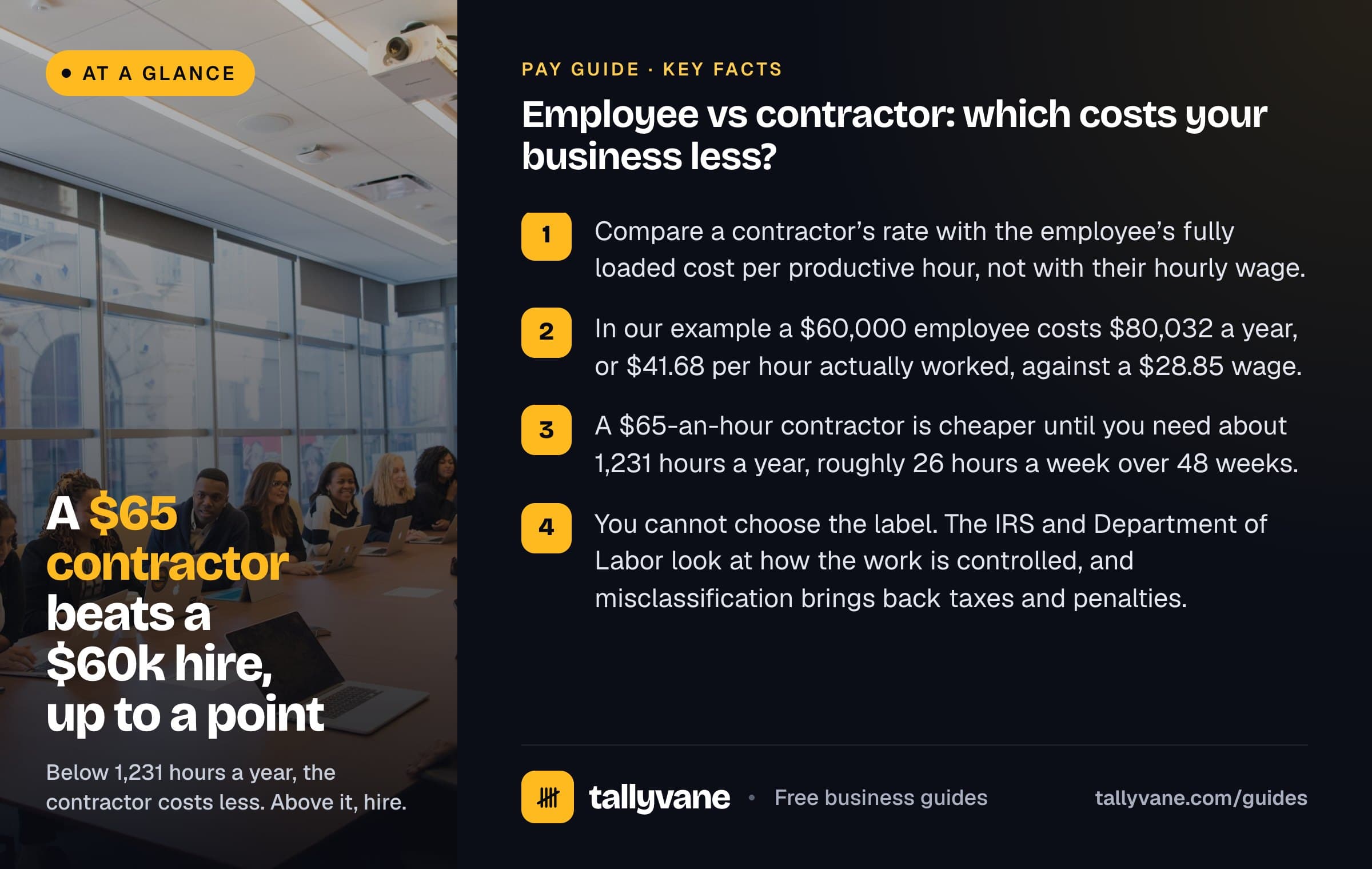
- Compare a contractor’s rate with the employee’s fully loaded cost per productive hour, not with their hourly wage.
- In our example a $60,000 employee costs $80,032 a year, or $41.68 per hour actually worked, against a $28.85 wage.
- A $65-an-hour contractor is cheaper until you need about 1,231 hours a year, roughly 26 hours a week over 48 weeks.
- You cannot choose the label. The IRS and Department of Labor look at how the work is controlled, and misclassification brings back taxes and penalties.
Why the hourly rates are not comparable
A contractor quoting $65 an hour can look expensive next to an employee paid $28.85 an hour ($60,000 ÷ 2,080). That comparison leaves out most of what the employee costs and most of what the contractor’s rate pays for.
On top of an employee’s wage you pay employer payroll taxes, benefits, equipment, recruiting, and paid holidays and leave in which no work gets done. A contractor pays all of that out of their own rate: both halves of Social Security and Medicare through self-employment tax, their own health cover and retirement, their own laptop and software, and the unpaid weeks between clients. Neither number means much until both are put on the same basis: cost per hour of work you actually get.
Step 1: the employee’s fully loaded cost per productive hour
Add up everything the employee costs in a year, then divide by the hours they actually work, after holidays and paid time off. The employee cost calculator does this: put all your employer taxes into the payroll tax percentage, add benefits, equipment and recruiting, and set the working hours to productive hours rather than 2,080.
For US employers the required taxes are 7.65% of wages for Social Security and Medicare (Social Security only up to $184,500 of wages in 2026), federal unemployment tax of usually $42 per employee a year, and state unemployment tax at your state’s rate. Workers’ compensation insurance is required in most states. For a full breakdown of each cost, see our guide on how much an employee costs.
Fully loaded annual cost = Salary + Employer taxes + Benefits + Equipment + (Recruiting ÷ Expected years) Cost per productive hour = Fully loaded annual cost ÷ Hours actually worked
Free toolEmployee cost calculatorStep 2: what the contractor’s rate has to cover
Before you push a contractor’s rate down, check what it needs to pay for. Suppose a contractor wants $52,000 a year after tax, has $9,000 of business costs including their own health insurance, sets aside 25% for tax, bills 30 hours a week for 46 weeks and adds a 10% buffer. The freelance rate calculator puts their minimum rate at $62.44 an hour.
So $65 an hour is not a premium for a contractor whose take-home is about the same as a $60,000 employee’s. It is roughly what that income costs when someone carries their own taxes, benefits and unbilled time. That is useful in negotiation: an unusually low rate may mean the contractor is not accounting for their costs and may not last.
Revenue needed = (Take-home ÷ (1 − Tax rate) + Business costs) × (1 + Buffer) ($52,000 ÷ 0.75 + $9,000) × 1.10 = $86,166.67 $86,166.67 ÷ (30 hours × 46 weeks) = $62.44 an hour
Free toolFreelance rate calculatorWorked example: hire at $60,000 or use a $65 contractor
A small agency needs help with project work and compares a full-time hire at $60,000 with a contractor at $65 an hour. The state unemployment rate, health cost and other amounts below are assumptions for illustration. The employer tax line combines FICA, FUTA and SUTA, which is 8.22% of salary, the figure to enter in the employee cost calculator.
- Over 2,080 paid hours the employee costs $38.48 an hour.
- After 10 paid holidays and 10 days of leave they work 1,920 hours, so the cost per productive hour is $41.68.
- The contractor at $65 an hour costs $23.32 more per hour worked, but you pay only for hours you use.
| Item | Basis | Annual cost |
|---|---|---|
| Salary | Gross pay | $60,000 |
| Social Security and Medicare | 7.65% × $60,000 | $4,590 |
| FUTA | 0.6% × $7,000 | $42 |
| SUTA | Assumed 3% × $10,000 wage base | $300 |
| Health insurance | Employer share, assumed | $7,200 |
| 401(k) match | 4% × $60,000 | $2,400 |
| Other benefits and workers’ comp | Assumed | $1,000 |
| Equipment and software | Assumed | $2,500 |
| Recruiting | $6,000 ÷ 3 years | $2,000 |
| Total | 1.33 × salary | $80,032 |
The break-even point: how many hours do you need?
Divide the employee’s fully loaded annual cost by the contractor’s rate. Below that many hours of work a year, the contractor is cheaper. Above it, the employee is. In the example, $80,032 ÷ $65 = 1,231 hours, about 26 hours a week over 48 working weeks.
Break-even hours = Employee’s fully loaded annual cost ÷ Contractor’s hourly rate $80,032 ÷ $65 = 1,231 hours a year
| Hours needed a week | Hours a year | Contractor cost | Cheaper option |
|---|---|---|---|
| 10 | 480 | $31,200 | Contractor, by $48,832 |
| 20 | 960 | $62,400 | Contractor, by $17,632 |
| 30 | 1,440 | $93,600 | Employee, by $13,568 |
| 40 | 1,920 | $124,800 | Employee, by $44,768 |

Costs the spreadsheet misses
Money is only part of the decision. Some costs and benefits do not show up in an hourly rate.
- Speed: a contractor can usually start within days and stop when the project ends, with no recruiting fee or severance.
- Idle time: an employee is paid through slow weeks; a contractor is not.
- Continuity: an employee builds knowledge of your business and customers. A contractor may move on, and you pay again to brief the next one.
- Admin: employees need payroll, tax deposits and quarterly returns. Contractors need a W-9 up front and a Form 1099-NEC if you pay them $2,000 or more in a year.
- Control: you can direct how an employee works. With a contractor you agree the result, not the method, which is also the legal line between the two.
You do not get to pick the label: IRS and DOL rules
The IRS uses the common-law control test. A worker is an employee if you have the right to control what is done and how it is done, even if you rarely use that right. The IRS groups the evidence into three areas: behavioral control (instructions, training, how the work is done), financial control (who pays expenses, can the worker make a profit or loss, do they work for others) and the relationship (contracts, benefits, how permanent the work is). No single factor decides it, and calling someone a contractor in a contract does not settle it. If you are unsure, either side can ask the IRS to decide using Form SS-8.
The Department of Labor applies its own economic-reality test for minimum wage and overtime under the Fair Labor Standards Act. Its current rule dates from 2024. In May 2025 the DOL said it would stop applying that analysis in its own investigations, and in February 2026 it proposed replacing it with a test centered on two core factors: control over the work and the worker’s opportunity for profit or loss. As of November 2026 that proposal has not been made final, so check the DOL website before relying on either version. Many states, including California, use a stricter test of their own.
Getting it wrong is expensive. Misclassified workers can be owed back overtime and minimum wage, and the IRS can assess the employment taxes you should have paid, with penalties and interest. If you have treated workers as contractors and want to correct it, the IRS Voluntary Classification Settlement Program lets you reclassify them going forward and pay 10% of one year’s employment tax liability, worked out at reduced rates, if you qualify.