
Key takeaways
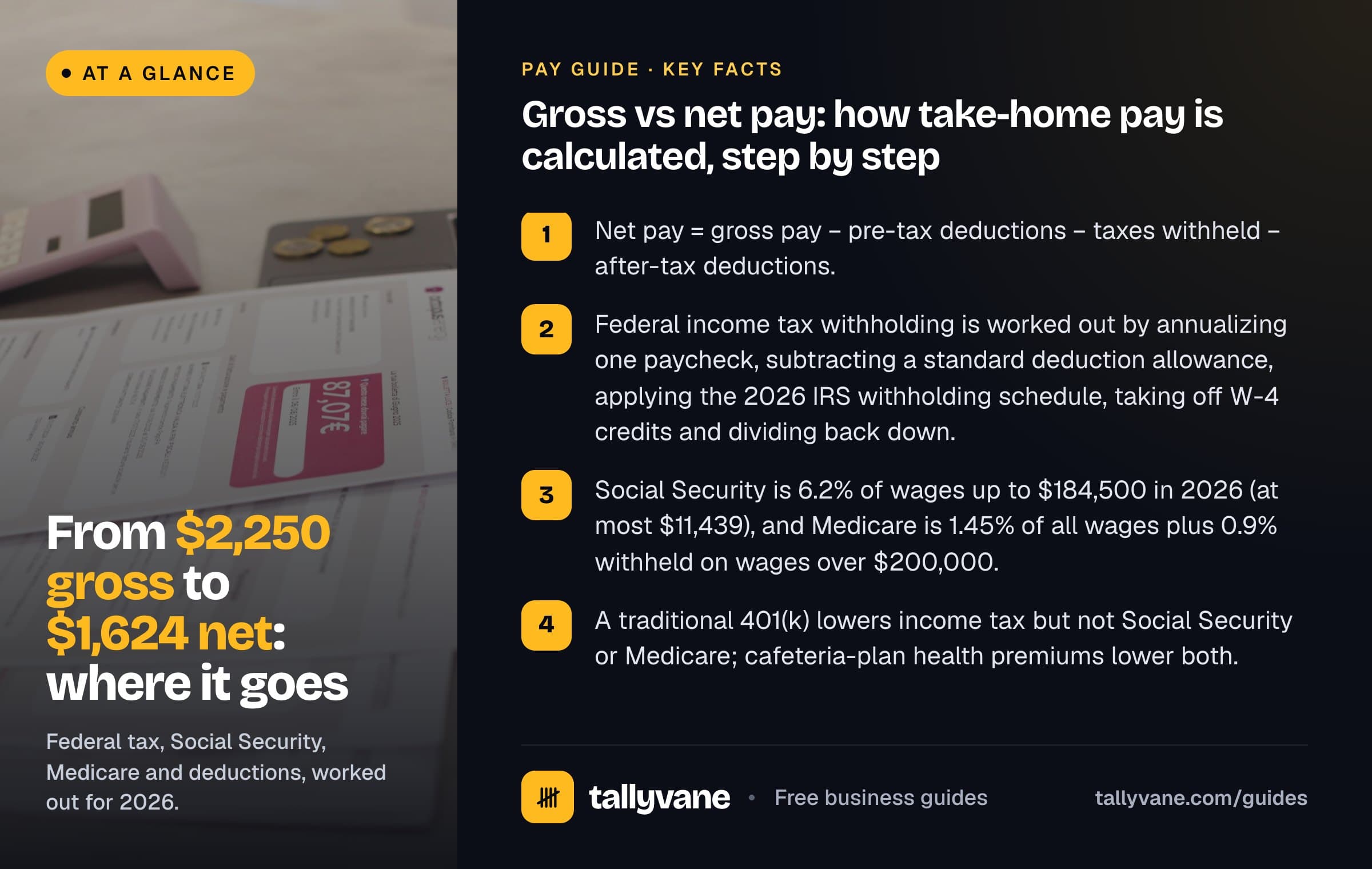
- Net pay = gross pay − pre-tax deductions − taxes withheld − after-tax deductions.
- Federal income tax withholding is worked out by annualizing one paycheck, subtracting a standard deduction allowance, applying the 2026 IRS withholding schedule, taking off W-4 credits and dividing back down.
- Social Security is 6.2% of wages up to $184,500 in 2026 (at most $11,439), and Medicare is 1.45% of all wages plus 0.9% withheld on wages over $200,000.
- A traditional 401(k) lowers income tax but not Social Security or Medicare; cafeteria-plan health premiums lower both.
- For a single worker on $58,500 in Illinois with a 5% 401(k) and $90 health premiums, a $2,250 biweekly paycheck becomes about $1,624.63.
Gross pay and net pay
Gross pay is everything you earned in the pay period before anything comes out. For a salary, it is the yearly amount divided by the number of paychecks: 52 weekly, 26 biweekly, 24 semimonthly or 12 monthly. For hourly work, it is hours times rate, plus overtime and any bonus or commission paid that period.
Net pay, or take-home pay, is what is left after deductions. The order matters, because pre-tax deductions shrink the wages that some taxes are worked out on. Get the order right and you can rebuild any paycheck by hand.
Net pay = Gross pay − Pre-tax deductions (401(k), Section 125 health premiums, HSA) − Federal income tax − Social Security − Medicare − State and local taxes − After-tax deductions (Roth 401(k), garnishments, union dues)
Step 1: take out pre-tax deductions
Pre-tax deductions come off first, but not every one lowers every tax. A traditional 401(k) or 403(b) deferral is not subject to federal income tax withholding, yet it still counts as wages for Social Security and Medicare. Health, dental and vision premiums paid through a Section 125 cafeteria plan, and HSA contributions made through one, are generally exempt from income tax and from Social Security and Medicare.
That is why a pay stub can show two different taxable wage figures: one for income tax and a higher one for FICA. In 2026 the employee limit for 401(k) deferrals is $24,500, and the HSA limit is $4,400 for self-only cover and $8,750 for family cover.
| Deduction | Federal income tax | Social Security and Medicare |
|---|---|---|
| Traditional 401(k) or 403(b) | Lowers it | No effect |
| Health, dental, vision premiums (Section 125) | Lowers it | Lowers it |
| HSA through a cafeteria plan | Lowers it | Lowers it |
| Roth 401(k) | No effect (after tax) | No effect |
Step 2: federal income tax withholding
Your employer works out federal withholding from your gross pay, pay frequency and Form W-4, using IRS Publication 15-T. Most payroll software uses the percentage method in Worksheet 1A. A small employer doing payroll by hand can also use the wage bracket tables in the same publication, which give nearly the same answer.
The percentage method has four moves. First, multiply this paycheck’s taxable wages by the number of pay periods to get a yearly figure. Add any Step 4(a) other income, subtract any Step 4(b) deductions, and, if the Step 2 box is not checked, subtract $8,600 ($12,900 for married filing jointly). Second, look the result up in the 2026 annual withholding schedule and divide the tax by the number of pay periods. Third, subtract the Step 3 credits divided by the pay periods: $2,200 per child under 17 and $500 per other dependent. Fourth, add any Step 4(c) extra withholding.
The schedule builds in the rest of the standard deduction. For a single filer, the first $7,500 of adjusted wages is taxed at 0%. Add the $8,600 already subtracted and you get the full 2026 standard deduction of $16,100. Checking the Step 2 box switches to a schedule with half the standard deduction and half-width brackets, for people with two jobs or a working spouse.
Adjusted annual wages = Taxable wages per paycheck × Pay periods + Step 4(a) − Step 4(b) − $8,600 Withholding per paycheck = (Schedule tax ÷ Pay periods) − (Step 3 credits ÷ Pay periods) + Step 4(c)
| Adjusted annual wages | Withholding |
|---|---|
| $0 to $7,500 | $0 |
| $7,500 to $19,900 | 10% of the amount over $7,500 |
| $19,900 to $57,900 | $1,240 plus 12% of the amount over $19,900 |
| $57,900 to $113,200 | $5,800 plus 22% of the amount over $57,900 |
| $113,200 to $209,275 | $17,966 plus 24% of the amount over $113,200 |
Step 4: state and local income tax
Nine states do not tax wages: Alaska, Florida, Nevada, New Hampshire, South Dakota, Tennessee, Texas, Washington and Wyoming. The rest tax them either at one flat rate or through brackets, each with its own deductions, exemptions and withholding form. Most follow the federal treatment of 401(k) deferrals, but Pennsylvania taxes them.
Some states add employee payroll contributions for disability or paid family leave, such as California SDI. Some cities and counties also tax wages, including New York City, Philadelphia and many Ohio cities. Your employer withholds for the state where you work and, where they apply, the local taxes.
Step 5: after-tax deductions
After-tax deductions come out last, from pay that has already been taxed. They do not change any tax line on the stub. Common ones are Roth 401(k) contributions, union dues, court-ordered child support and other wage garnishments, voluntary life or disability insurance and charitable giving through payroll.
Worked example: $58,500 salary in Illinois
A single employee in Illinois earns $58,500 a year, paid every two weeks. Gross pay per paycheck is $58,500 ÷ 26 = $2,250. They put 5% into a traditional 401(k) and pay $90 per paycheck for health insurance through a cafeteria plan. Their W-4 has no dependents and nothing in Steps 2 or 4.
Federal taxable wages are $2,250 − $112.50 − $90 = $2,047.50. Annualized that is $53,235. Subtract $8,600 to get adjusted wages of $44,635. The schedule gives $1,240 + 12% × ($44,635 − $19,900) = $4,208.20 a year, or $161.85 per paycheck.
FICA wages are $2,250 − $90 = $2,160, because the 401(k) still counts. Illinois taxes income at a flat 4.95% after a $2,925 exemption: ($53,235 − $2,925) × 4.95% = $2,490.35 a year, or $95.78 per paycheck.
- Taxes take $422.87, or 18.8% of gross pay. The 401(k) and health premium take another $202.50, which is savings and cover, not tax.
- The 5% 401(k) contribution of $112.50 cuts take-home pay by only about $93, because it lowers federal and Illinois income tax.
- The paycheck calculator gives the same lines. It keeps fractions of a cent until the end, so it shows net pay of $1,624.62.
| Line | Working | Amount |
|---|---|---|
| Gross pay | $58,500 ÷ 26 | $2,250.00 |
| 401(k), pre-tax | 5% × $2,250 | −$112.50 |
| Health insurance, Section 125 | Per paycheck | −$90.00 |
| Federal income tax | $4,208.20 ÷ 26 | −$161.85 |
| Social Security | 6.2% × $2,160 | −$133.92 |
| Medicare | 1.45% × $2,160 | −$31.32 |
| Illinois income tax | $2,490.35 ÷ 26 | −$95.78 |
| Net pay | Gross minus all lines above | $1,624.63 |
What a calculator simplifies, and why your stub may differ
Our paycheck calculator follows the Publication 15-T percentage method for federal tax exactly, but it makes some simplifying choices you should know about when you compare it with a real stub.
- It assumes the same pay every period. Real payroll applies the Social Security wage base and the $200,000 Additional Medicare threshold as year-to-date wages cross them, so high earners see Social Security stop late in the year.
- State income tax is an estimate of the yearly tax on your wages, not the state’s own withholding tables, which can withhold a little more or less.
- It has fields for a traditional 401(k) and pre-tax health premiums only. Enter cafeteria-plan HSA contributions in the health field, since they are treated the same way. Roth contributions, garnishments and other after-tax deductions are not included, so subtract them yourself.
- For hourly pay it uses your usual weekly hours and overtime times 52, so a week with different hours gives a different paycheck.
- Withholding is not your final tax. Your return settles it using all your income, deductions and credits. If you expect a big refund or bill, use the IRS Tax Withholding Estimator and give your employer a new W-4.