
Key takeaways
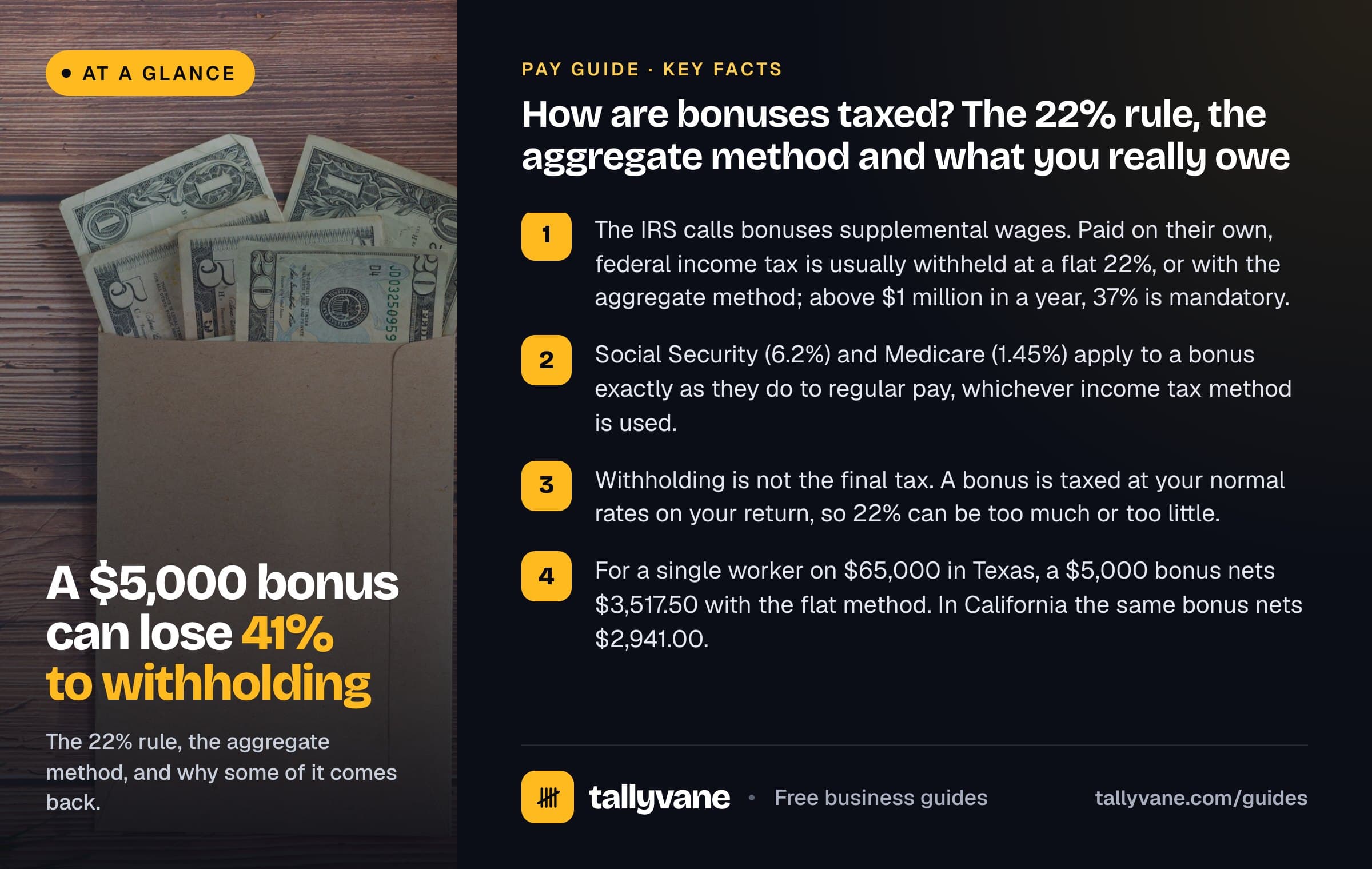
- The IRS calls bonuses supplemental wages. Paid on their own, federal income tax is usually withheld at a flat 22%, or with the aggregate method; above $1 million in a year, 37% is mandatory.
- Social Security (6.2%) and Medicare (1.45%) apply to a bonus exactly as they do to regular pay, whichever income tax method is used.
- Withholding is not the final tax. A bonus is taxed at your normal rates on your return, so 22% can be too much or too little.
- For a single worker on $65,000 in Texas, a $5,000 bonus nets $3,517.50 with the flat method. In California the same bonus nets $2,941.00.
- The 2026 deductions for tips and overtime do not cover ordinary bonuses.
A bonus is a supplemental wage
IRS Publication 15 defines supplemental wages as pay that is not regular wages. Bonuses, commissions, overtime pay, back pay, awards and prizes, and severance all count. They go on your Form W-2 with the rest of your pay and are taxed at the same rates on your return. What differs is how your employer withholds tax from them during the year.
The method depends on how the bonus is paid. If it is added to a normal paycheck and not shown separately, your employer simply withholds on the total as if it were one regular payment. If it is paid on its own, or shown as a separate amount on the same check, your employer can choose between two federal methods: a flat 22%, or the aggregate method.
The flat 22% method
Your employer withholds exactly 22% of the bonus for federal income tax and ignores your Form W-4: no filing status, no dependents, no extra withholding. Publication 15 for 2026 confirms the rate remains 22%, and no other percentage is allowed.
There is one condition. The employer must have withheld income tax from your regular wages in the current or the previous calendar year. If it has not, for example because your W-4 claims so many credits that nothing is withheld, it must use the aggregate method instead.
Once your supplemental wages from one employer pass $1 million in a calendar year, the employer must withhold 37% on the amount over $1 million, whatever your W-4 says.
Federal withholding on a bonus = Bonus × 22% On supplemental wages over $1 million in the year = Excess × 37%
The aggregate method
The aggregate method treats the bonus as part of a paycheck. Your employer adds the bonus to your regular wages for the current or most recent pay period, works out withholding on the total as if it were one normal paycheck, then subtracts the tax already withheld from the regular wages. What is left is withheld from the bonus.
Because the normal withholding method annualizes each paycheck, a large bonus is treated as if you earned it every pay period. That pushes it into higher brackets for the calculation, so the aggregate method can withhold more or less than 22%, depending on your salary and the size of the bonus.
Our paycheck calculator works out a bonus with the flat method: open "Bonus paycheck" and enter the amount. For a rough aggregate figure, enter your regular pay plus the bonus, multiplied by your number of paychecks a year, as the yearly salary. Read only the federal income tax line and subtract the federal tax on a normal paycheck. Ignore its Social Security line for this, because the inflated yearly figure can cross the wage base.
Aggregate withholding on the bonus = Withholding on (regular pay + bonus) as one paycheck − Withholding on regular pay alone
Free toolPaycheck calculatorWorked example: a $5,000 bonus on a $65,000 salary
A single employee in Texas earns $65,000 a year, paid every two weeks, so a normal paycheck is $2,500. Their W-4 has no dependents and nothing in Steps 2 or 4, so federal withholding on a normal paycheck is $216.15. In December they get a $5,000 bonus on a separate check. Texas has no state income tax.
For the aggregate method, the employer works out withholding on $7,500 as one biweekly paycheck. Annualized, that is $195,000, and the 2026 schedule gives $1,366.69 per paycheck. Subtract the $216.15 already withheld on the regular pay and $1,150.54 comes out of the bonus.
To get the flat method column for your own salary, state and bonus, enter the bonus under "Bonus paycheck" in the paycheck calculator. It applies the 22% federal rate, Social Security up to the wage base, Medicare, and the state’s flat bonus rate in California and New York.
- In California, the flat method also takes 10.23% state income tax ($511.50) and 1.3% SDI ($65.00), leaving $2,941.00, or 41.2% withheld.
- In New York, the state supplemental rate of 11.70% adds $585.00 of state withholding, before New York’s own disability and paid family leave deductions.
- That 30% to 41% is withholding, not the tax rate on the bonus.
| Line | Flat 22% method | Aggregate method |
|---|---|---|
| Bonus | $5,000.00 | $5,000.00 |
| Federal income tax | −$1,100.00 | −$1,150.54 |
| Social Security (6.2%) | −$310.00 | −$310.00 |
| Medicare (1.45%) | −$72.50 | −$72.50 |
| Texas income tax | $0.00 | $0.00 |
| Net bonus | $3,517.50 | $3,466.96 |
| Share withheld | 29.7% | 30.7% |
Withholding is not the final tax
On your return, the bonus is simply added to your other income and taxed through the normal brackets. Whatever was withheld counts as a payment towards that tax. If 22% was more than the bonus actually adds to your tax, you get the difference back in your refund. If it was less, you owe it.
Whether 22% is enough depends on your top bracket. For 2026, a single filer with the $16,100 standard deduction reaches the 22% bracket at $50,400 of taxable income and the 24% bracket at $105,700.
- Social Security and the 1.45% Medicare tax withheld are final. The exception is when two or more employers together withheld Social Security on wages above $184,500; you claim the excess back on your return.
- If you expect a large bonus and earn in the 24% bracket or higher, ask for extra withholding on a new W-4 or plan for the bill.
| Salary | Bracket the bonus falls in | Extra tax owed | Withheld at 22% | At filing |
|---|---|---|---|---|
| $40,000 | 12% | $600 | $1,100 | $500 back |
| $65,000 | 12% and 22% | $950 | $1,100 | $150 back |
| $120,000 | 22% and 24% | $1,164 | $1,100 | $64 owed |
| $250,000 | 32% | $1,600 | $1,100 | $500 owed |
Grossing up a bonus to a set net amount
Some employers want the employee to receive a round figure, such as $5,000 in hand. To do that you gross up the bonus: divide the net amount by one minus all the percentage withholdings. This works with the flat method, where every rate is fixed. Leave out Social Security if the employee is already over the wage base, and add any state rates.
In Texas, with 22% federal, 6.2% Social Security and 1.45% Medicare, the rates add up to 29.65%. A $5,000 net bonus needs a gross bonus of $5,000 ÷ 0.7035 = $7,107.32. In California, adding 10.23% and 1.3% SDI brings the total to 41.18%, and the gross bonus to $8,500.51.
Gross bonus = Net bonus ÷ (1 − Federal 22% − 6.2% − 1.45% − State rates)
| Line | Working | Amount |
|---|---|---|
| Gross bonus | $5,000 ÷ 0.7035 | $7,107.32 |
| Federal income tax | 22% × $7,107.32 | −$1,563.61 |
| Social Security | 6.2% × $7,107.32 | −$440.65 |
| Medicare | 1.45% × $7,107.32 | −$103.06 |
| Net bonus | Gross minus the lines above | $5,000.00 |
| Employer FICA on top | 7.65% × $7,107.32 | $543.71 |
What changed for 2026, and what did not
The flat rate stays at 22%, and the $1 million threshold for 37% is unchanged. The bigger news is two new deductions from the One Big Beautiful Bill Act, for 2025 through 2028. Workers can deduct up to $25,000 of qualified tips received in occupations the IRS lists as customarily tipped. They can also deduct up to $12,500 ($25,000 on a joint return) of qualified overtime compensation, which is only the premium the Fair Labor Standards Act requires, the “half” in time and a half. Both phase out above $150,000 of modified adjusted gross income ($300,000 joint).
Ordinary bonuses are neither tips nor overtime premium. A holiday, signing, retention or performance bonus is fully taxable and gets no deduction. Tips and overtime also stay subject to Social Security and Medicare. From 2026, employers report qualified overtime on the W-2 in box 12 with code TT, and bonuses stay in ordinary wages.
Bonuses still affect overtime. A non-discretionary bonus, such as one promised for hitting a target, must be included in an hourly worker’s regular rate, which raises the overtime owed.
Free toolOvertime pay calculator


Social Security, Medicare and state tax on a bonus
Social Security and Medicare apply to a bonus in full, whichever income tax method is used. Social Security is 6.2% until your wages for the year reach the 2026 wage base of $184,500; a bonus that takes you past it is taxed only on the part below. Medicare is 1.45% with no cap, and your employer withholds an extra 0.9% on wages over $200,000 in the year.
Your employer pays its own 6.2% and 1.45% on top, and federal and state unemployment tax up to their wage bases. A $5,000 bonus costs the employer at least $5,382.50, before unemployment tax.
States set their own rules. California’s Employment Development Department sets a flat 10.23% for bonuses and stock options and 6.6% for other supplemental wages, or the employer can use an aggregate method. New York’s 2026 withholding tables (NYS-50-T-NYS) set 11.70%, again with an aggregate option. States with no income tax on wages, such as Texas and Florida, withhold none. For any other state, check the state revenue department’s employer withholding guide.
Free toolEmployee cost calculatorFind the true yearly, monthly and hourly cost of an employee, including payroll taxes, benefits, equipment and hiring.