Key takeaways
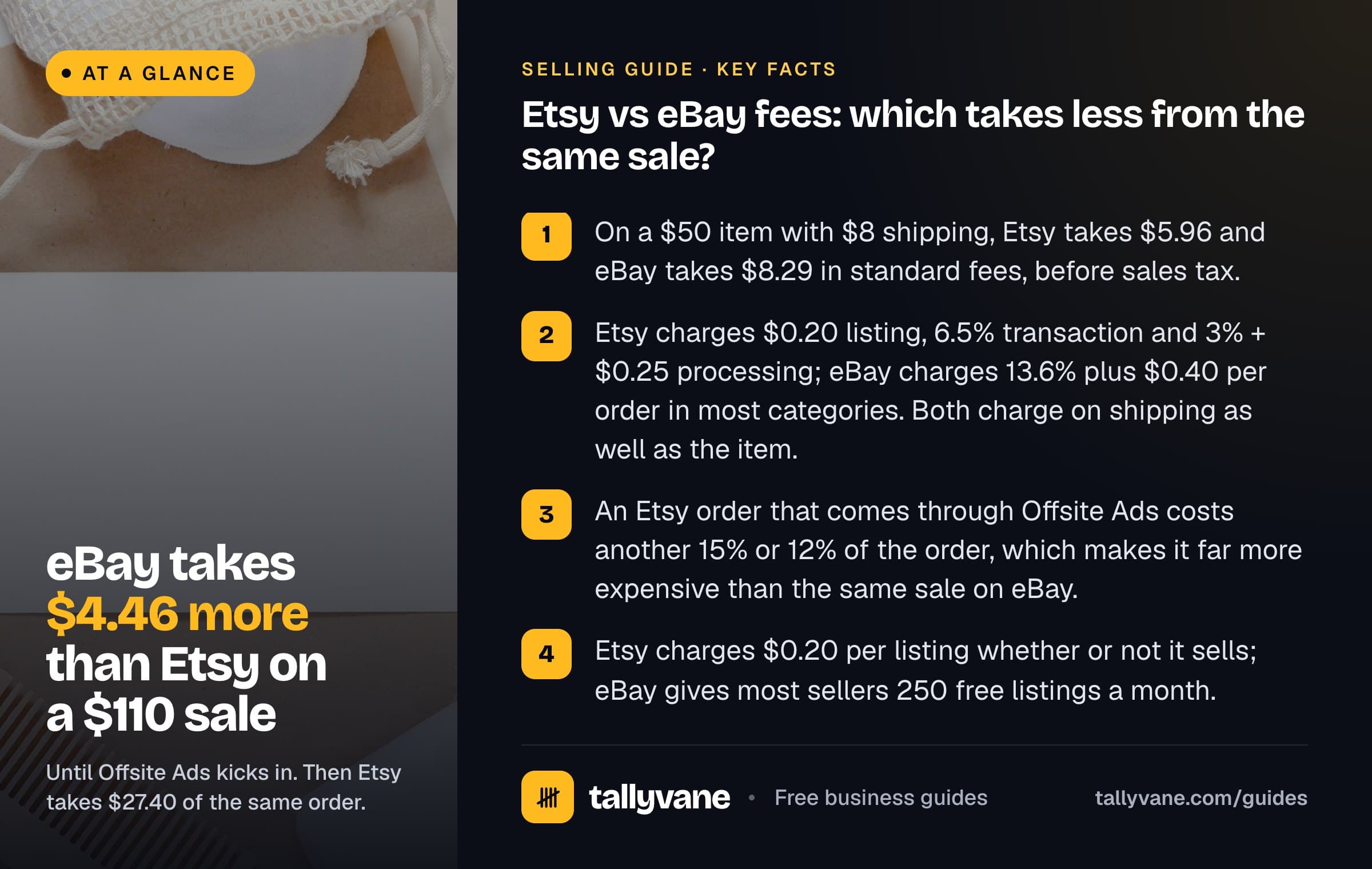
- On a $50 item with $8 shipping, Etsy takes $5.96 and eBay takes $8.29 in standard fees, before sales tax.
- Etsy charges $0.20 listing, 6.5% transaction and 3% + $0.25 processing; eBay charges 13.6% plus $0.40 per order in most categories. Both charge on shipping as well as the item.
- An Etsy order that comes through Offsite Ads costs another 15% or 12% of the order, which makes it far more expensive than the same sale on eBay.
- Etsy charges $0.20 per listing whether or not it sells; eBay gives most sellers 250 free listings a month.
- Etsy only allows items you make or design, vintage items at least 20 years old, and craft supplies, so for most resold goods eBay is the choice anyway.
The fees side by side
Both marketplaces take their fees out of your payout automatically, and both charge on the whole order: the item price plus the shipping the buyer pays. The difference is in how the fee is built. Etsy splits it into a small fixed listing fee, a 6.5% transaction fee and a payment processing fee. eBay rolls most of it into one final value fee of 13.6% in most categories, plus a small per-order fee.
Here is the same sale on each: a $50 item with $8 shipping, a $58 order from a US seller, with no ads and sales tax left out. The marketplace fee comparison starts without tax too; enter the buyer’s sales tax rate there to see how it changes each marketplace’s fees.
| Fee | Etsy | eBay (most categories, no Store) |
|---|---|---|
| Listing or insertion fee | $0.20 | $0.00 (within 250 free listings) |
| Percentage fee | 6.5% transaction = $3.77 | 13.6% final value fee = $7.89 |
| Payment processing | 3% + $0.25 = $1.99 | Included in the final value fee |
| Per-order fee | None | $0.40 |
| Total fees | $5.96 (10.3%) | $8.29 (14.3%) |
How each fee is worked out
On Etsy, the listing fee is US$0.20 and lasts four months or until the item sells. When a listing with more stock sells, it renews and you pay another $0.20, so each item sold carries one listing fee. The transaction fee is 6.5% of the order total including shipping and gift wrap. US payment processing is 3% of the order plus $0.25, and Etsy works the 3% out on the total including any sales tax.
On eBay, the final value fee in most categories is 13.6% of the total amount of the sale up to $7,500, and 2.35% on any part above that. The total amount of the sale includes the item, handling, shipping and the sales tax eBay collects. The per-order fee is $0.40, or $0.30 when the order is $10 or less.
Sales tax nudges both up, eBay more than Etsy, because eBay charges its full rate on the tax and Etsy only charges processing on it. On the $58 order with 7% sales tax ($4.06), Etsy’s fees rise to $6.08 and eBay’s to $8.84. Enter the tax rate in the Etsy or eBay calculator to check your own orders.
Etsy fees = $0.20 × Items + Order total × 6.5% + Order total × 3% + $0.25 eBay fees = Total sale × 13.6% (up to $7,500) + $0.40 per order ($0.30 if $10 or less)
Free toolEtsy fee calculatorWorked example: the same sale at five price points
The table runs the same comparison from a cheap sticker to a $1,000 piece of furniture, one item per order, standard fees only, no ads and no sales tax. eBay uses the most-categories rate for a seller without a Store.
- On standard fees, Etsy is cheaper at every price above a few dollars, and the gap grows with the order: about 4 percentage points of the order.
- Small orders lose the biggest share on both, because Etsy’s $0.45 of fixed fees and eBay’s $0.30 or $0.40 weigh more on a few dollars.
- A Basic eBay Store lowers the final value fee to 12.7% in most categories, which narrows the gap but does not close it.
| Order (item + shipping) | Etsy fees | eBay fees | eBay costs more by |
|---|---|---|---|
| $8 + free shipping = $8 | $1.21 (15.1%) | $1.39 (17.4%) | $0.18 |
| $25 + $5 = $30 | $3.30 (11.0%) | $4.48 (14.9%) | $1.18 |
| $50 + $8 = $58 | $5.96 (10.3%) | $8.29 (14.3%) | $2.33 |
| $100 + $10 = $110 | $10.90 (9.9%) | $15.36 (14.0%) | $4.46 |
| $250 + $15 = $265 | $25.63 (9.7%) | $36.44 (13.8%) | $10.81 |
| $1,000 + free shipping = $1,000 | $95.45 (9.5%) | $136.40 (13.6%) | $40.95 |
Offsite Ads and Promoted Listings: where Etsy can cost more
The table above is only the standard fees. Etsy advertises listings on other websites, and if a buyer clicks one of those ads and buys within 30 days, the order carries an Offsite Ads fee of 15% of the order. Shops with US$10,000 or more in sales over the past 365 days pay 12% and cannot opt out; smaller shops can opt out. The fee is capped at US$100 per order.
eBay’s nearest equivalent, Promoted Listings General, is optional. You pick the ad rate, from 2%, and pay it only when an item sells after a click on your ad. The ad fee is charged on the total sale, like the final value fee.
On a $100 item with $10 shipping, an Etsy Offsite Ads order at 15% costs $27.40 in fees. The same order on eBay costs $15.36 with no ad, or $19.76 with a 4% Promoted Listing. So the honest comparison depends on how many of your Etsy orders come through Offsite Ads. Your Etsy payment account shows each Offsite Ads fee, so you can work out the share.
| Scenario | Fees | Share of order |
|---|---|---|
| Etsy, standard | $10.90 | 9.9% |
| Etsy, Offsite Ads at 12% | $24.10 | 21.9% |
| Etsy, Offsite Ads at 15% | $27.40 | 24.9% |
| eBay, standard | $15.36 | 14.0% |
| eBay, 4% Promoted Listing | $19.76 | 18.0% |
Listing fees and items that do not sell
Etsy charges $0.20 for every listing you publish, whether it sells or not. If you have set listings to auto-renew, an unsold listing renews every four months for another $0.20. A shop with 100 slow-moving listings on auto-renew pays $60 a year in listing fees before it sells anything.
eBay gives most sellers 250 zero insertion fee listings a month. Beyond that, each listing costs $0.35, also charged whether or not it sells. For a shop with a few hundred listings or fewer, eBay listings are usually free, which suits sellers with a large, slow-moving stock of one-off items.
Category rates and what each site allows
eBay’s rate depends on the category. Books, movies and music pay 15.3%, trading cards and coins 13.25%, and guitars and basses only 6.7%. A $600 guitar with $40 shipping costs $43.28 in eBay fees, against $61.25 on Etsy. Handbags, jewelry and watches pay 15% at lower prices, so check the category before you compare.
Etsy charges the same rates in every category, but it limits what you can sell. Its house rules allow items you make or design, vintage items at least 20 years old, and craft supplies. New branded goods, used clothing under 20 years old and most other resale stock belong on eBay or another marketplace, whatever the fees.
Free tooleBay fee calculatorWhich is cheaper for which seller
There is no single winner. Use these as starting points, then check your own numbers with real prices, postage and your share of advertised orders.
- Handmade and print-on-demand sellers: Etsy usually costs less per sale, as long as Offsite Ads orders are a small share. Price so an Offsite Ads order still makes a profit.
- Vintage sellers with large, slow-moving stock: eBay’s free listings can beat Etsy’s $0.20 renewals, even though eBay’s rate per sale is higher.
- Resellers of new or used branded goods: eBay, because Etsy does not allow most of it.
- Guitars and basses: eBay’s 6.7% rate beats Etsy’s roughly 9.5% to 10% on every sale.
- Books and media: Etsy is cheaper if your items qualify as vintage or handmade; otherwise eBay at 15.3%.
- High-volume eBay sellers: a Store cuts the rate to 12.7% in most categories, which can pay for itself, but Etsy’s standard fees are still lower.