
Key takeaways
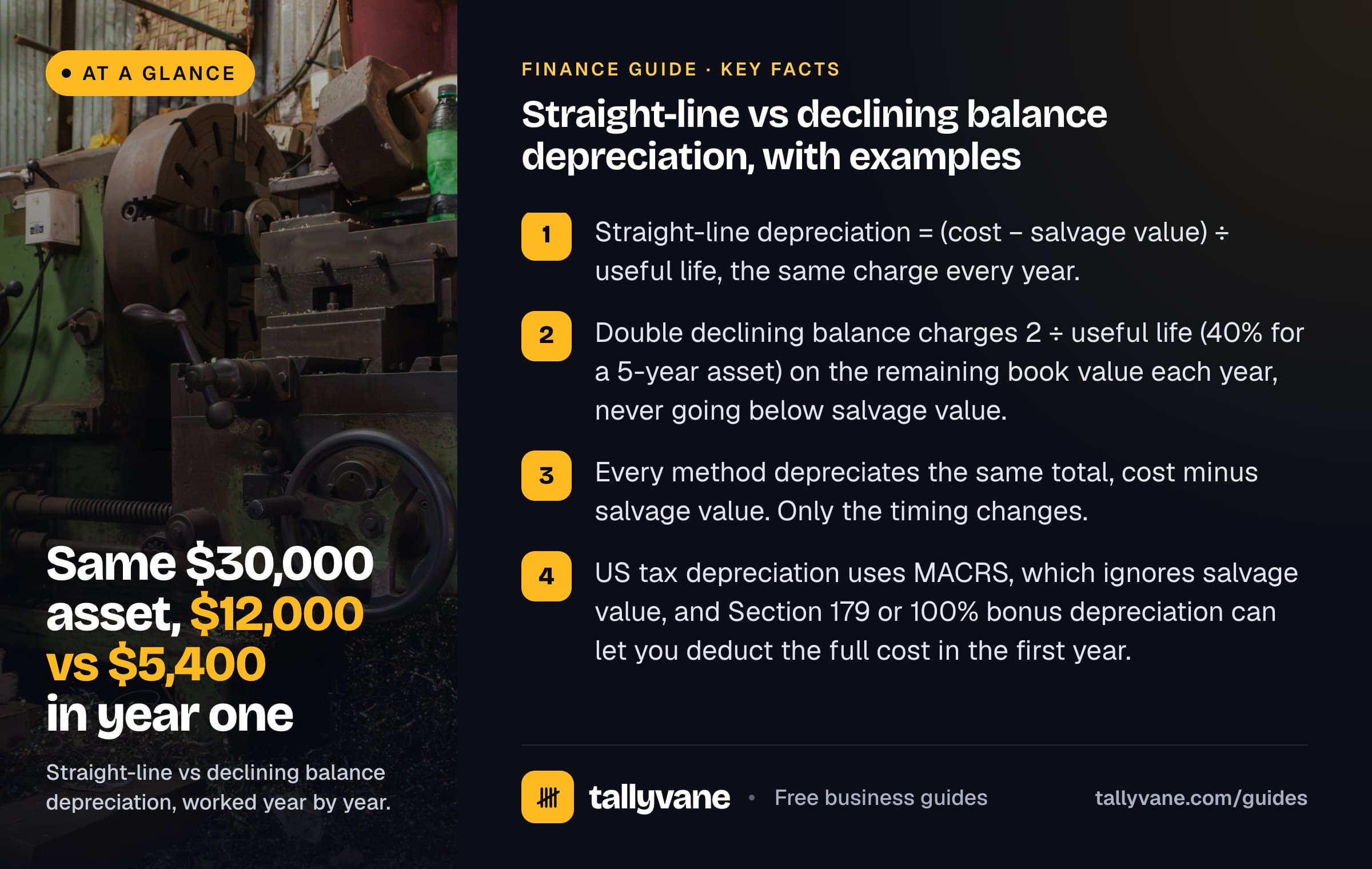
- Straight-line depreciation = (cost − salvage value) ÷ useful life, the same charge every year.
- Double declining balance charges 2 ÷ useful life (40% for a 5-year asset) on the remaining book value each year, never going below salvage value.
- Every method depreciates the same total, cost minus salvage value. Only the timing changes.
- US tax depreciation uses MACRS, which ignores salvage value, and Section 179 or 100% bonus depreciation can let you deduct the full cost in the first year.
The three numbers every method needs
Depreciation turns a large purchase into a yearly expense on your profit and loss statement, so one big year of buying equipment does not make the business look like it lost money. To work it out you need three figures.
- Cost: the purchase price plus delivery, installation and anything needed to get the asset working. Sales tax you paid on it is usually part of the cost.
- Salvage value: what you expect to sell or scrap the asset for when you stop using it. Use 0 if it will be worth nothing.
- Useful life: how many years you expect to use it in the business. Base it on experience, the maker’s guidance or how often you replace similar assets, not on a tax table.
Straight-line depreciation formula
Straight-line spreads the depreciable amount, cost minus salvage value, evenly over the useful life. It is the simplest method and the most common in small business accounts. It suits assets that wear out at a steady pace, such as furniture, shelving and shop fittings.
A $30,000 asset with a $3,000 salvage value and a 5-year life depreciates by $27,000 ÷ 5 = $5,400 a year. That is 18% of the cost each year, and the book value falls by the same amount every year until it reaches $3,000.
Annual depreciation = (Cost − Salvage value) ÷ Useful life Book value = Cost − Accumulated depreciation
Declining balance and double declining balance
Declining balance charges a fixed percentage of the book value left at the start of each year. Because the book value shrinks, so does the charge. The rate is a multiple of the straight-line rate: 2× is double declining balance, and 1.5× is the 150% method. For a 5-year life, the straight-line rate is 1 ÷ 5 = 20%, so double declining uses 40% and the 150% method uses 30%.
Salvage value works differently here. You do not subtract it before applying the rate, but the book value is never allowed to fall below it. The method also never reaches salvage value on its own, so the final year takes whatever depreciation is left.
Many businesses switch to straight-line on the remaining depreciable amount in the first year that straight-line gives a larger charge. With a low salvage value, that switch is what stops the later years from dwindling to almost nothing. Our calculator can apply the switch for you and marks the year it happens.
Rate = Multiple ÷ Useful life (2 for double declining, 1.5 for 150%) Depreciation = Opening book value × Rate Capped so book value never falls below salvage value
Free toolDepreciation calculatorSum-of-the-years’-digits
This third method is also front-loaded, but less steeply than double declining. Add the digits of the useful life: for 5 years, 1 + 2 + 3 + 4 + 5 = 15. Each year, multiply the depreciable amount by the years remaining divided by that sum, so 5/15 in year one, 4/15 in year two, and so on down to 1/15.
Unlike declining balance, it starts from cost minus salvage, so it lands exactly on the salvage value without any capping.
Sum of digits = n × (n + 1) ÷ 2 Depreciation in year y = (Cost − Salvage) × (n − y + 1) ÷ Sum of digits
Worked example: $30,000 of studio equipment
A design studio buys computers, a server and a large-format printer for $30,000 including setup. It expects to sell the lot for $3,000 after 5 years. Here is each year’s depreciation under the three methods our calculator supports, with the book value at the end of each year.
- Double declining charges $12,000 in year one, more than twice the straight-line figure, because 40% applies to the full $30,000.
- In year 5, 40% of $3,888 would be $1,555.20, which would take the book value below $3,000. The charge is capped at $888.
- The switch to straight-line never triggers here: in year 4, straight-line on what is left would be ($6,480 − $3,000) ÷ 2 = $1,740, less than $2,592.
- At 150% declining balance the charges are $9,000, $6,300 and $4,410, then the method switches to straight-line for $3,645 in each of years 4 and 5.
- All three methods depreciate exactly $27,000. They only move expense between years.
| Year | Straight-line | Book value (SL) | Double declining (40%) | Book value (DDB) | Sum of years’ digits |
|---|---|---|---|---|---|
| 1 | $5,400 | $24,600 | $12,000 | $18,000 | $9,000 |
| 2 | $5,400 | $19,200 | $7,200 | $10,800 | $7,200 |
| 3 | $5,400 | $13,800 | $4,320 | $6,480 | $5,400 |
| 4 | $5,400 | $8,400 | $2,592 | $3,888 | $3,600 |
| 5 | $5,400 | $3,000 | $888 | $3,000 | $1,800 |
| Total | $27,000 | $27,000 | $27,000 |

Which method should a small business use?
Straight-line is the default choice for most small businesses. It is easy to work out, easy to explain to a lender, and gives a steady expense line on your P&L. Accelerated methods make more sense when an asset loses most of its value or usefulness early on.
- Use straight-line for furniture, fit-outs, shelving and other assets that wear evenly.
- Consider double declining balance for computers, phones, vehicles and machinery that lose value fast or need more repairs as they age.
- Pick one method for each type of asset and stick with it. Switching back and forth makes your accounts hard to compare from year to year.
- Remember that a front-loaded method lowers reported profit in the early years. That can matter if a lender looks at your profit when you apply for finance.
How tax depreciation differs in the US
The methods above are book methods for your own accounts. For a US tax return, most business property placed in service after 1986 must use the Modified Accelerated Cost Recovery System (MACRS). MACRS sets the recovery period by type of asset, not by your own estimate: computers, cars and light trucks are 5-year property, and office furniture and fixtures are 7-year property. It also ignores salvage value, so the full cost is recovered.
For 5-year and 7-year property the default MACRS method is 200% declining balance, switching to straight-line when that gives an equal or larger deduction, with a half-year convention that treats the asset as placed in service halfway through the first year. The mid-quarter convention applies instead if more than 40% of the year’s purchases were placed in service in the last three months.
Two rules can move the whole deduction into the first year. Section 179 lets you choose to expense qualifying property up to a yearly limit: for tax years beginning in 2026 the limit is $2,560,000, reduced dollar for dollar once you place more than $4,090,000 of qualifying property in service, and the deduction cannot exceed your taxable business income. Separately, the One, Big, Beautiful Bill made 100% bonus depreciation permanent for qualified property acquired after January 19, 2025.
- The studio’s $30,000 of 5-year equipment under MACRS, with no Section 179 or bonus, would give tax deductions of $6,000, $9,600, $5,760, $3,456, $3,456 and $1,728 over six tax years, using the IRS table rates of 20%, 32%, 19.2%, 11.52%, 11.52% and 5.76%.
- With 100% bonus depreciation or Section 179, the studio could deduct the full $30,000 on its 2026 return while its own accounts still show $5,400 a year.
- Keeping two sets of figures is normal. Your book schedule shows how the business is really doing; your tax schedule follows IRS Form 4562. Check the details with a tax professional before you file.