Key takeaways
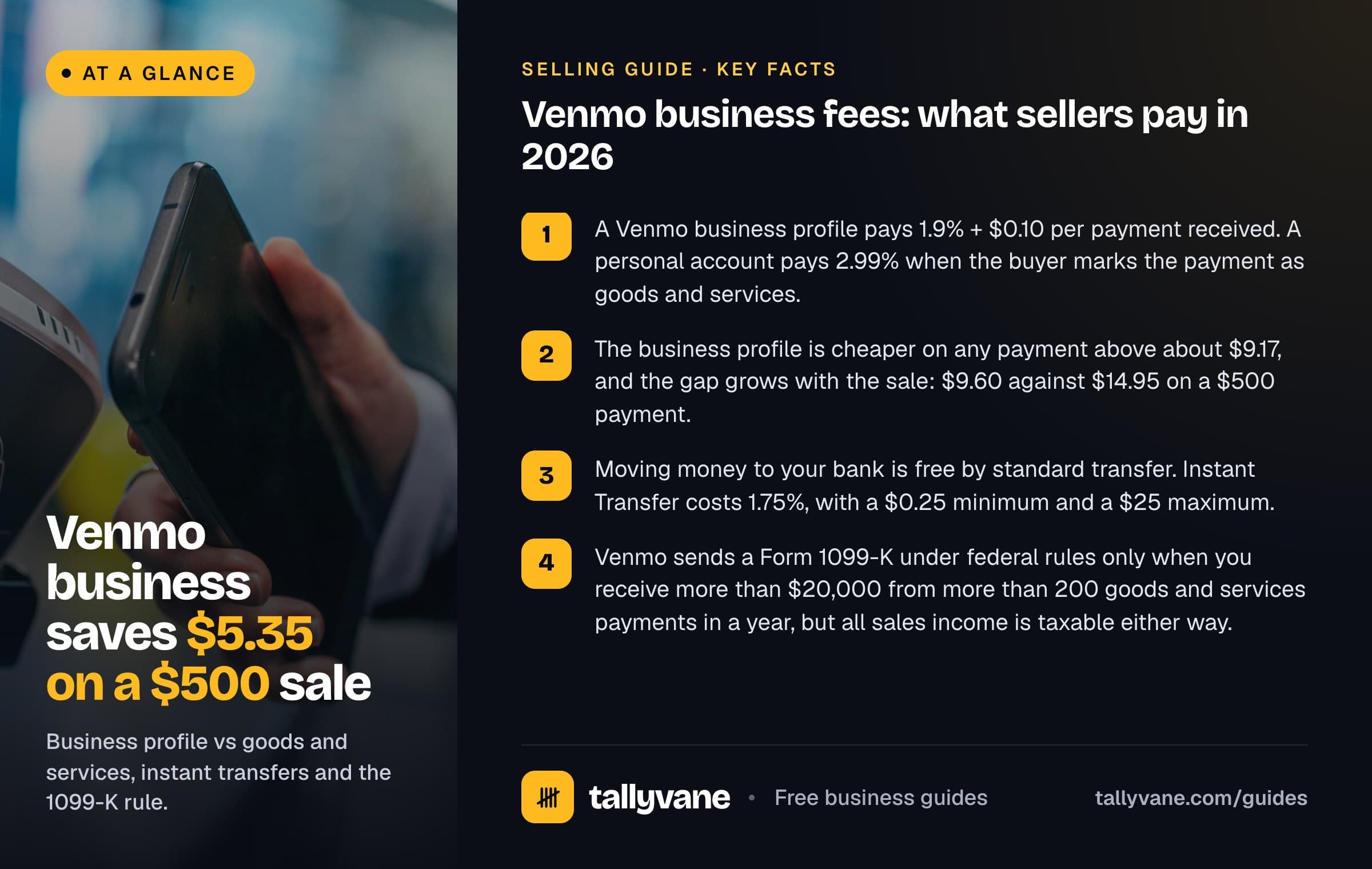
- A Venmo business profile pays 1.9% + $0.10 per payment received. A personal account pays 2.99% when the buyer marks the payment as goods and services.
- The business profile is cheaper on any payment above about $9.17, and the gap grows with the sale: $9.60 against $14.95 on a $500 payment.
- Moving money to your bank is free by standard transfer. Instant Transfer costs 1.75%, with a $0.25 minimum and a $25 maximum.
- Venmo sends a Form 1099-K under federal rules only when you receive more than $20,000 from more than 200 goods and services payments in a year, but all sales income is taxable either way.
The two ways Venmo charges sellers
Venmo has one fee for getting paid and another for getting your money out. The first depends on the kind of account that receives the payment. The second depends only on how fast you want the money.
Payments between friends funded from a Venmo balance, bank account or debit card are free to send and free to receive. Fees start when a payment is for something you sold. Venmo expects those payments to arrive either at a business profile or, on a personal account, marked by the buyer as goods and services.
All rates in this guide are from Venmo’s fees page and help center as checked in November 2026. Venmo can change them, and the fee your app shows on a payment is the one that applies.
- Business profile: 1.9% + $0.10 per payment received.
- Business profile, Tap to Pay in person: 2.29% + $0.09 per payment on Venmo’s fees page.
- Personal account, goods and services payment: 2.99% of the payment, no fixed fee.
- Standard transfer to your bank: free, usually 1 to 3 business days.
- Instant Transfer: 1.75% of the amount, minimum $0.25, maximum $25.
Business profile vs goods and services on a personal account
A business profile is a separate profile linked to your Venmo account. Customers can find it in the app, pay it by scanning your QR code, and leave tips, and you can refund them from the app. Venmo recommends one if you sell regularly. Its seller fee is 1.9% + $0.10 on each payment. Venmo’s help center says the fee applies to payments of $1.00 or more.
On a personal account, a buyer can switch on the purchase option when paying you. That makes it a goods and services payment, and Venmo takes 2.99% from what you receive. Once the sender has marked a payment that way, it cannot be changed to a friends payment.
The $0.10 fixed part of the business fee makes it slightly dearer only on very small payments. Below about $9.17 the 2.99% rate costs less; above it, the business profile always wins. There is also a buyer-side difference: Venmo charges a sender 3% to send money with a credit card, but its help center says buyers paying a business profile by credit card are exempt.
Goods and services fee = Payment × 2.99% Business profile fee = Payment × 1.9% + $0.10 Break-even payment = $0.10 ÷ (2.99% − 1.9%) = about $9.17
Free toolVenmo fee calculatorWorked example: fees on single payments
Here is what each option costs on four payment sizes. Venmo rounds each fee to the cent.
- At $8 the personal account is a cent cheaper. From $20 up the business profile costs less every time.
- On a $500 payment the business profile saves $5.35, more than a third of the goods and services fee.
- Tap to Pay sits between the two. You pay a little more than a normal business payment for taking a card or phone in person.
| Payment | Personal, goods and services (2.99%) | Business profile (1.9% + $0.10) | Tap to Pay (2.29% + $0.09) |
|---|---|---|---|
| $8 | $0.24 | $0.25 | $0.27 |
| $20 | $0.60 | $0.48 | $0.55 |
| $100 | $2.99 | $2.00 | $2.38 |
| $500 | $14.95 | $9.60 | $11.54 |
Worked example: a month of sales
A home baker takes 50 orders a month at $60 each through Venmo, $3,000 in all. Working from monthly totals, the fees compare like this.
- The business profile saves $27.70 a month, or $332.40 a year, on the same sales.
- Instant Transfer is capped at $25, so one large instant transfer a month costs far less than many small ones. Transferring $100 instantly each day for a month costs $1.75 a time, or $52.50 over 30 days.
- Paying no transfer fee at all only means waiting 1 to 3 business days for a standard transfer.
| Item | Personal, goods and services | Business profile |
|---|---|---|
| Sales received | $3,000.00 | $3,000.00 |
| Seller fees | $89.70 (2.99% × $3,000) | $62.00 ($57.00 + 50 × $0.10) |
| Balance after fees | $2,910.30 | $2,938.00 |
| Instant Transfer of the whole balance once | $25.00 (cap) | $25.00 (cap) |
| Standard transfer instead | $0.00 | $0.00 |
| Kept with a standard transfer | $2,910.30 | $2,938.00 |
Instant Transfer: when the fee is worth it
Instant Transfer sends your Venmo balance to an eligible bank account or debit card much faster than a standard transfer. The fee is 1.75% of the amount, never less than $0.25 and never more than $25. The cap kicks in at about $1,428.57, so a $2,000 transfer costs $25, which is 1.25%, and you receive $1,975.
Small transfers pay more than 1.75% because of the minimum. An instant transfer of $10 costs $0.25, or 2.5%. If you cash out instantly after every sale, the transfer fee can cost you nearly as much as the seller fee.
Most sellers are better off letting the balance build and using a free standard transfer on a set day each week. Keep Instant Transfer for the times you need cash today, such as paying a supplier.
Instant Transfer fee = Amount × 1.75%, no less than $0.25 and no more than $25
Tap to Pay, QR codes and purchase protection
Venmo gives business profiles two ways to get paid in person. A customer with Venmo can scan your QR code and pay from the app, at the normal business rate of 1.9% + $0.10. With Tap to Pay, your phone works as a card reader and accepts contactless cards and digital wallets from customers who do not use Venmo. Venmo’s fees page lists Tap to Pay at 2.29% + $0.09, but other Venmo pages show 2.29% + $0.10 and 2.9% + $0.09, so check the rate in your app before you rely on it.
Purchase protection is the reason buyers may ask you to accept goods and services rather than a friends payment. Venmo says it covers eligible payments to business profiles and payments the buyer marks as a purchase. An eligible buyer whose order never arrives, or arrives damaged, wrong or with parts missing, can claim a refund of the price plus the original shipping.
Sellers get protection too, against unauthorized payments and false item-not-received claims, if the sale meets Venmo’s rules and you can prove the order was fulfilled. Ship to the buyer’s address and keep tracking or proof of delivery. Venmo’s protection pages describe payments in the app, QR code payments and the Venmo Debit Card; they do not mention Tap to Pay card payments, so treat those like any other card sale.
Asking a buyer to pay as friends to dodge the fee removes protection for both of you and breaks Venmo’s rules for sales. Venmo also keeps the seller fee if you refund a goods and services or business payment.
The 1099-K threshold and your taxes
Payment apps report sales to the IRS on Form 1099-K. The One, Big, Beautiful Bill, signed in July 2025, put back the old federal threshold, and the IRS says it applies retroactively. A payment app has to send a 1099-K only if your goods and services payments in a calendar year total more than $20,000 and number more than 200. That is the rule for 2026.
Both conditions must be met. A seller who receives $22,000 from 180 sales would not get a federal 1099-K. Venmo may still issue one below the threshold, and some states set lower thresholds of their own, which Venmo follows.
None of this changes what you owe. The IRS says all income is taxable whether or not you get a form, so record every sale. Friends payments for splitting a bill are not reported and are not income. Venmo seller and transfer fees are a business expense you can deduct.
Federal 1099-K required = Payments over $20,000 AND more than 200 transactions in the year
Free toolSelf-employment tax calculatorHow Venmo compares with card processors
A Venmo business profile at 1.9% + $0.10 is cheaper than most card processors for customers who already use Venmo. Standard online card processing is typically around 2.9% + $0.30. The catch is reach: only Venmo users can pay you through the app, so most businesses still need a card processor alongside it.
To compare Venmo with PayPal, Stripe and Square on your own payment sizes, use the payment fee calculator.
Free toolPayment fee calculator