Key takeaways
- Count what you own at close of business on the last day of your tax year, usually 31 December, and freeze receiving and shipping while you do it.
- Include goods you own that are still in transit; leave out goods you hold for someone else on consignment.
- Value stock at cost, not selling price. Damaged or out-of-date stock goes in at what you can actually sell it for, less the cost of selling it.
- Every dollar of closing stock you overstate cuts cost of goods sold by a dollar and adds a dollar to taxable profit.
- Compare the count with your records. The gap is shrinkage, and it tells you how much stock went missing during the year.
Why the year-end count matters
If you sell physical products, your profit for the year depends on how much stock you had left at the end of it. Cost of goods sold is worked out as opening stock plus purchases, minus closing stock. A sloppy count means a wrong profit on your accounts and tax return.
The IRS expects you to take a physical inventory at reasonable intervals, even if you keep running stock records in software, and to adjust your book figures to agree with what you actually find. For most small sellers, the year-end count is that check.
This guide covers counting and valuing. For the COGS formula itself, see our guide to calculating COGS.
Step 1: set the cut-off date and freeze movement
Count at close of business on the last day of your tax year. For most sole proprietors and small companies that is 31 December. If you cannot count on the day itself, count as close to it as you can and adjust for every sale and delivery between the count and the year end.
Cut-off is the line that decides which year each transaction belongs to. Anything that arrives after cut-off is next year’s purchase. Anything that ships to a customer before cut-off is this year’s sale and must not be counted.
- Stop receiving deliveries during the count, or put them in a marked area to be counted separately.
- Ship all orders due before cut-off, then pause fulfilment until the count is done.
- Note the last invoice number, the last delivery note and the last order shipped, so you can match paperwork to the correct year later.
- If you sell through a marketplace fulfilment service, download its inventory report as at the same date. That stock is yours and must be included.
Step 2: prepare before count day
Spend the week before tidying: put like items together, empty returns bins and set aside anything broken.
- Print or export count sheets by location, listing SKU and description but not the expected quantity, so counters write what they see rather than what they expect.
- Label every shelf, bin and box with a location code, and tag each area once it has been counted.
- Work in pairs: one counts, one records. Recount any line where the result looks wrong, or recount a sample of lines with a different pair.
- Keep damaged, returned and slow-moving stock separate. It will be valued differently.
Step 3: choose a counting method
A full physical count means counting every item at once, at year end. It is the simplest approach for a small shop or online seller with a few hundred lines, and it gives a clean closing figure. The downside is that you stop trading or shipping for a day or more.
Cycle counting means counting a few products every week or month on rotation, so the whole range is checked over the year. Fast-selling and high-value lines are counted most often. It catches errors early, but it only works if you keep perpetual stock records in software, because the year-end figure comes from those records rather than a single count.
Many growing sellers do both: cycle counts through the year, then a full count at year end.
| Full physical count | Cycle counting | |
|---|---|---|
| When | Once, at year end | A few lines every week or month |
| Disruption | Trading pauses for the count | Little, counts fit into normal days |
| Needs perpetual records | No | Yes |
| Best for | Small range, periodic system | Larger range, stock software in place |
| Finds errors | Once a year | Through the year, while still fixable |
Step 4: goods in transit, consignment and other edge cases
The rule is ownership, not location. IRS Publication 538 says you include goods once title has passed to you, even if they are still in transit, and exclude goods you have sold once title has passed to the buyer. Your purchase terms decide when title passes. Under FOB shipping point terms, you own the goods once they leave the supplier. Under FOB destination, you own them when they arrive.
- Goods in transit that you own: add them to the count from the supplier invoice and shipping documents.
- Goods on consignment to you, such as a local maker’s products you sell for a commission: leave them out. They belong to the maker.
- Goods you have consigned to another shop or held at a marketplace warehouse: include them.
- Customer orders paid but not yet shipped: if title has not passed, the stock is still yours. Count it.
- Items taken for personal use or given away during the year: they are not in the count, and their cost comes out of purchases, not cost of goods sold.

Step 5: value the stock at cost
Multiply each counted quantity by its unit cost. Cost is the invoice price less trade discounts, plus inbound freight and other charges to get the goods to you.
When you buy the same item at different prices, you need a rule for which cost applies. Publication 538 describes specific identification (the actual cost of each item), FIFO (first in, first out: the oldest stock is treated as sold first, so what is left is valued at the latest prices) and LIFO. Many accounting and stock systems use weighted average cost instead, which spreads the cost evenly across all units. Pick one method, use it every year, and check with your tax preparer before you change it, because a change of method generally needs IRS consent.
Suppose you bought 100 units at $10, then 100 more at $12, and 50 are left at year end. Under FIFO the 50 are valued at $12 each, $600. Under weighted average the cost per unit is $11, so they are worth $550. Same shelf, $50 difference in closing stock and in profit.
Stock value = Units counted × Unit cost Weighted average cost = Total cost of units bought ÷ Units bought
Step 6: write down damaged and obsolete stock
Stock you can no longer sell at a normal price should not stay on the books at full cost. The IRS calls these subnormal goods: items that are damaged, shop-worn, out of style or in broken lots. You value them at a genuine selling price less the direct cost of selling them. Under the tax regulations that price must be backed by an actual offer of the goods for sale within 30 days after the inventory date, and you need records showing what happened to them.
You can also use the lower of cost or market method, where each item goes in at the lower of its cost and its market value, meaning the usual price you would pay to replace it on the count date. Under US accounting standards (GAAP), businesses using FIFO or average cost compare cost with net realisable value instead: expected selling price less the costs to complete and sell. The idea is the same: stock is never worth more on paper than you can get for it. Lower of cost or market cannot be combined with LIFO for tax.
Stock that is broken beyond sale and thrown away is written off completely. Its cost simply drops out of closing stock and ends up in cost of goods sold.
Worked example: an online homeware seller on 31 December
A small online homeware seller counted its stock at close of business on 31 December. It also had 200 jute bags in transit, shipped FOB shipping point on 28 December, and 40 handmade soaps on consignment from a local maker. Its stock software said the shelves should hold $5,730 of stock at cost.
- Shrinkage: the records said $5,730 and the shelves held $5,568 at cost, a gap of $162, or 2.8% of the book value.
- The planners were written down by $375 and the bowls by $168. Both amounts raise cost of goods sold for the year.
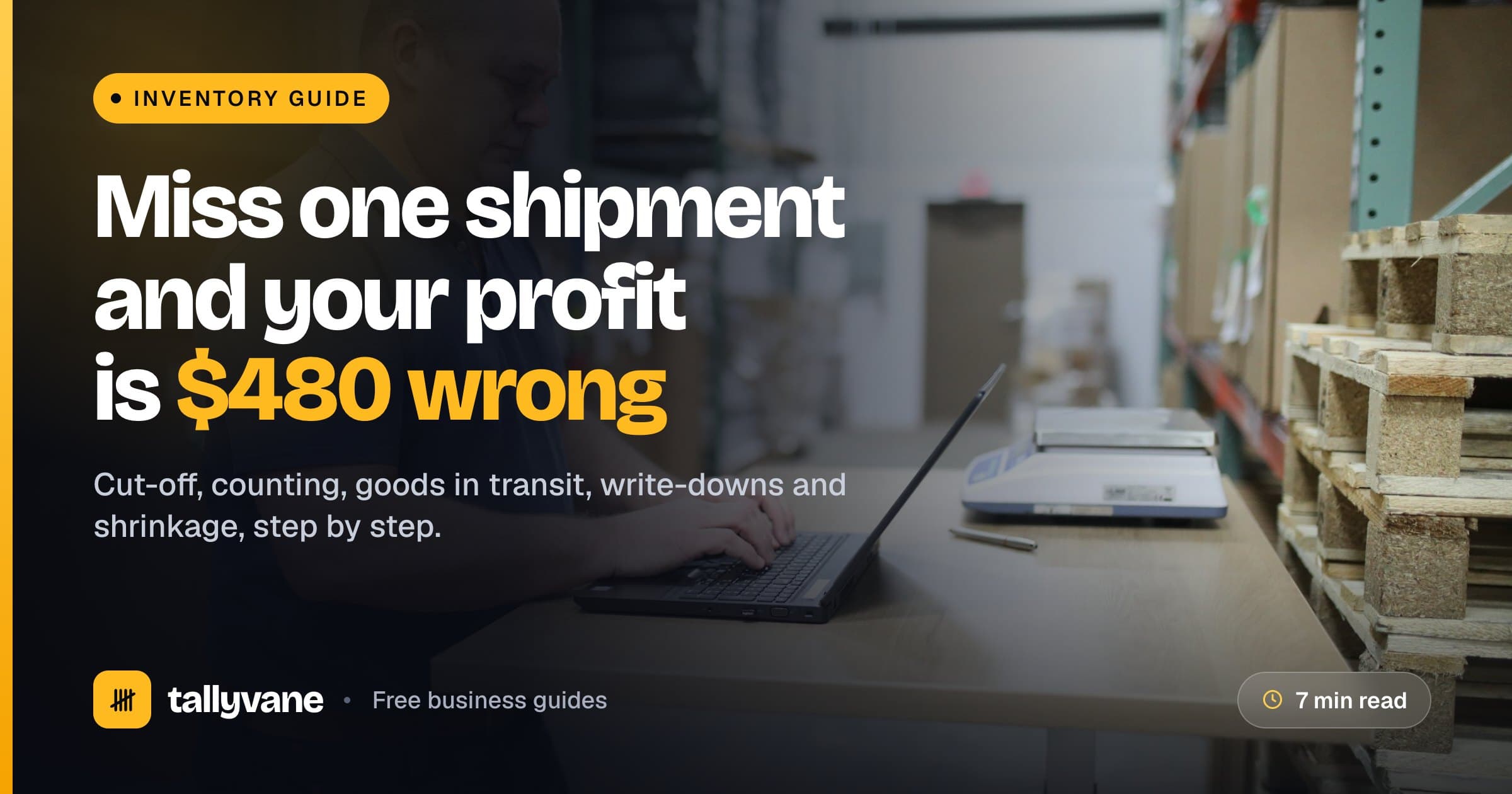
- Had the seller forgotten the bags in transit, closing stock would be $480 too low and profit $480 too low. Had it counted the consigned soaps, profit would be overstated by their cost.
| Item | Units | Unit cost | At cost | Year-end value |
|---|---|---|---|---|
| Ceramic mugs | 420 | $4.50 | $1,890 | $1,890 |
| Linen tea towels | 310 | $3.20 | $992 | $992 |
| Scented candles | 260 | $6.80 | $1,768 | $1,768 |
| 2026 planners, now selling at $3.00 less $0.50 to sell | 150 | $5.00 | $750 | $375 |
| Chipped bowls, thrown away | 24 | $7.00 | $168 | $0 |
| Counted on the shelves | $5,568 | $5,025 | ||
| Jute bags in transit, title passed | 200 | $2.40 | $480 | $480 |
| Consigned soaps (not owned) | 40 | Excluded | Excluded | |
| Closing inventory | $6,048 | $5,505 |
Shrinkage, and why the closing figure drives your tax
Shrinkage is stock you paid for that is no longer there: theft, damage nobody recorded, picking errors and supplier short deliveries. Compare your counted value with your book value to measure it. Track your own rate year on year and investigate the products with the biggest gaps.
Your closing stock goes straight into cost of goods sold, and from there into gross profit and taxable profit. Overstate it and you pay tax on profit you did not make; understate it and your profit and tax are too low, which can mean penalties if the IRS adjusts it. This year’s closing stock is also next year’s opening stock, so an error carries forward into the next return.
Very small businesses may have a simpler option. If your average annual gross receipts for the three prior tax years are $32 million or less for tax years beginning in 2026, and you are not a tax shelter, you can choose not to keep inventories in the usual way for tax. You can instead treat stock as non-incidental materials and supplies, or follow the method in your own books. Even then, a year-end count keeps your books accurate and tells you what you are holding.
Shrinkage = Book inventory − Counted inventory Shrinkage rate % = Shrinkage ÷ Book inventory × 100
Free toolProfit and loss statement generator