Key takeaways
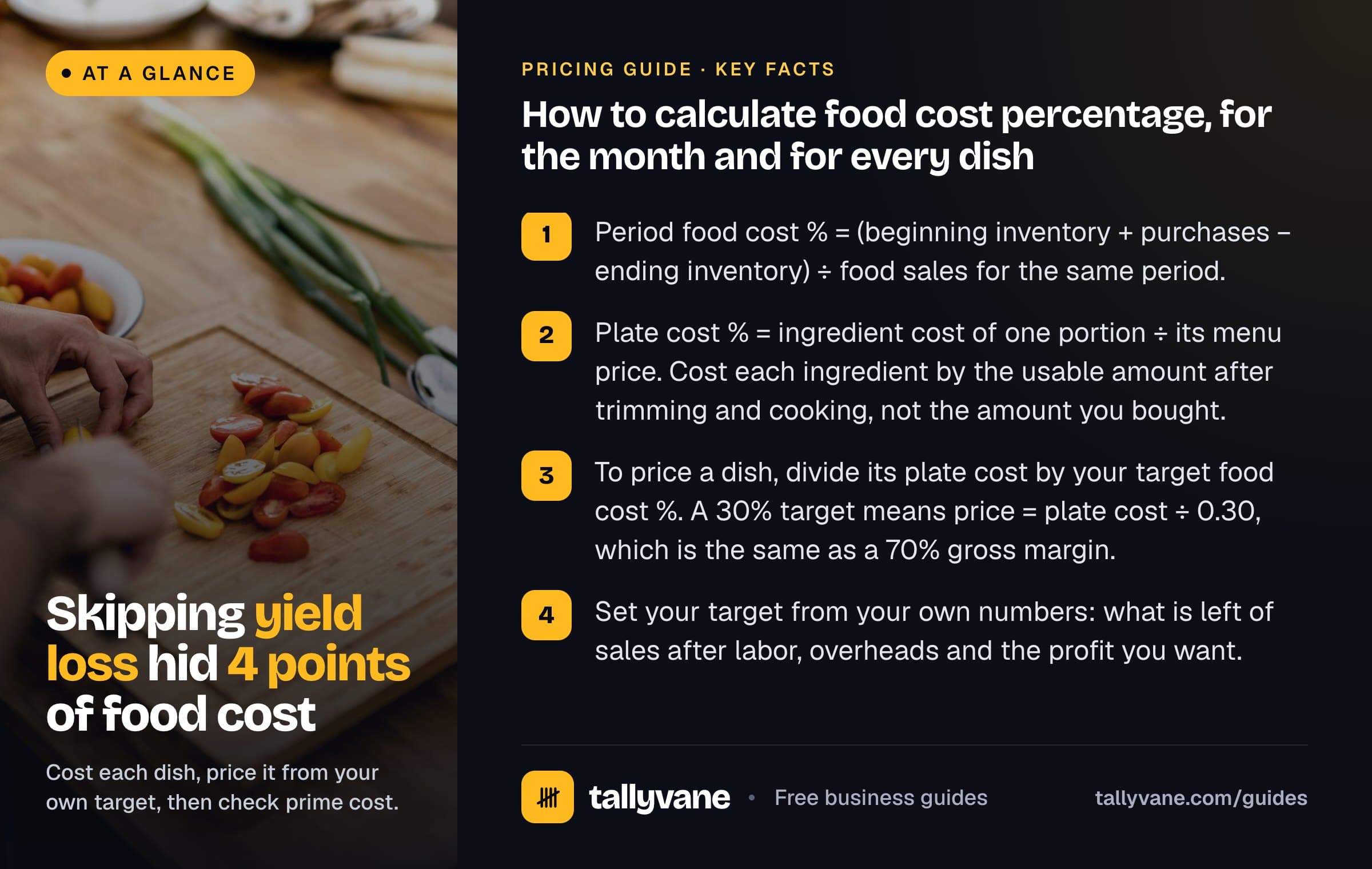
- Period food cost % = (beginning inventory + purchases − ending inventory) ÷ food sales for the same period.
- Plate cost % = ingredient cost of one portion ÷ its menu price. Cost each ingredient by the usable amount after trimming and cooking, not the amount you bought.
- To price a dish, divide its plate cost by your target food cost %. A 30% target means price = plate cost ÷ 0.30, which is the same as a 70% gross margin.
- Set your target from your own numbers: what is left of sales after labor, overheads and the profit you want.
- Prime cost (food + beverage + labor) shows whether your two biggest controllable costs leave room for rent and profit.
Two ways to measure food cost
Food cost percentage is food cost divided by food sales. You will use it in two places, and they answer different questions.
The period food cost percentage covers a week or a month and tells you what actually happened: what you spent on the food you sold, including waste, over-portioning, staff meals and theft. The plate cost percentage covers one dish and tells you what should happen if the recipe is followed exactly. The gap between the two is the money you lose in the kitchen.
Period food cost % = Cost of food used ÷ Food sales × 100 Plate cost % = Ingredient cost of one portion ÷ Menu price × 100
Period food cost percentage
The cost of food used in a period is the same calculation as cost of goods sold: what you had at the start, plus what you bought, minus what is left. Our guide to calculating COGS covers where each number comes from and how to value stock at cost. The only difference here is that a kitchen usually counts every week or month rather than once a year.
Count every storage area at the same time each period, so no delivery is counted twice or missed. Purchases are the invoices for food delivered in the period, less credits for returns.
Divide by food sales only, net of discounts and excluding sales tax. If you sell drinks, keep beverage purchases, stock and sales separate. Coffee and soft drinks usually cost much less per dollar of sales than food, so mixing them hides what the kitchen is doing.
Cost of food used = Beginning food inventory + Food purchases − Ending food inventory Food cost % = Cost of food used ÷ Food sales × 100
Worked example: a $42,000-a-month cafe
A small cafe takes $42,000 in a month after discounts and before sales tax: $24,000 from food and $18,000 from coffee and other drinks. It counts food and beverage stock separately on the last evening of each month.
- Food cost is $7,500 ÷ $24,000 = 31.25%. Beverage cost is $3,800 ÷ $18,000 = 21.1%.
- The combined 26.9% looks better than the kitchen really is, because cheap-to-make coffee pulls it down. Track the two lines separately.
- Stock rose by $300 over the month, so food cost is $300 lower than food purchases. If you used purchases alone, you would overstate the month’s food cost.
| Line | Food | Beverage | Total |
|---|---|---|---|
| Beginning inventory | $2,600 | $1,500 | $4,100 |
| Purchases | $7,800 | $3,900 | $11,700 |
| Ending inventory | −$2,900 | −$1,600 | −$4,500 |
| Cost of goods used | $7,500 | $3,800 | $11,300 |
| Sales | $24,000 | $18,000 | $42,000 |
| Cost % | 31.3% | 21.1% | 26.9% |
Costing a recipe, including yield loss
To find a dish’s plate cost, list every ingredient in one portion, the amount used and the cost of that amount. Include garnishes, sauces, oil and, for takeaway or a food truck, the wrap or box.
Many ingredients lose weight before they reach the plate. You buy a pound of raw chicken breast, but after trimming and cooking you may have only 70% of it to serve. The yield percentage measures that loss, and the cost of the usable amount is the purchase price divided by the yield. Find your yields by weighing a batch before and after prep. The USDA Food Buying Guide also publishes yield data for many foods, but your own test with your own suppliers and recipes is more accurate.
- Usable chicken costs $4.50 ÷ 0.70 = $6.43 a pound, so the 4 oz (0.25 lb) cooked portion costs $1.61.
- Skip the yield step and the chicken looks like $1.13 and the tomato $0.25, a plate cost of $3.19. At a $12.50 price that is a 25.5% plate cost on paper against 29.7% in reality.
Yield % = Usable weight ÷ Purchased weight × 100 Cost per usable unit = Purchase price per unit ÷ Yield % Plate cost = Sum of (amount used × cost per usable unit) for every ingredient
| Ingredient | Bought at | Yield | Used per sandwich | Cost |
|---|---|---|---|---|
| Sourdough | $6.00 a loaf of 20 slices | 100% | 2 slices | $0.60 |
| Chicken breast | $4.50 per lb raw | 70% | 4 oz cooked (0.357 lb raw) | $1.61 |
| Avocado | $1.50 each | n/a | Half | $0.75 |
| Tomato | $2.00 per lb | 90% | 2 oz sliced | $0.28 |
| Lettuce | By the case | n/a | Portion | $0.15 |
| Herb mayo | Made in house | n/a | 1 oz | $0.12 |
| Wrap and napkin | By the case | n/a | 1 each | $0.20 |
| Plate cost | $3.71 |
Pricing a dish from a target food cost
Once you know the plate cost, divide it by your target food cost percentage to get the price that hits the target. A dish with a $3.71 plate cost and a 30% target needs a price of $12.37. The cafe rounds to $12.50, which gives a plate cost of 29.7%.
This is the same maths as pricing for a margin. A 30% food cost leaves 70% of the price as gross profit on the ingredients, so our profit margin calculator gives the same $12.37 if you enter a $3.71 cost and a 70% target margin. As a markup on cost, that is 233%. If the market sets the price, flip the formula: the most you can spend on a $12.50 sandwich at a 30% target is $3.75.
Treat the result as a starting point and check it against what nearby cafes charge.
Menu price = Plate cost ÷ Target food cost % $3.71 ÷ 0.30 = $12.37 Gross margin % = 100 − Food cost % Maximum plate cost = Menu price × Target food cost %
Free toolProfit margin calculator
How to set your own target
There is no single right food cost percentage. It depends on your menu, your prices, your labor and your rent. An open food service textbook by Beth Egan of Penn State warns against using a familiar figure such as 30% out of habit, and suggests working out the target from your own costs instead.
Start with sales, take away labor, overheads and the profit you want, and what is left is what you can afford to spend on food and drink. For the cafe, monthly labor is $12,726 (worked out in our labor cost percentage guide), overheads such as rent, utilities, card fees, insurance and repairs are $13,000, and the owner wants $4,200 of profit, 10% of sales.
Not every dish needs to hit the target. A sandwich at 30% and a coffee at 15% can average out below the cafe’s limit. Look at the dollars too: a dish with a higher food cost percentage can still leave more gross profit per sale than a cheap one, and you bank dollars, not percentages.
- The cafe’s actual combined cost is 26.9%, below its 28.7% ceiling, so this month’s profit comes in at $4,974 instead of $4,200.
- If food and drink costs rose to 30% of sales, profit would fall to about $3,670. That is why the target has to be checked every month, not set once.
Food and beverage budget = Sales − Labor − Overheads − Target profit $42,000 − $12,726 − $13,000 − $4,200 = $12,074 Target cost % = $12,074 ÷ $42,000 = 28.7%
Prime cost: food, beverage and labor together
Prime cost is the total of what you spend on food, drink and labor. They are the biggest costs you can change week to week, and they trade off: buying prepared ingredients cuts labor but raises food cost, so a change can look good on food cost when it only moved money into wages.
For the cafe, food and beverage cost of $11,300 plus labor of $12,726 gives a prime cost of $24,026, or 57.2% of sales. Everything else, from rent to profit, has to come out of the remaining 42.8%. As with food cost, set your own ceiling from your overheads and profit goal rather than borrowing someone else’s.
Prime cost = Food cost + Beverage cost + Labor cost Prime cost % = Prime cost ÷ Total sales × 100 ($11,300 + $12,726) ÷ $42,000 = 57.2%
Keeping food cost on target
When the period food cost runs above the plate costs of what you sold, the money is going somewhere between the delivery door and the customer. Most fixes are routine.
- Re-cost recipes whenever a supplier changes a price, and at least every quarter. A plate cost from last year is not a plate cost.
- Keep a waste log next to the bin for spoiled stock, dropped plates and returned dishes. It shows where the gap between plate and period cost comes from.
- Weigh or scoop portions to the recipe. A slightly heavier hand with chicken and avocado adds up across hundreds of sandwiches a month.
- Review the menu mix. If sales shift towards dishes with a higher plate cost, the period figure rises even when nothing in the kitchen has changed.