
Key takeaways
- Sale price = original price × (1 − discount ÷ 100). 25% off $80 is $80 × 0.75 = $60.
- Discount % = (original price − sale price) ÷ original price × 100.
- Stacked discounts multiply, they do not add: 20% off then 10% off is 28% off, not 30%.
- To keep the same gross profit after a discount, you need to sell discount ÷ (margin − discount) more units. At a 40% margin, a 20% discount needs 100% more units.
- If the discount is as big as your margin, you are selling at cost, and no extra volume will make up for it.
How to calculate the sale price
To find the sale price, work out what share of the price the customer still pays and multiply by it. 25% off means the customer pays 75%, so a $80 jacket sells for $80 × 0.75 = $60.
If you want the saving as well, multiply the original price by the discount: $80 × 0.25 = $20. The saving plus the sale price always adds back to the original price, which is a quick way to check your sum.
For a fixed amount off, such as $15 off a $60 order, the discount percentage is $15 ÷ $60 × 100 = 25%. This is handy when you are choosing between a percentage code and a dollar code.
Sale price = Original price × (1 − Discount % ÷ 100) Saving = Original price × Discount % ÷ 100
Free toolDiscount calculator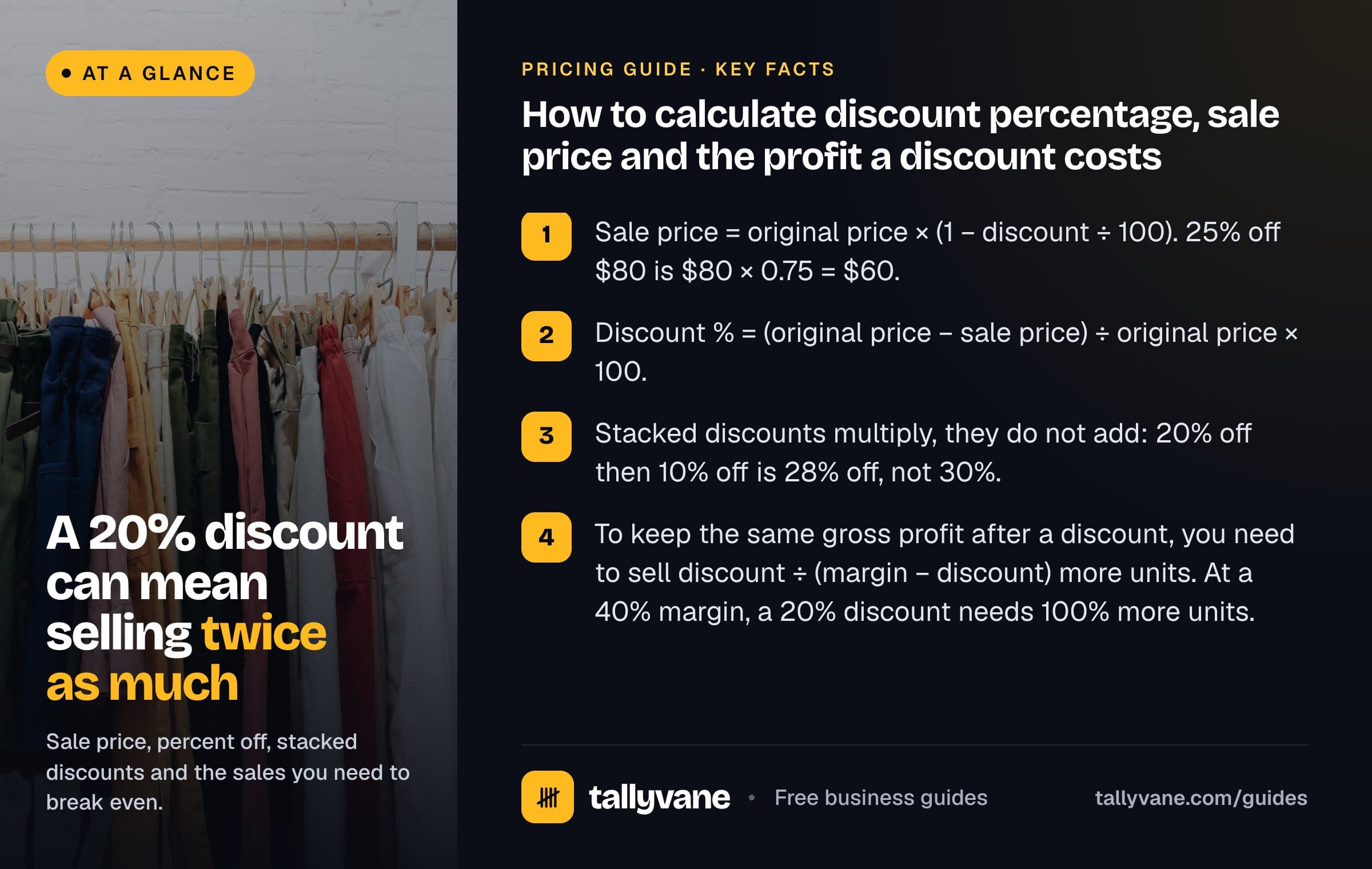
How to find the percent off from two prices
When you know the old and new prices, subtract the new from the old and divide by the old price, never the new one. A product cut from $89 to $64.99 is $24.01 cheaper, and $24.01 ÷ $89 × 100 = 27.0% off.
Dividing by the sale price instead is a common slip. It gives $24.01 ÷ $64.99 = 36.9%, which is how much the price would have to rise to get back to $89, not the discount.
Discount % = (Original price − Sale price) ÷ Original price × 100
Stacked discounts: why 20% + 10% is not 30%
When two discounts apply one after the other, the second one is taken off the already reduced price. 20% off $100 is $80. Another 10% off $80 is $72. The customer saved $28, so the combined discount is 28%.
To combine percentages, multiply what is left after each one: 0.80 × 0.90 = 0.72, so the customer pays 72% and the total discount is 28%. The order of two percentage discounts does not matter. The order of a percentage and a fixed amount does: $10 off then 20% off $100 is $72, but 20% off then $10 off is $70.
- Before you allow a sitewide code on top of clearance prices, work out the combined discount and check it against your margin.
- If you want a promotion to be "30% off" in total, apply one 30% discount rather than two that only appear to add up to 30%.
Combined discount % = (1 − (1 − Discount 1 ÷ 100) × (1 − Discount 2 ÷ 100)) × 100
| First discount | Second discount | Customer pays | Combined discount |
|---|---|---|---|
| 10% | 10% | 81% | 19% |
| 20% | 10% | 72% | 28% |
| 25% | 10% | 67.5% | 32.5% |
| 30% | 20% | 56% | 44% |
| 50% | 20% | 40% | 60% |
What a discount does to your margin
For a seller, the whole discount comes out of profit, because your cost per unit does not change. On a $50 product that costs you $30, profit is $20, a 40% margin. At 20% off the price is $40, profit falls to $10 and margin to 25%. A 20% discount has cut profit per unit in half.
The table shows the gross margin left on the discounted price for common starting margins. Where the discount reaches your margin, you are selling at cost or below.
Margin after discount = (Margin − Discount) ÷ (1 − Discount) with margin and discount as decimals of the original price
| Margin at full price | 10% off | 15% off | 20% off | 25% off |
|---|---|---|---|---|
| 20% | 11.1% | 5.9% | 0% (at cost) | Below cost |
| 30% | 22.2% | 17.6% | 12.5% | 6.7% |
| 40% | 33.3% | 29.4% | 25.0% | 20.0% |
| 50% | 44.4% | 41.2% | 37.5% | 33.3% |
| 60% | 55.6% | 52.9% | 50.0% | 46.7% |
How much more you must sell to keep the same profit
Because each discounted sale earns less, you need more of them to earn the same total gross profit. Divide the profit per unit at full price by the profit per unit after the discount. Anything above 1 is the extra volume you need just to stand still.
With a 40% margin and a 20% discount, full-price profit is 40% of the price and discounted profit is 20%, so you need 40 ÷ 20 = 2 times the units: 100% more. The shortcut is discount ÷ (margin − discount).
Read this table before planning any sale. Low-margin products need huge volume increases for even small discounts, while high-margin products can absorb them more easily.
Extra units needed = Discount ÷ (Margin − Discount) × 100 Example: 20 ÷ (40 − 20) × 100 = 100%
| Margin at full price | 5% off | 10% off | 15% off | 20% off | 25% off |
|---|---|---|---|---|---|
| 20% | 33% | 100% | 300% | Not possible | Not possible |
| 30% | 20% | 50% | 100% | 200% | 500% |
| 40% | 14% | 33% | 60% | 100% | 167% |
| 50% | 11% | 25% | 43% | 67% | 100% |
| 60% | 9% | 20% | 33% | 50% | 71% |

Worked example: a 20% off month
A homeware shop sells a ceramic planter for $50. It costs $30 landed, a 40% margin, and the shop normally sells 200 a month. It is considering 20% off for a month.
- Selling 50% more planters raises revenue by $2,000 but lowers gross profit by $1,000.
- The shop has to double its sales to 400 just to match its normal $4,000 of gross profit, and that is before extra shipping, packing and payment fees on the extra orders.
- A 10% discount would need only 33% more units, about 267 planters, to break even on gross profit.
| Figure | Full price | 20% off, 300 sold | 20% off, 400 sold |
|---|---|---|---|
| Price | $50 | $40 | $40 |
| Profit per unit | $20 | $10 | $10 |
| Units sold | 200 | 300 | 400 |
| Revenue | $10,000 | $12,000 | $16,000 |
| Gross profit | $4,000 | $3,000 | $4,000 |
When a discount is worth it
A discount that loses gross profit on the day can still be a good decision, but you should know what you are paying for. Common reasons that hold up are clearing old or seasonal stock that would otherwise be written off, winning new customers who are likely to buy again at full price, and raising cash quickly from stock you already own.
Before you run one, set the discount from your margin rather than from what competitors advertise, and decide the volume you need to hit. Fixed-amount codes with a minimum order, bundles, and free gifts often cost less margin than a straight percentage off.
In the US, if you advertise a sale against a former price, the Federal Trade Commission’s guides say that price should be one you actually offered to the public in good faith for a reasonable period. A "was" price invented to make the discount look bigger is deceptive.
Free toolMarkup calculator