Key takeaways
- Work out your maximum discount from the profit you want to keep per order, not from what other shops advertise.
- Lowest price = (target profit + every per-order cost + fixed fees) ÷ (1 − percentage fees) − shipping the buyer pays. Maximum discount = 1 − lowest price ÷ full price.
- Marketplace fees shrink your room to discount: in our example the same candle can take 28% off on its own store, 21% on Etsy and 17% on eBay.
- Bundles, spend thresholds and free gifts usually give buyers a bigger deal for less lost profit per item than a straight percentage off.
- In the US, a "was" price must be a real price you offered in good faith for a reasonably substantial period (16 CFR 233.1). Raising prices just before the sale to inflate the discount is deceptive.
Start from the profit you need, not the discount you have seen
Black Friday 2026 is on 27 November, with Cyber Monday on 30 November. Most small sellers pick a number like 30% because it is what they see everywhere. That number was chosen by businesses with different costs, different fees and often much bigger margins than yours.
Turn the question around. Decide how much profit you need to keep on each order, then find the lowest price that still delivers it. The gap between that price and your full price is the most you can give away. Anything less than that is your choice; anything more means every Black Friday order makes less than you decided it must.
Count every cost that comes with an order, not just the product. Packaging, the shipping label, payment or marketplace fees and the ad spend it takes to win an order in a busy, expensive week all stay the same or rise while the price falls. If you have not added these up before, the ecommerce profit calculator lists them line by line.
Free toolEcommerce profit calculator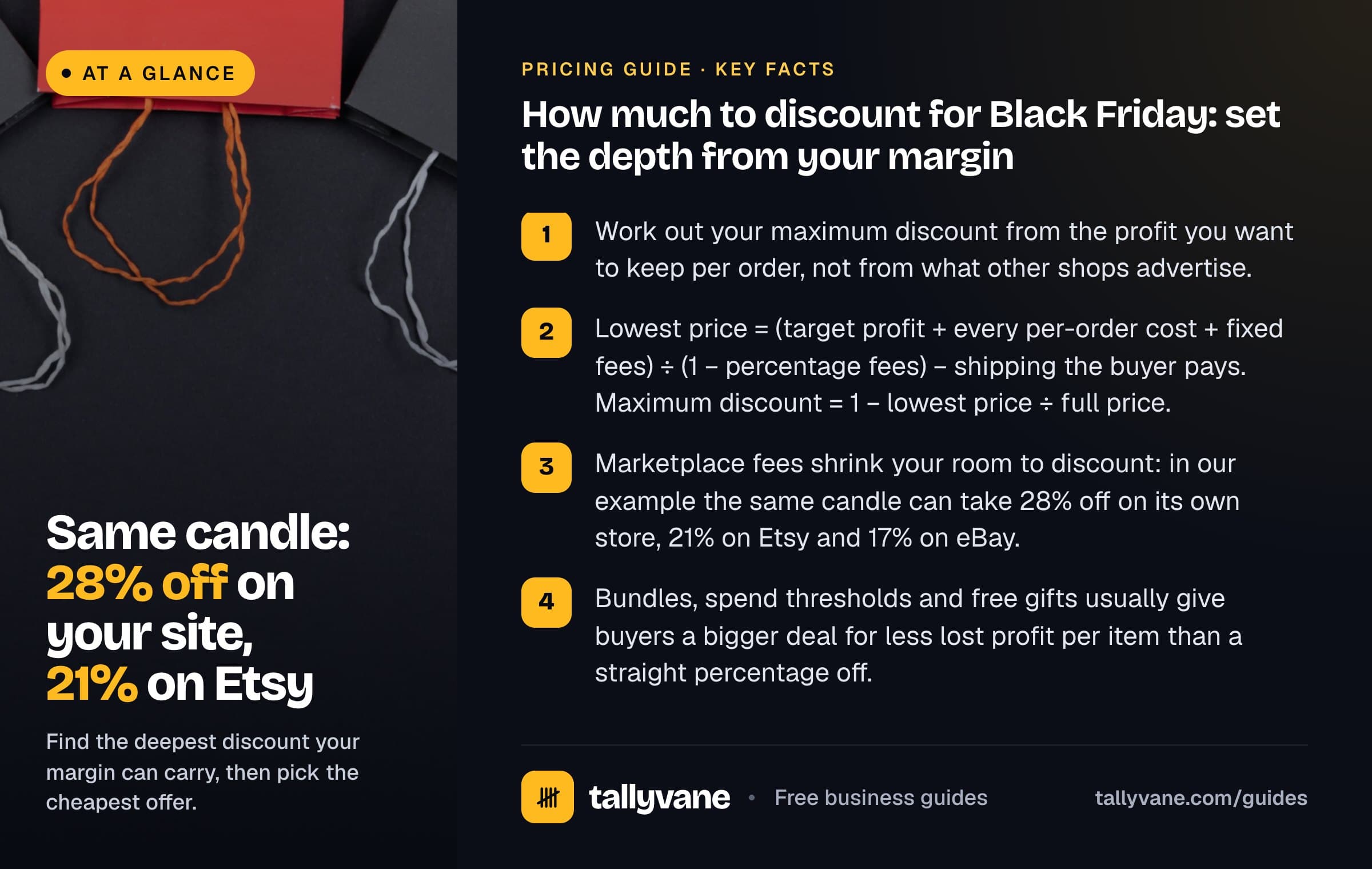
How to find your maximum discount
Add your target profit to every fixed cost of the order: product, packaging, the label you pay for, ad cost per order and any fixed fee per sale. Divide by what is left after percentage fees, because those fees fall with the price. Then take off any shipping the buyer pays you, since that money also covers costs. The result is the lowest item price you can accept.
Your maximum discount is how far that lowest price sits below the full price. Set the target profit to zero and the same sum gives your break-even discount, the point at which an order makes nothing at all.
- At full price this order earns $18.84, so a $8 target means you accept giving up about $10.84 per order in exchange for more orders.
- A 25% discount leaves $9.13 per order, inside the limit. A 30% discount would not reach the $8 target.
- Whether the extra volume makes up for the thinner profit is a separate question, covered in our guide to how to calculate discount percentage.
Lowest price = (Target profit + Per-order costs + Fixed fees) ÷ (1 − Percentage fees) − Shipping the buyer pays Maximum discount = 1 − Lowest price ÷ Full price
| Target profit per order | Lowest price | Maximum discount |
|---|---|---|
| $0 (break even) | $20.60 | 48.5% |
| $8 | $28.84 | 27.9% |
Marketplace fees cut your room to discount
Percentage fees are charged on what the buyer actually pays, so they fall a little when you discount. But they also take a bigger slice of every dollar, which raises the lowest price you can accept. The higher the fee, the less discount your margin can carry.
Here is the same candle, same costs and same $8 target, sold through three channels using each platform’s standard US fees on item price plus shipping. eBay also charges its fee on sales tax, so its real limit is slightly lower than shown. Ads, Etsy Offsite Ads and promoted listings would cut every figure further.
- If you sell the same product in several places, set the discount per channel rather than one sitewide number.
- Check whether a platform’s own sale event or coupon tool adds a fee or a required minimum discount before you sign up for it.
| Channel | Fees used | Lowest price | Maximum discount |
|---|---|---|---|
| Own store | 2.9% + $0.30 | $28.84 | 27.9% |
| Etsy | 6.5% transaction, 3% + $0.25 processing, $0.20 listing | $31.62 | 21.0% |
| eBay | 13.6% + $0.40 per order | $33.39 | 16.5% |
Percent off, dollars off, free shipping, bundles or a free gift
The headline percentage is only one way to give buyers a deal. Each format costs you a different amount for the same perceived value.
- Percent off: simple and easy to compare. It gives away the most on your most expensive items, where a fixed cost such as shipping is a smaller share of the price.
- Dollars off with a minimum spend, such as $15 off orders over $80: pushes buyers to add a second item, and the label and ad cost are shared across both.
- Free shipping: costs you the shipping you would have charged. On a $40 item with $7 shipping that is a 17.5% discount on the item price, so treat it as one.
- Bundles, such as 3 for $99: raise the order value and spread the per-order costs across more units. They suit products people buy as gifts or use up.
- Gift with purchase: the buyer sees the gift’s retail value, but you pay only its cost. Good for clearing small, slow stock and samples.
Worked example: comparing Black Friday offers
The candle shop from the earlier example sells a $40 candle, charges $7 shipping, and normally earns $18.84 per order on its own store. Each offer below uses the same costs, with a slightly bigger box and label for multi-candle orders. Fees are 2.9% + $0.30 on everything the buyer pays.
- The free gift gives buyers $9 of value for $2.50 of your cost, and keeps $16.34 per order.
- The bundle and spend threshold give the biggest savings in dollars, yet keep more profit per candle than 20% off, because the label, box and ad cost are shared.
- Free shipping costs nearly as much as 20% off. Pair it with a minimum spend rather than offering it on every order.
- Run your own numbers through the profit margin calculator before you commit, because a different product cost changes the ranking.
| Offer | Buyer pays | Buyer saves | Profit per order | Profit per candle |
|---|---|---|---|---|
| Full price, 1 candle | $47.00 | $0 | $18.84 | $18.84 |
| 20% off, 1 candle | $39.00 | $8.00 | $11.07 | $11.07 |
| 25% off, 1 candle | $37.00 | $10.00 | $9.13 | $9.13 |
| Free shipping, 1 candle | $40.00 | $7.00 | $12.04 | $12.04 |
| Free gift (costs $2.50, sells for $9) | $47.00 | $9 in value | $16.34 | $16.34 |
| $15 off orders over $80, 2 candles | $72.00 | $15.00 | $28.86 | $14.43 |
| 3 for $99, 3 candles | $106.00 | $21.00 | $47.63 | $15.88 |
The FTC rules on "was" prices and free offers
In the US, the Federal Trade Commission’s Guides Against Deceptive Pricing (16 CFR Part 233) apply to sale advertising. Under section 233.1, a former price is a fair basis for a comparison only if it is the actual, bona fide price you openly offered the item at, in good faith, for a reasonably substantial period. Marking prices up in early November so that "50% off" lands on your normal price is the example the guide calls deceptive.
You do not need to have sold many units at the former price, but you must have genuinely offered it. Avoid saying "was" or "formerly sold at" unless real sales happened at that price. If you do not state the old price, the saving must still be big enough to mean something to a buyer.
Buy-one-get-one and gift offers are covered by section 233.4 and by the FTC’s separate guide on the word "free" (16 CFR 251.1). State the conditions clearly up front, and do not raise the price of the item the buyer must purchase to pay for the "free" one. Some states have their own former-price rules too, so check yours before you advertise a comparison.
Check the whole week, not just the order
A discount that clears your per-order target can still lose money for the month if the week does not bring enough extra orders to cover your fixed costs, or if it pulls forward sales you would have made at full price in December. Use your discounted profit per order in the break-even calculator to see how many Black Friday orders you need to cover the month’s overheads.
Set an end date, a stock limit and a cap on ad spend before the sale starts. Then compare the week’s total profit with an ordinary week, not just its revenue. Revenue almost always goes up during a sale. Profit is the number that tells you whether to do it again next year.
Free toolBreak-even calculator