Key takeaways
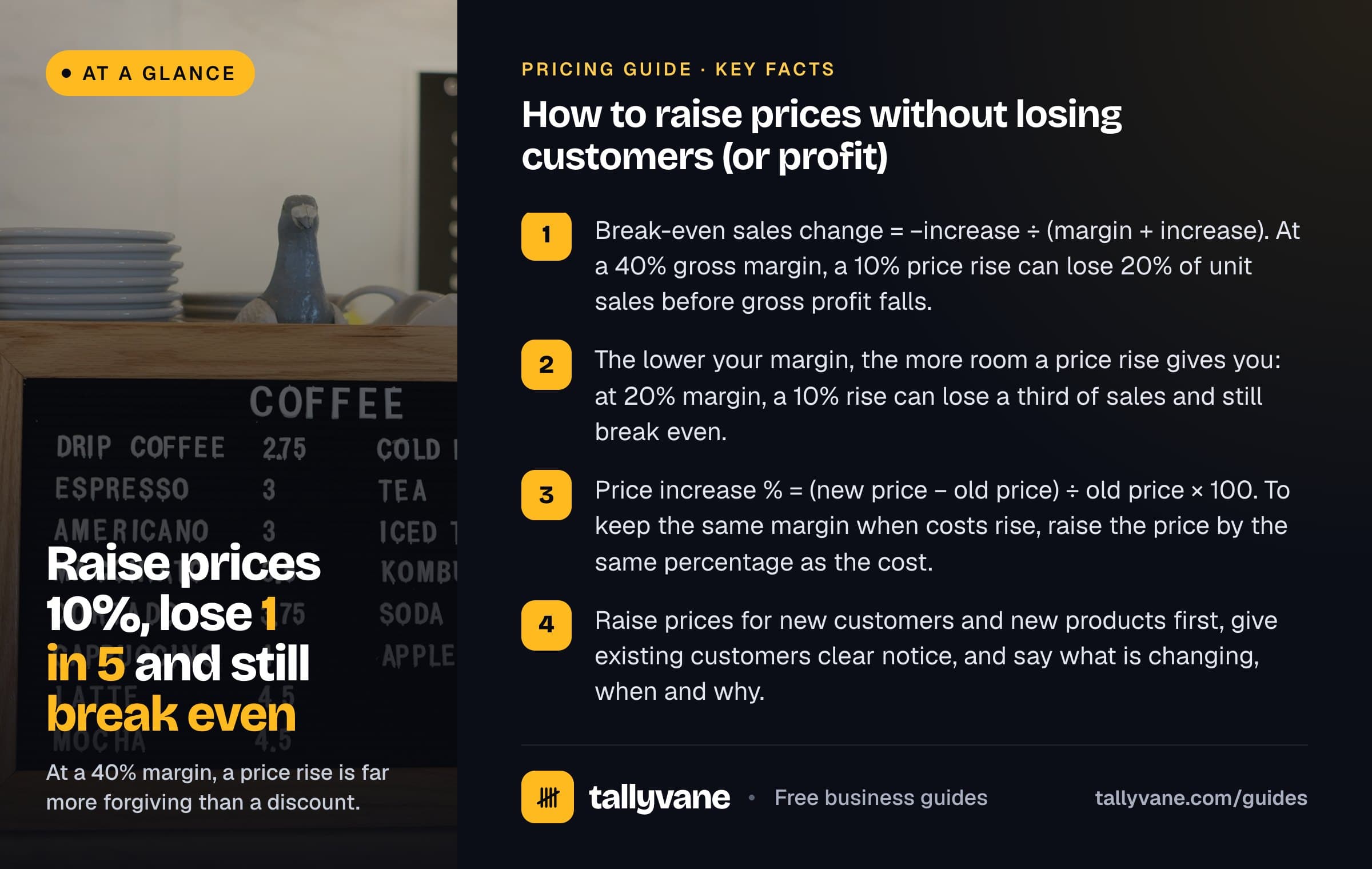
- Break-even sales change = −increase ÷ (margin + increase). At a 40% gross margin, a 10% price rise can lose 20% of unit sales before gross profit falls.
- The lower your margin, the more room a price rise gives you: at 20% margin, a 10% rise can lose a third of sales and still break even.
- Price increase % = (new price − old price) ÷ old price × 100. To keep the same margin when costs rise, raise the price by the same percentage as the cost.
- Raise prices for new customers and new products first, give existing customers clear notice, and say what is changing, when and why.
- Track unit sales against your break-even number for two or three months before deciding the rise did or did not work.
How many customers you can lose after a price increase
When you raise a price and your cost per unit stays the same, every extra dollar goes straight to gross profit. So you can sell fewer units and still earn the same total. The question is how many fewer.
Divide your margin by your margin plus the increase, both as a share of the old price. That tells you what share of your current sales you need to keep. Take it from 1 and you have the share you can lose. At a 40% margin and a 10% rise, you need 40 ÷ 50 = 80% of your sales, so you can lose 20% and stand still.
This is the mirror of the discount maths in our guide to calculating discount percentage. At a 40% margin, a 10% discount needs 33% more sales just to break even. A 10% increase can lose 20% of sales and still break even. Price rises are far more forgiving than price cuts.
- Use your margin after every cost that comes with a sale: product, packaging, shipping you pay and fees. Overheads such as rent do not change with a price rise, so leave them out.
- If a payment or marketplace fee takes a percentage of each sale, part of the rise goes to the fee. A 10% rise with 3% fees is worth 9.7% to you, so at a 40% margin you could lose 19.5% of sales, not 20%.
- The table counts units. If every customer buys the same amount, units and customers are the same thing.
Break-even sales change = −Increase ÷ (Margin + Increase) Example: −10 ÷ (40 + 10) = −20% Margin after the increase = (Margin + Increase) ÷ (1 + Increase)
| Gross margin now | 3% rise | 5% rise | 10% rise | 15% rise | 20% rise |
|---|---|---|---|---|---|
| 20% | 13.0% | 20.0% | 33.3% | 42.9% | 50.0% |
| 30% | 9.1% | 14.3% | 25.0% | 33.3% | 40.0% |
| 40% | 7.0% | 11.1% | 20.0% | 27.3% | 33.3% |
| 50% | 5.7% | 9.1% | 16.7% | 23.1% | 28.6% |
| 60% | 4.8% | 7.7% | 14.3% | 20.0% | 25.0% |
Worked example: a 10% rise on a coffee subscription
A small coffee roaster sells a monthly subscription bag for $20. Beans, roasting, the bag and the part of shipping it pays come to $12, a 40% gross margin, or $8 a bag. It has 400 subscribers and wants to charge $22, a 10% rise. Profit per bag goes from $8 to $10, and the margin from 40% to 45.5%.
- The roaster can lose 80 subscribers before it is worse off. Losing 20 still leaves it $600 a month, or $7,200 a year, ahead.
- If the price had stayed at $20, the roaster would need 100 extra subscribers, a 25% rise, to make the same extra $800.
| Scenario | Subscribers | Revenue | Gross profit | Change vs today |
|---|---|---|---|---|
| Today, $20 | 400 | $8,000 | $3,200 | $0 |
| $22, nobody leaves | 400 | $8,800 | $4,000 | +$800 |
| $22, 20 leave (5%) | 380 | $8,360 | $3,800 | +$600 |
| $22, 80 leave (20%) | 320 | $7,040 | $3,200 | $0 |
| $22, 100 leave (25%) | 300 | $6,600 | $3,000 | −$200 |
Price increase percentage, and how much to raise when costs go up
To find the percentage of a price rise, divide the change by the old price. Going from $20 to $22 is $2 ÷ $20 = 10%. Always divide by the old price. Dividing by the new one gives 9.1%, which is the share of the new price the rise makes up, not the rise itself.
The same rule explains why a cut and a rise do not cancel out. After 20% off, a $50 product sells for $40. Getting back to $50 needs a 25% rise, because the $10 is now measured against $40.
When a supplier puts your cost up, decide what you want to protect. Say the roaster’s cost rises from $12 to $13, an 8.3% rise. To keep the same $8 profit per bag, it needs $21, a 5% price rise. To keep the same 40% margin, it needs $13 ÷ 0.6 = $21.67, an 8.3% rise. Keeping your margin percentage always means raising the price by the same percentage as the cost.
Price increase % = (New price − Old price) ÷ Old price × 100 Keep the same cash profit: New price = Old price + Cost increase Keep the same margin: New price = New cost ÷ (1 − Margin)
Free toolMarkup calculatorChoose the timing
There is rarely a perfect moment, and waiting usually costs more than it saves, because every month at the old price is a month of lower profit. Some moments make a rise easier for customers to accept.
- When your costs have clearly risen and customers can see it, such as after supplier, shipping or wage increases.
- When you launch an improvement, a new version or a better service level, so the new price arrives with something new.
- At a natural break: the start of a year, a new season, a contract renewal or a new catalog.
- On a regular schedule. A small, planned review every year is easier to explain than a large jump after several years of standing still.
- Not in the middle of a known problem, such as late deliveries or a quality issue. Fix that first.
Existing customers: notice and grandfathering
Read your terms and contracts before you announce anything. If customers agreed to a price for a fixed term, the new price normally waits until that term ends. Subscription and auto-renewal rules in some places also require advance notice of a price change, so check the rules where your customers are.
Even where no notice is required, give it. A full billing cycle is a sensible minimum for subscribers and retainer clients, and business customers who set budgets for the year may need longer. A surprise on an invoice causes more cancellations than the price itself.
Grandfathering means keeping existing customers on the old price for a while, or for good. It rewards loyalty and lowers the risk of cancellations, but it has a cost you should count. If the roaster kept all 400 subscribers at $20 for six months, it would give up 400 × $2 × 6 = $4,800 of gross profit. A middle way is to offer existing customers the old price if they prepay for a year, which also brings cash in now.
Start with new products, new customers and wholesale terms
New customers have never seen your old price, so a higher price for them carries little risk of upsetting anyone. Put new listings, new products and new clients on the new price first, and watch how they convert before moving existing customers.
If you add value to justify a rise, count what the extra value costs. A $2 increase that comes with a $0.50 better box is a $1.50 increase in profit per unit. Use that smaller figure in the break-even formula.
If you sell wholesale, remember that your stockists mark up your price. Under keystone pricing, a $1 rise in your wholesale price becomes a $2 rise on their shelf. Retailers also plan their prices by season, so tell them before they set their next catalog, not after.
Free toolRetail price calculatorHow to tell customers about a price increase
Keep the message short, plain and early. Customers mostly want to know what is changing, when, and what they can do about it. Long apologies make a modest rise sound worse than it is.
- Say the old price, the new price and the date it starts, in the first lines.
- Give the reason in one or two sentences, such as higher bean, packaging or shipping costs, if that is true.
- Remind them what they get: quality, service, speed, anything you have recently improved.
- Offer a choice where you can: lock in the old price by prepaying, switch to a smaller plan, or a final order at the old price before the date.
- Make cancelling easy and say how. Customers who feel trapped complain; customers who feel respected often stay.
- Brief your staff with the same facts, so the answer to "why did this go up?" is the same everywhere.
Measure the result
Write down your break-even number before the rise goes live. For the roaster, that is 320 subscribers. Then track units, customers and gross profit for two or three months. The first weeks can mislead: some customers stock up before the change and others delay cancelling until the next bill.
If losses stay well below your break-even share, the rise worked, and you have learned that customers value what you sell more than your old price suggested. If losses come close to it, look at which customers left. Losing occasional, low-margin buyers can still leave you better off, even when the headline count looks bad.