Key takeaways
- Cost per unit = (total fixed costs + total variable costs) ÷ number of units, or variable cost per unit + fixed costs ÷ units.
- For imports, landed cost per unit adds freight, duty, customs fees and inland delivery to the supplier price, then divides by the units you can actually sell.
- The US $800 de minimis duty exemption has been suspended for imports from every country since 29 August 2025, so small parcels now pay duty and need a customs entry.
- For handmade goods, count materials, your time at a real hourly rate and a share of monthly overheads. Larger batches lower the per-unit share of setup time.
- Price from the full unit cost, but use only the variable cost per unit when you work out a break-even point, or you count overheads twice.
The cost per unit formula
Add up every cost of producing or buying a batch of goods over a period, then divide by the number of units the batch gives you. That is your average cost per unit.
Variable costs rise with each unit: the product itself, materials, packaging, the per-unit share of freight. Fixed costs stay the same whatever you make that month: rent, insurance, software, equipment. Divide the fixed costs by the units in the period and add the result to the variable cost of one unit.
Fixed costs per unit fall as volume rises, which is why the same product can cost $10 a unit to make at 100 a month and $8 at 300.
Cost per unit = (Total fixed costs + Total variable costs) ÷ Units Cost per unit = Variable cost per unit + (Fixed costs ÷ Units)
Landed cost per unit for imported goods
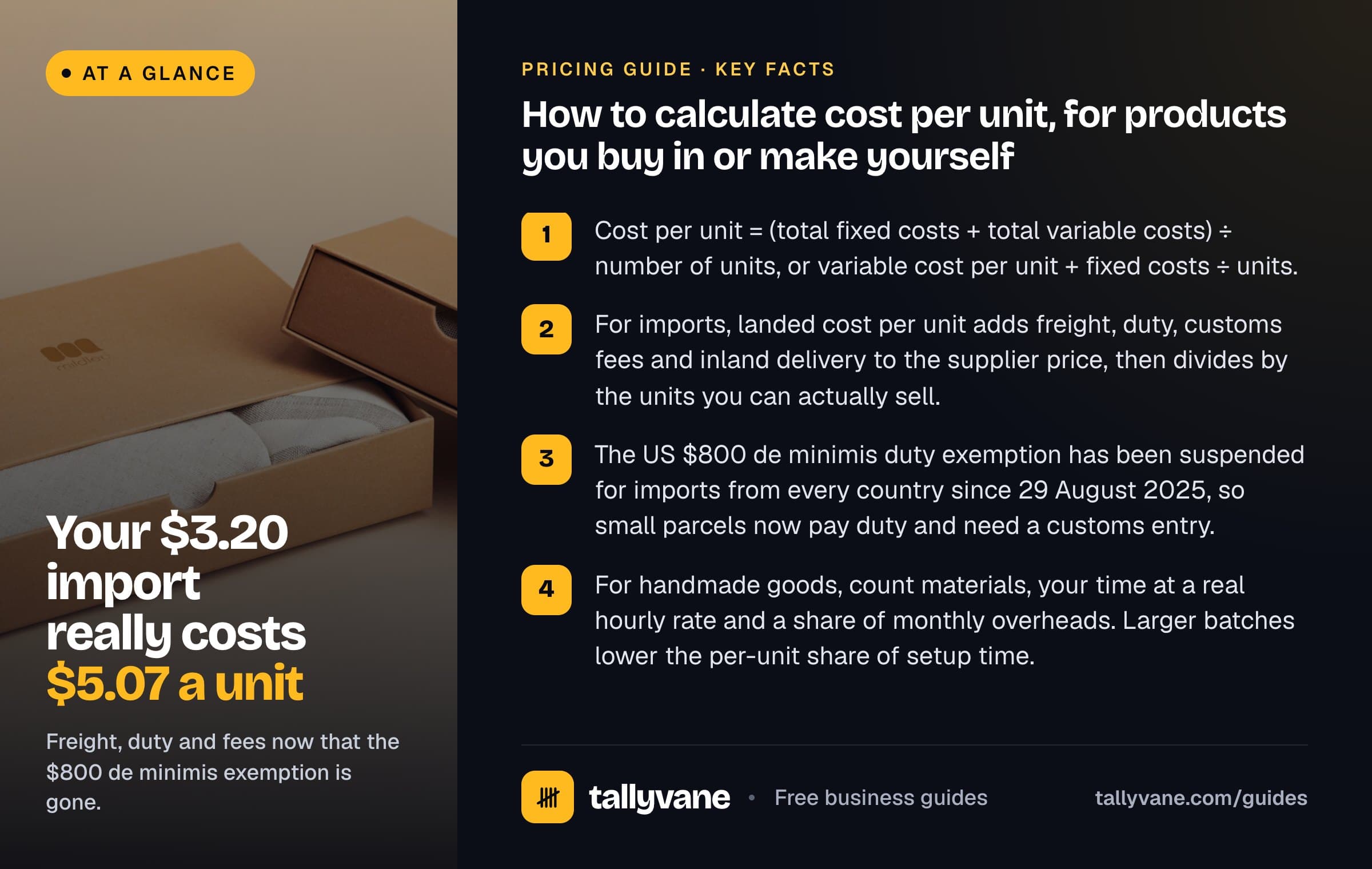
If you buy stock from overseas, the supplier’s price per unit is only the start. Landed cost is what it takes to get the goods onto your shelf: the product, international freight and insurance, customs duty, customs fees, your broker’s charges and delivery from the port to you. Spread the total across the units you can sell, not the units you ordered, because damaged or faulty items still had to be paid for.
In the US, duty is usually charged as a percentage of the transaction value of the goods, which does not include international freight and insurance. The rate depends on the product’s Harmonized Tariff Schedule (HTS) classification and its country of origin, and extra tariffs on top of the normal rate have changed several times since 2025. Look up your code on the US International Trade Commission’s HTS site and confirm the total rate with your customs broker before you order.
Commercial shipments valued over $2,500 generally need a formal entry, which pays a merchandise processing fee of 0.3464% of the value, within a minimum and maximum that CBP resets each October. Goods arriving by sea also pay a harbor maintenance fee of 0.125% of their value.
Landed cost = Product + Freight and insurance + Duty + Customs fees + Broker fees + Inland delivery Landed cost per unit = Landed cost ÷ Sellable units
The end of de minimis for small imports
Until 2025, US shipments worth $800 or less could enter duty-free under the de minimis rule, which is why many small sellers never thought about duty. That exemption ended for goods from China and Hong Kong in May 2025 and was suspended for low-value imports from all countries from 29 August 2025.
In June 2026 US Customs and Border Protection issued interim final rules suspending the exemption indefinitely, for postal and non-postal shipments alike, and the One Big Beautiful Bill Act repeals it in law from 1 July 2027. Gift and traveller exemptions are separate and were not affected.
In practice, every parcel of stock you import now needs a customs entry and pays the duty that applies. If you buy small quantities from overseas suppliers or marketplaces, check your invoices: duty and carrier brokerage fees that used to be zero now belong in your landed cost per unit.
Worked example: landed cost of an imported water bottle
A small shop orders 1,000 insulated water bottles at $3.20 each from an overseas supplier, shipped by sea. The duty rate used here is 20% for illustration only; your rate depends on your product’s HTS code and origin. The value is over $2,500, so the shipment needs a formal entry, and the processing fee on $3,200 is below CBP’s minimum, so the minimum applies. The shop’s broker bills that fee, the customs bond and their own charge together. Twenty bottles arrive dented and cannot be sold.
- The bottle costs $5.07 to land, not the $3.20 on the supplier’s invoice: 58% more.
- Dividing by sellable units adds 10 cents a bottle that would otherwise vanish from your margin unnoticed.
- Packaging, outbound shipping and selling fees come on top of this when you price each sale.
| Cost | Working | Amount |
|---|---|---|
| Product | 1,000 × $3.20 | $3,200.00 |
| Ocean freight and destination charges | Forwarder quote | $780.00 |
| Duty | $3,200 × 20% (illustrative rate) | $640.00 |
| Broker fee, bond and processing fee | Broker invoice | $185.00 |
| Harbor maintenance fee | $3,200 × 0.125% | $4.00 |
| Delivery from port to shop | Local carrier | $160.00 |
| Total landed cost | Sum of the above | $4,969.00 |
| Landed cost per unit ordered | $4,969 ÷ 1,000 | $4.97 |
| Landed cost per sellable unit | $4,969 ÷ 980 | $5.07 |
Cost per unit for products you make
For handmade or small-batch goods, three costs make up the unit cost. Materials are easy to count: weigh or measure what goes into one item and price it from your last invoice. Labour is your time, or your staff’s, at an hourly rate you would accept for the work. Overhead is the rest of the business spread across what you make.
Take a candle maker. Materials per candle are wax $2.10, wick $0.15, jar $1.60, fragrance $1.05 and label $0.25, so $5.15. Each batch takes 1.5 hours of setup, melting and cleanup whatever its size, which is $30 at $20 an hour, plus about $1.25 of pouring and labelling time per candle. Monthly overheads of $480 cover a share of studio rent, insurance, software and equipment.
In a batch of 24 the labour is $30 + 24 × $1.25 = $60, or $2.50 a candle. At 240 candles a month the overhead is $480 ÷ 240 = $2.00 a candle. Full cost per unit: $5.15 + $2.50 + $2.00 = $9.65.
- Pay yourself in the labour line even if you do not take a wage yet. A price that only works when your time is free stops working when you hire help.
- Allocate overhead by expected monthly units. If you make several products, split it by the time each takes or by units, and stick to one method.
Maker cost per unit = Materials per unit + (Labour per batch ÷ Units per batch) + (Monthly overhead ÷ Units per month)
How batch size changes your unit cost
Costs that are paid once per batch, such as setup and cleanup time, machine setup or a supplier’s fixed order charge, get cheaper per unit as the batch grows. Costs paid per unit, such as materials, do not. The candle maker’s figures show how quickly the saving levels off.
- Doubling from 12 to 24 saves $1.25 a candle; doubling from 48 to 96 saves only 32 cents.
- Bigger batches tie up cash in materials and stock, and slow sellers can go stale. Make the batch size you can sell, not the one with the lowest number on paper.
| Candles per batch | Setup per candle | Cost before overhead | Full cost per unit |
|---|---|---|---|
| 12 | $2.50 | $8.90 | $10.90 |
| 24 | $1.25 | $7.65 | $9.65 |
| 48 | $0.63 | $7.03 | $9.03 |
| 96 | $0.31 | $6.71 | $8.71 |
Setting a price from your unit cost
Once you know the unit cost, price from it. If you sell to shops, a wholesale price that gives you a 50% margin is $9.65 ÷ (1 − 0.50) = $19.30, and a retailer that also takes a 50% margin will sell it at $38.60. The retail price calculator works this chain forwards from your cost, or backwards from a target shelf price to the most your unit can cost.
A 50% margin is the same as a 100% markup on cost: $9.65 × 2 = $19.30. If you think in markups, the markup calculator gives the same answer. For direct sales, add packaging, shipping and fees before you set the margin; our guide on how to price a product walks through that step.
Wholesale price = Unit cost ÷ (1 − Your margin) Retail price = Wholesale price ÷ (1 − Retailer margin)
Free toolRetail price calculatorUsing unit cost for break-even, without counting overheads twice
The $9.65 full cost already includes $2.00 of overhead per candle. A break-even calculation treats overhead as the fixed cost and needs only the variable cost per unit, here $7.65 for materials and labour. Use the full cost and you count the overhead twice.
At a $19.30 wholesale price, each candle contributes $19.30 − $7.65 = $11.65 towards the $480 of monthly overhead. $480 ÷ $11.65 = 41.2, so the maker needs to sell 42 candles a month to break even, and every candle after that is profit.
Free toolBreak-even calculator