Key takeaways
- To add GST, multiply the price before GST by 1.1 in Australia or 1.15 in New Zealand.
- To find the GST inside a GST-inclusive total, divide by 11 in Australia, or multiply by 3 and divide by 23 in New Zealand.
- Never take 10% or 15% off a total to remove GST: on A$110 that gives A$99 instead of the correct A$100.
- Round GST to the nearest cent. In Australia, half a cent rounds up.
- Registration is compulsory from A$75,000 GST turnover in Australia (A$150,000 for non-profits) and NZ$60,000 turnover in New Zealand.
The rates: 10% in Australia, 15% in New Zealand
Australia charges GST at a single rate of 10%. New Zealand charges a single rate of 15%. Neither country has reduced rates the way European VAT does. Instead, some supplies carry no GST at all: in Australia they are called GST-free (many basic foods, most health and education services, exports), and in New Zealand they are zero-rated (exports) or exempt (financial services, residential rent).
So the maths below only has two rates to deal with. The harder question is usually whether a particular sale is taxable, GST-free or exempt, and that is worth checking with the ATO or Inland Revenue before you invoice.
Canada also has a tax called GST, but it works differently, at 5% and combined with provincial taxes in many provinces. This guide does not cover it. Use the GST/HST calculator for Canadian prices.
Free toolGST calculator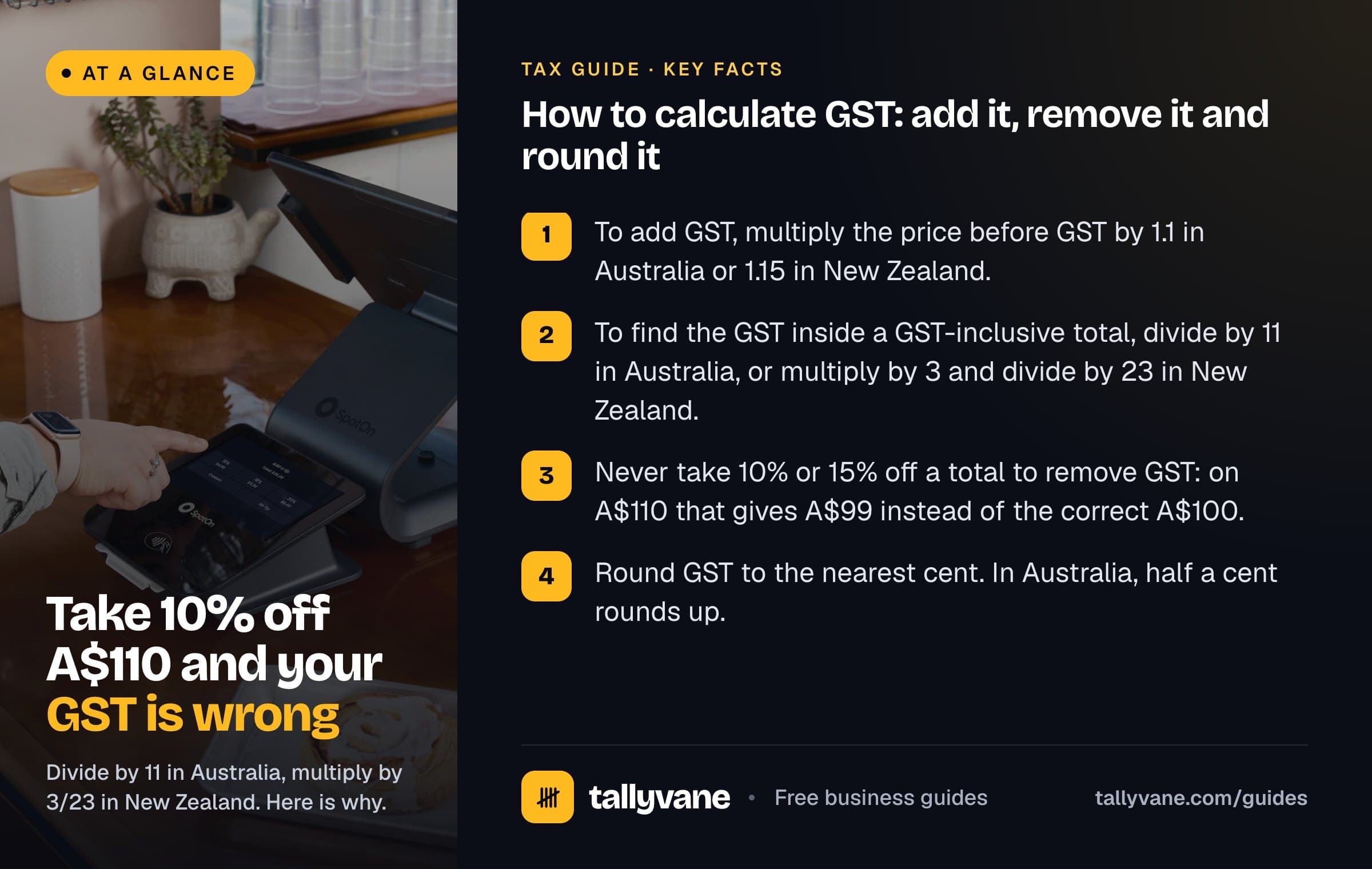
How to add GST to a price
Start with the price before GST, also called the GST-exclusive price. Multiply it by the rate to get the GST, then add the two together. Or skip a step and multiply by 1.1 (Australia) or 1.15 (New Zealand) to get the total in one go.
For a A$250 job, the GST is A$25 and the total is A$275. For a NZ$80 item, the GST is NZ$12 and the total is NZ$92.
Australia: GST = Price × 0.10 Total = Price × 1.10 New Zealand: GST = Price × 0.15 Total = Price × 1.15
How to remove GST from an inclusive price
When a price already includes GST, the GST is a share of the total, not 10% or 15% of it. A GST-inclusive total is the price before GST plus GST, so in Australia it is 110% of the price before GST. The GST is 10 parts out of those 110, which simplifies to 1 part in 11. That is why you divide by 11.
New Zealand works the same way. The total is 115% of the price before GST, so GST is 15 parts in 115. Divide both by 5 and you get 3 parts in 23. Multiply the total by 3 and divide by 23, which is the same as taking about 13.04% of it.
To get the price before GST, either subtract the GST from the total or divide the total by 1.1 (Australia) or 1.15 (New Zealand). Both give the same answer.
Australia: GST in a total = Total ÷ 11 Price before GST = Total ÷ 1.1 New Zealand: GST in a total = Total × 3 ÷ 23 Price before GST = Total ÷ 1.15
Free toolGST calculatorThe common mistake: taking 10% or 15% off
The most common error is to work out GST as 10% or 15% of a total that already includes it. GST is charged on the price before GST, which is smaller than the total, so this always takes off too much.
On a A$3,300 payment, 10% of the total is A$330, but the real GST is A$300 and the income is A$3,000. On a NZ$2,875 invoice, 15% of the total is NZ$431.25, but the real GST is NZ$375. Record the wrong figure and you overstate the GST you owe, understate your income, and your records stop matching the invoices.
The same trap catches people the other way. Dividing by 10 instead of 11 in Australia overstates the GST by 10%: A$110 ÷ 10 gives A$11 instead of A$10.
Worked examples: inclusive to exclusive
These are GST-inclusive totals, the kind you see on a receipt or a customer payment. The last column shows the wrong answer you get by taking the rate off the total, so you can see how far off it is.
- Check any answer by adding GST back on: A$45.41 × 1.1 = A$49.95, and NZ$869.57 × 1.15 = NZ$1,000.00 to the cent.
- If you set prices you want to end in a round number, work backwards: a A$50.00 shelf price means a pre-GST price of A$45.45 and GST of A$4.55.
| Country | Total incl. GST | Shortcut | GST | Price before GST | Wrong: rate off total |
|---|---|---|---|---|---|
| Australia | A$110.00 | ÷ 11 | A$10.00 | A$100.00 | A$99.00 |
| Australia | A$49.95 | ÷ 11 | A$4.54 | A$45.41 | A$44.96 |
| Australia | A$1,650.00 | ÷ 11 | A$150.00 | A$1,500.00 | A$1,485.00 |
| Australia | A$3,300.00 | ÷ 11 | A$300.00 | A$3,000.00 | A$2,970.00 |
| New Zealand | NZ$115.00 | × 3 ÷ 23 | NZ$15.00 | NZ$100.00 | NZ$97.75 |
| New Zealand | NZ$49.95 | × 3 ÷ 23 | NZ$6.52 | NZ$43.43 | NZ$42.46 |
| New Zealand | NZ$1,000.00 | × 3 ÷ 23 | NZ$130.43 | NZ$869.57 | NZ$850.00 |
| New Zealand | NZ$2,875.00 | × 3 ÷ 23 | NZ$375.00 | NZ$2,500.00 | NZ$2,443.75 |
Rounding GST to the cent
GST often comes out at a fraction of a cent, as A$49.95 ÷ 11 = A$4.5409 does. Round it to the nearest cent. The ATO’s rule for tax invoices is that half a cent rounds up, so A$0.335 becomes A$0.34.
On an invoice with several lines, rounding each line and adding them up can give a different answer from adding the lines first and rounding once. Three items at A$3.35 each before GST show the difference: rounded per line, GST is A$0.34 × 3 = A$1.02; worked on the A$10.05 total, it is A$1.005, which rounds to A$1.01.
The ATO accepts either approach for a tax invoice, and your customer does not have to use the same method as you. What matters is that you pick one, use it consistently, and set your invoicing or accounting software to match. A one-cent difference between your records and a supplier’s invoice is normally just rounding, not an error.
When you have to register for GST
You only charge GST if you are registered, and registration becomes compulsory at a turnover threshold. Below it you can choose to register, for example to claim GST credits on business purchases, but then you must charge GST on your taxable sales.
In Australia, you must register once your GST turnover reaches A$75,000 a year, or A$150,000 for a non-profit organisation. The ATO looks at both current turnover (this month and the previous 11) and projected turnover (this month and the next 11). Taxi and ride-sourcing drivers must register whatever their turnover. Prices shown to consumers must include GST.
In New Zealand, you must register if your turnover was at least NZ$60,000 in the last 12 months, or you expect it to reach NZ$60,000 in the next 12 months.
Thresholds and rules change, so confirm them on the ATO and Inland Revenue websites before you decide. For Canada’s $30,000 small supplier test and provincial rates, see the GST/HST calculator.
| Australia | New Zealand | |
|---|---|---|
| Rate | 10% | 15% |
| GST inside a total | Total ÷ 11 | Total × 3 ÷ 23 |
| Price before GST | Total ÷ 1.1 | Total ÷ 1.15 |
| Must register from | A$75,000 GST turnover (A$150,000 non-profit) | NZ$60,000 turnover in 12 months |
| Tax office | Australian Taxation Office | Inland Revenue |