Key takeaways
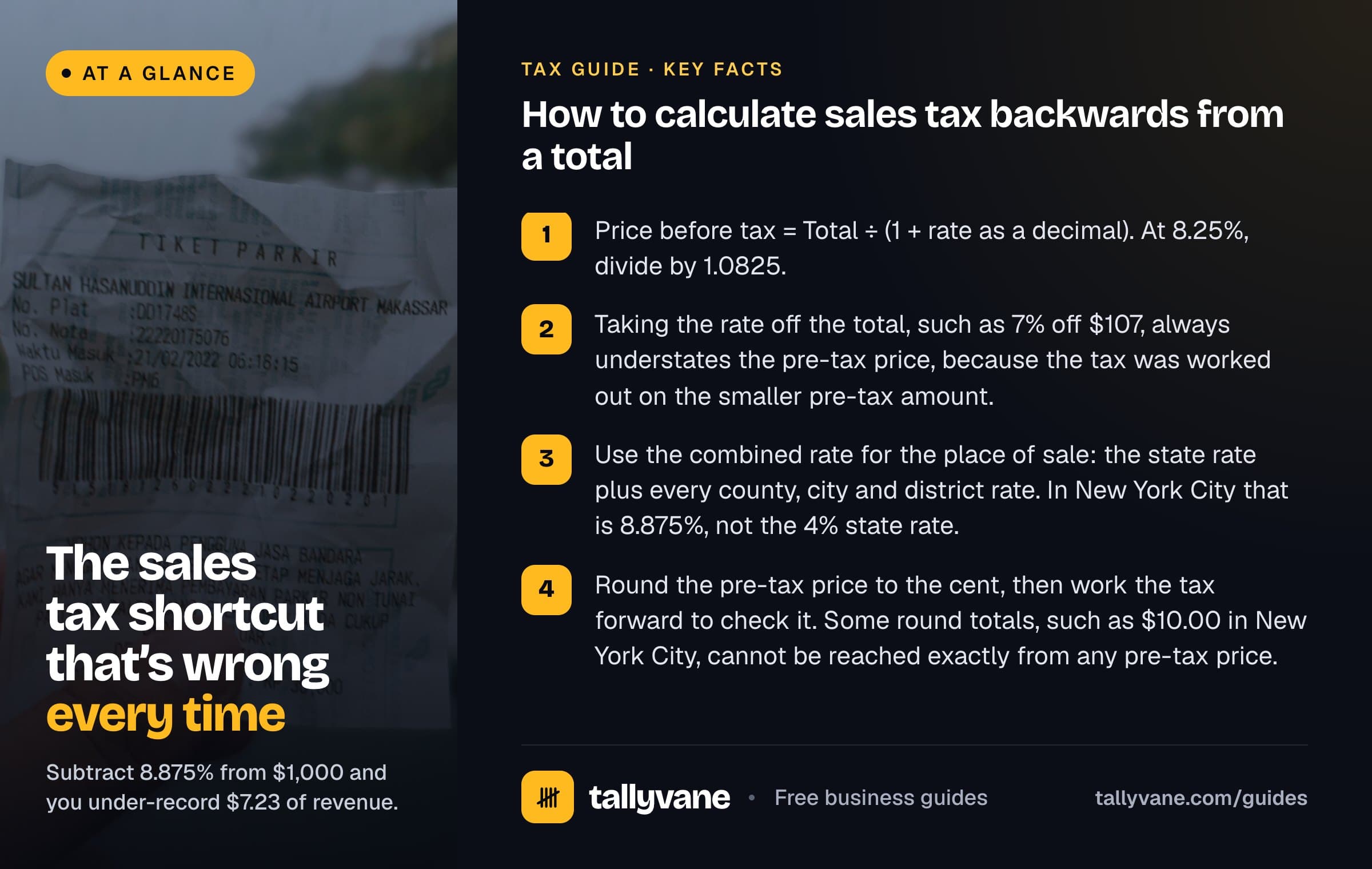
- Price before tax = Total ÷ (1 + rate as a decimal). At 8.25%, divide by 1.0825.
- Taking the rate off the total, such as 7% off $107, always understates the pre-tax price, because the tax was worked out on the smaller pre-tax amount.
- Use the combined rate for the place of sale: the state rate plus every county, city and district rate. In New York City that is 8.875%, not the 4% state rate.
- Round the pre-tax price to the cent, then work the tax forward to check it. Some round totals, such as $10.00 in New York City, cannot be reached exactly from any pre-tax price.
When you need to work sales tax backwards
Most US prices are shown before tax, and tax is added at the register. But plenty of everyday numbers already have the tax baked in: a receipt that shows only the total, a bank statement line for a business purchase, a market stall that charges $20 flat, or a customer who says they want to spend exactly $100.
In each case you need to split the total into two parts: the price before tax, which is your revenue or your cost, and the tax, which belongs to the state. You need that split for your books, for your sales tax return, and to see what you really earn on a sale.
The formula: divide by one plus the rate
A tax-inclusive total is the pre-tax price multiplied by one plus the rate. At 7%, a $100 item costs $100 × 1.07 = $107. To go back, reverse the step: divide the total by 1.07.
Turn the percentage into a decimal first by dividing it by 100, then add 1. A rate of 8.875% becomes 0.08875, and the divisor is 1.08875. The tax is whatever is left when you take the pre-tax price away from the total.
If you only want the tax, there is a shortcut: multiply the total by the rate, then divide by one plus the rate. At 7%, $107 × 0.07 ÷ 1.07 = $7.
Price before tax = Total ÷ (1 + Rate % ÷ 100) Sales tax = Total − Price before tax Shortcut: Sales tax = Total × Rate ÷ (1 + Rate)
Free toolSales tax calculatorWhy subtracting the rate gives the wrong answer
The most common mistake is to take the tax rate off the total. Take 7% off $107 and you get $99.51. The real pre-tax price is $100.00.
The reason is that sales tax is a percentage of the pre-tax price, not of the total. Seven percent of $107 is $7.49, but the tax actually charged was 7% of $100, which is $7.00. Subtracting the rate always takes off too much, because it applies the rate to a number that already includes the tax.
The error grows with the rate and the amount. On a $1,000 total in New York City, taking 8.875% off gives $911.25, while the correct pre-tax price is $918.48. That is $7.23 of revenue you would under-record on a single sale, and $7.23 too much tax reported to the state.
Wrong: $107 × (1 − 0.07) = $99.51 Right: $107 ÷ 1.07 = $100.00
Use the combined state and local rate
The formula is only as good as the rate you put in. In most states, the rate a customer pays is the state rate plus county, city and special district rates. If you divide by the state rate alone, you will overstate your pre-tax price and understate the tax you owe.
Some real 2026 combinations show how far apart the two can be. Texas has a 6.25% state rate, and local jurisdictions can add up to 2%, for a maximum combined rate of 8.25%. New York City is 8.875%: the 4% state rate, the city’s 4.5% and a 0.375% transit surcharge. Chicago is 10.25% on general merchandise: Illinois’s 6.25% state rate plus 4% of local taxes. Indiana, by contrast, has no local sales taxes, so 7% applies everywhere in the state.
Rates are set by address and change during the year, often on January 1, April 1, July 1 or October 1. Check the combined rate on the state revenue department’s rate lookup for the address where the sale is taxed, or in your checkout software. Our state sales tax pages list each state’s base rate and whether local taxes apply.
| Place | Rate used | Price before tax | Sales tax |
|---|---|---|---|
| Texas, state rate only (wrong) | 6.25% | $101.88 | $6.37 |
| Texas, 8.25% combined (right) | 8.25% | $100.00 | $8.25 |
Worked examples at real 2026 rates
Each line below starts from a tax-inclusive total and works back to the price before tax. The last column shows what you would have recorded by wrongly subtracting the rate.
- Check any line by working forward: $45.92 × 8.875% = $4.08 of tax, and $45.92 + $4.08 = $50.00.
- In Chicago, almost a tenth of a $100 total is tax. Pricing as if the full $100 were revenue overstates income by $9.30.
| Total paid | Combined rate | Divide by | Price before tax | Sales tax | Wrong (rate subtracted) |
|---|---|---|---|---|---|
| $25.00 | 7% (Indiana) | 1.07 | $23.36 | $1.64 | $23.25 |
| $20.00 | 8.25% (Texas maximum) | 1.0825 | $18.48 | $1.52 | $18.35 |
| $150.00 | 8.25% (Texas maximum) | 1.0825 | $138.57 | $11.43 | $137.63 |
| $50.00 | 8.875% (New York City) | 1.08875 | $45.92 | $4.08 | $45.56 |
| $1,000.00 | 8.875% (New York City) | 1.08875 | $918.48 | $81.52 | $911.25 |
| $100.00 | 10.25% (Chicago) | 1.1025 | $90.70 | $9.30 | $89.75 |
Rounding: round once, then check forward
Dividing by one plus the rate rarely gives a whole number of cents. $20 ÷ 1.0825 is $18.4757…, which rounds to $18.48. Round the pre-tax price to the nearest cent, then find the tax by subtracting it from the total, so the two parts always add back to what the customer paid.
Then check the result forward, the way a register would. Tax on $18.48 at 8.25% is $1.5246, which rounds to $1.52, and $18.48 + $1.52 = $20.00. The numbers match.
Sometimes they cannot match. In New York City, a $10.00 total divided by 1.08875 is $9.18. But a register charging $9.18 adds $0.81 of tax, for $9.99, and one charging $9.19 adds $0.82, for $10.01. No pre-tax price gives exactly $10.00. If you want a round tax-inclusive price, accept that the tax you report may differ from a clean percentage by a cent, and keep your records consistent with what your register or checkout actually charged.
Rounding rules also differ between systems. Some round tax on each item and others once per order, which can move a total by a cent or two. Check what your state requires and how your point-of-sale software is set.
When customers pay a round number
Market traders, food trucks, salons and event sellers often charge tax-inclusive prices such as $5, $20 or $50 so they can avoid handling coins. That is fine in many states, but the tax is still owed. You do not earn the whole $20: in a Texas city at 8.25%, $1.52 of it belongs to the state and your sale is $18.48.
Set your round prices by working backwards from the price you want to earn. If you need at least $18.50 on an item, a $20 tax-inclusive price at 8.25% falls just short, so you would need to charge more or accept the lower figure. Run the numbers for your bestsellers before the event, not after.
Some states have rules about advertising tax-included prices or require you to tell the customer that tax is included, for example with a sign or a line on the receipt. Check your state revenue department’s guidance on tax-included pricing before you rely on it, and record each sale’s tax separately so your sales tax return matches your takings.
- A $5 tax-inclusive price at 8.25% is $4.62 of revenue and $0.38 of tax.
- A $100 sale in Chicago at 10.25% is $90.70 of revenue and $9.30 of tax.
- Give customers a receipt that shows the tax, which a receipt maker can do in seconds.