Key takeaways
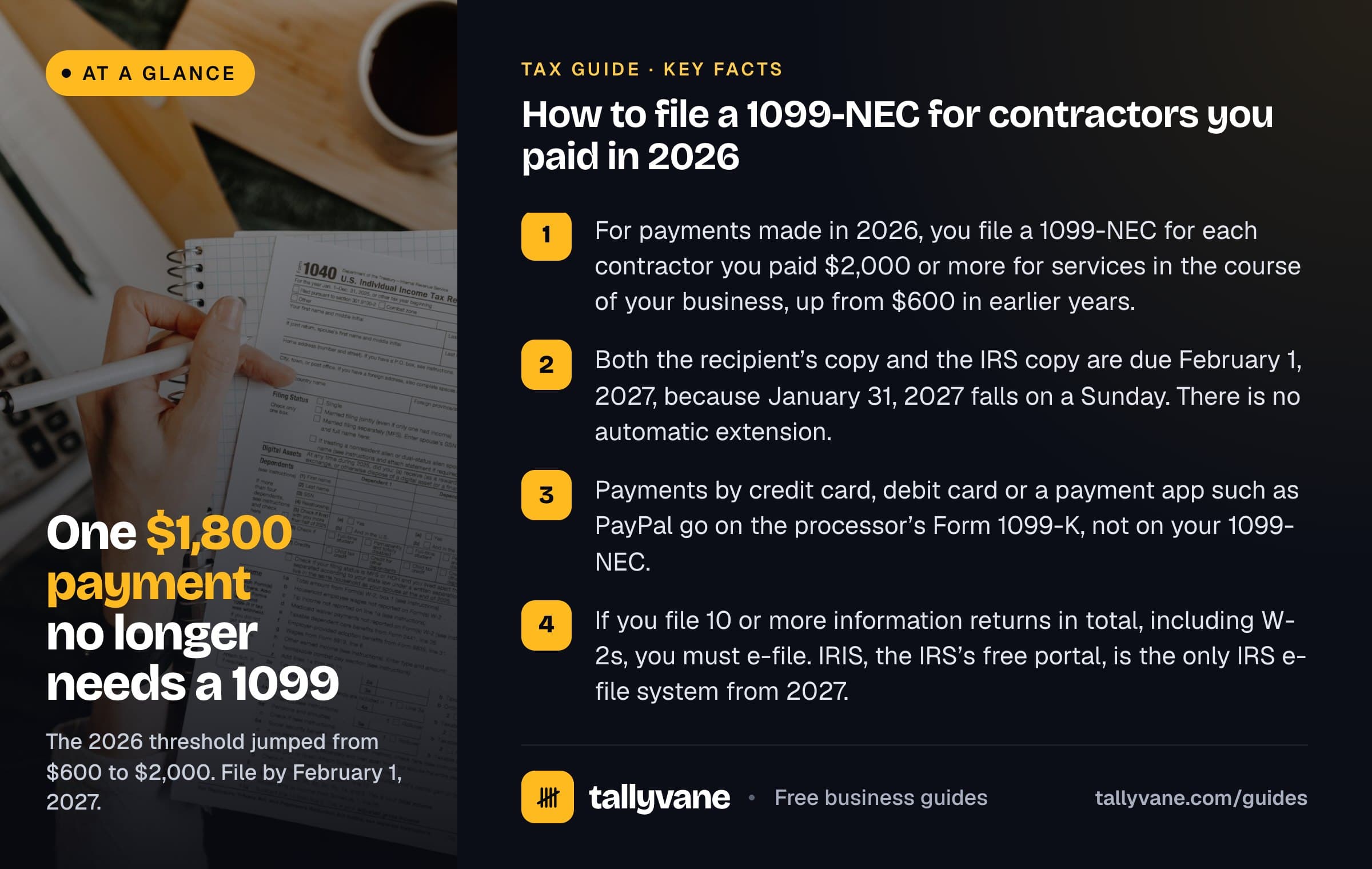
- For payments made in 2026, you file a 1099-NEC for each contractor you paid $2,000 or more for services in the course of your business, up from $600 in earlier years.
- Both the recipient’s copy and the IRS copy are due February 1, 2027, because January 31, 2027 falls on a Sunday. There is no automatic extension.
- Payments by credit card, debit card or a payment app such as PayPal go on the processor’s Form 1099-K, not on your 1099-NEC.
- If you file 10 or more information returns in total, including W-2s, you must e-file. IRIS, the IRS’s free portal, is the only IRS e-file system from 2027.
- A 1099-NEC filed more than 30 days late costs $130 per form, or $340 if filed after August 1, 2027 or never filed.
Who gets a 1099-NEC for 2026
Form 1099-NEC reports nonemployee compensation: money you paid someone who is not your employee for services, in the course of your trade or business. Freelancers, independent contractors, sole proprietors, partnerships and most LLCs that you paid for work all count. Parts and materials supplied as part of the service count too.
The One, Big, Beautiful Bill Act raised the reporting threshold from $600 to $2,000 for payments made after December 31, 2025. The IRS instructions for the 2026 forms confirm the $2,000 figure and say it may be adjusted for inflation from 2027. So for work paid in 2026, add up what you paid each contractor during the year. At $2,000 or more, they need a 1099-NEC.
- Do file for: sole proprietors, single-member LLCs, partnerships and LLCs taxed as partnerships paid $2,000 or more for services.
- Do file for attorneys paid $2,000 or more in fees, even if their firm is a corporation.
- Do not file for: corporations and LLCs taxed as C or S corporations (except attorneys), payments for goods or merchandise, rent, freight or storage, or personal payments that are not for your business.
- Do not file for employees. Their pay goes on Form W-2.
Collect a W-9 before you pay
Form W-9 is how a contractor gives you their legal name, tax classification, address and taxpayer identification number (TIN), either a Social Security number or an employer identification number. You keep it on file; you do not send it to the IRS. The tax classification box tells you whether they are a corporation and so exempt from 1099 reporting.
Ask for the W-9 before the first payment, not in January. A contractor who has already been paid has little reason to reply quickly, and you need the TIN to file on time. Store W-9s with your contractor invoices so the payment totals and identity details are in one place.
Free toolInvoice generatorBackup withholding when a contractor will not give a TIN
If a contractor you will pay a reportable amount does not give you a TIN, you must withhold federal income tax from their payments at 24%. This is backup withholding. You also start it if the IRS sends you a notice that the TIN you filed does not match their name and the problem is not fixed in time.
Backup withholding is deposited with your other federal tax deposits and reported once a year on Form 945. You must file a 1099-NEC for anyone you backup withheld from, whatever the amount, and show the tax withheld in box 4. You can stop once the contractor gives you a correct, signed W-9.
Backup withholding = Payment × 24% Example: $2,500 invoice × 24% = $600 withheld; the contractor receives $1,900
Card and PayPal payments go on a 1099-K, not a 1099-NEC
If you paid a contractor by credit card, debit card or through a third-party payment network such as PayPal, those payments are reported by the payment company on Form 1099-K. The IRS instructions say you leave them off the 1099-NEC, so the same income is not reported twice.
Only count payments made by check, bank transfer, ACH or cash toward the $2,000 threshold. If you paid one contractor partly by bank transfer and partly by card, only the bank transfer part counts. Whether the payment company issues a 1099-K is its responsibility under its own threshold, not yours.
Worked example: a small design studio
A two-person design studio paid six outside workers in 2026. It checks each one’s W-9 and how it paid them, and totals only the payments that count.
- The studio files three 1099-NECs. Under the old $600 rule, the photographer would have needed one too.
- The illustrator’s $900 PayPal payment will appear on PayPal’s records, not the studio’s 1099-NEC.
- With two employees’ W-2s added, the studio files five information returns in total, so it may file on paper, though e-filing through IRIS is free.
| Payee | Paid in 2026 | How paid | 1099-NEC? |
|---|---|---|---|
| Web developer, single-member LLC | $4,500 | Bank transfer | Yes, $4,500 in box 1 |
| Bookkeeper, LLC taxed as an S corporation | $3,600 | Bank transfer | No, a corporation |
| Photographer, sole proprietor | $1,800 | Check | No, under $2,000 |
| Illustrator, sole proprietor | $2,400 | $1,500 check, $900 PayPal | No, only $1,500 counts |
| Attorney, professional corporation | $2,500 | Check | Yes, attorneys are not exempt |
| Copywriter, sole proprietor | $2,200 | $1,200 cash, $1,000 transfer | Yes, $2,200 in box 1 |

How to file: deadlines, IRIS and paper
Send each contractor their copy and file the IRS copy by the same date. The law sets January 31, but when a due date falls on a weekend or legal holiday it moves to the next business day. January 31, 2027 is a Sunday, so the deadline for 2026 forms is Monday, February 1, 2027. Form 8809 does not give an automatic extension for the 1099-NEC.
If you file 10 or more information returns of all types combined, including W-2s, you must file electronically. The IRS Information Returns Intake System (IRIS) has a free Taxpayer Portal where you can type returns in or upload a CSV file. The older FIRE system took its last filings on November 19, 2026, and from January 1, 2027 IRIS is the only IRS system for e-filing 1099s. You need an IRIS Transmitter Control Code, so apply well before January. Many payroll and accounting services file for you instead.
Under 10 returns you may still file on paper, but you must use the official red-ink Copy A ordered from the IRS, not a printout from its website, and send a Form 1096 summary with them. Many states also require their own copy of the 1099-NEC, so check your state revenue department.
- Payer: your business name, address and TIN.
- Recipient: name, address and TIN from their W-9.
- Box 1: total nonemployee compensation paid in 2026, excluding card and payment app payments.
- Box 4: any federal income tax you backup withheld.
- Boxes 5 to 7: state tax withheld and state details, if your state requires them.
Penalties for late or wrong forms
The IRS charges one penalty for a late or incorrect IRS copy and a separate one for a late or incorrect recipient copy, so missing both can double the cost. The amount depends on how late the correct form is filed. Small businesses, those with average gross receipts of $5 million or less, have lower annual maximums.
| When the correct form is filed | Penalty per form | Small business yearly maximum |
|---|---|---|
| Within 30 days of the due date | $60 | $244,500 |
| 31 days late through August 1, 2027 | $130 | $698,500 |
| After August 1, 2027, or not at all | $340 | $1,397,000 |
| Intentional disregard | $690 or more | No maximum |
If you are the contractor
Receiving a 1099-NEC does not change what you owe. All your business income is taxable, including payments under $2,000 and card payments that never appear on a 1099-NEC. You pay income tax and self-employment tax on the profit, usually through quarterly estimated payments, so check that your clients’ forms match your own records before you file.
Free toolSelf-employment tax calculator