Key takeaways
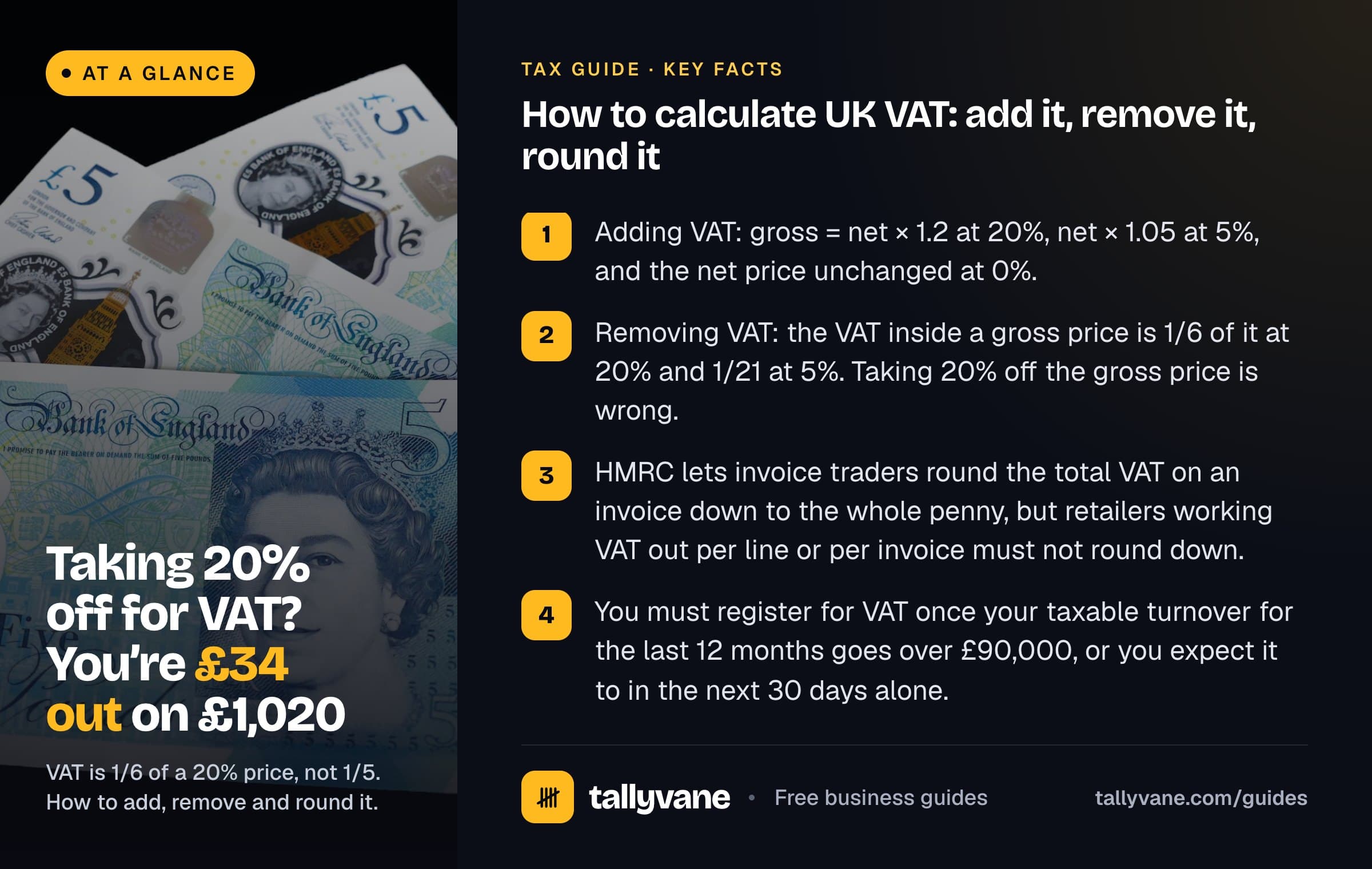
- Adding VAT: gross = net × 1.2 at 20%, net × 1.05 at 5%, and the net price unchanged at 0%.
- Removing VAT: the VAT inside a gross price is 1/6 of it at 20% and 1/21 at 5%. Taking 20% off the gross price is wrong.
- HMRC lets invoice traders round the total VAT on an invoice down to the whole penny, but retailers working VAT out per line or per invoice must not round down.
- You must register for VAT once your taxable turnover for the last 12 months goes over £90,000, or you expect it to in the next 30 days alone.
The three UK VAT rates
The UK has three rates. The standard rate of 20% covers most goods and services. The reduced rate of 5% covers some items, such as children’s car seats and home energy. The zero rate of 0% covers things like most food and children’s clothes.
Zero-rated is not the same as exempt. A zero-rated sale is still a taxable supply: it counts towards your VAT turnover and you can reclaim VAT on the costs of making it. An exempt sale, such as postage stamps or most financial and property transactions, sits outside VAT altogether.
Rates can change for specific goods. From 1 October 2026 to 31 March 2027, qualifying domestic electricity in Great Britain is temporarily zero-rated instead of 5%. In Northern Ireland it stays at 5%, and other fuels are not affected. Check the GOV.UK rate for your product before you price it.
How to add VAT to a price
Start with the net price, the amount before VAT. Multiply it by the rate to get the VAT, then add the two together. Or do it in one step by multiplying by one plus the rate: 1.2 at 20%, 1.05 at 5%.
A web designer who quotes £850 net adds £170 of VAT at 20% and invoices £1,020. A supplier of children’s car seats at 5% who sells one for £64 net adds £3.20 and charges £67.20. At 0% the VAT is nil and the gross price equals the net price, but the sale still goes on your VAT return.
VAT = Net × Rate % ÷ 100 Gross at 20% = Net × 1.2 Gross at 5% = Net × 1.05
Free toolVAT calculatorHow to remove VAT: the VAT fraction
When a price already includes VAT, you cannot take 20% off it. The VAT was 20% of the net price, and the gross price is bigger, so 20% of the gross price is too much.
HMRC’s VAT guide gives the method instead: the VAT fraction, which is the rate divided by 100 plus the rate. At 20% that is 20/120, or 1/6. At 5% it is 5/105, or 1/21. Multiply the gross price by the fraction to get the VAT, and the rest is the net price.
You get the same answer by dividing the gross price by 1.2 (or 1.05) to find the net price first. Use whichever you find easier. HMRC’s own example: a £2.40 price at 20% contains 40p of VAT, one sixth of the price, not 48p.
VAT fraction = Rate ÷ (100 + Rate) At 20%: VAT = Gross × 1/6, Net = Gross ÷ 1.2 At 5%: VAT = Gross × 1/21, Net = Gross ÷ 1.05 Wrong: Net = Gross × 0.8
Worked examples at 20%, 5% and 0%
The table works from gross prices back to net and VAT. The last column shows the net figure you would get by wrongly taking the rate off the gross price.
- On a £1,020 invoice, taking 20% off would understate your net income by £34 and overstate the VAT by the same amount.
- At 5% the gap is smaller but still there: £250 gross is £238.10 net, not £237.50.
| Gross price | Rate | VAT fraction | VAT | Net price | Wrong (rate taken off) |
|---|---|---|---|---|---|
| £60.00 | 20% | 1/6 | £10.00 | £50.00 | £48.00 |
| £120.00 | 20% | 1/6 | £20.00 | £100.00 | £96.00 |
| £1,020.00 | 20% | 1/6 | £170.00 | £850.00 | £816.00 |
| £42.00 | 5% | 1/21 | £2.00 | £40.00 | £39.90 |
| £250.00 | 5% | 1/21 | £11.90 | £238.10 | £237.50 |
| £36.00 | 0% | None | £0.00 | £36.00 | £36.00 |
Rounding: what HMRC allows
VAT rarely comes out in whole pennies, and HMRC’s VAT guide (Notice 700, section 17) sets out how you may round. The rules depend on whether you work VAT out on the whole invoice, on each line, or on each unit.
Take a £99.99 gross price at 20%. One sixth of it is £16.665. Rounded to the nearest penny that is £16.67; rounded down it is £16.66. Which one you use depends on the rules below. Pick a method, apply it the same way every time, and make sure your invoicing or till software does the same.
- Invoice total: if you issue VAT invoices, you may round the total VAT on an invoice down to the whole penny. This is meant for invoice traders where the VAT you charge customers is the VAT you pay HMRC, not for retailers.
- Per line: if you work VAT out on each line, round each line down to the nearest 0.1p, or to the nearest 1p or 0.5p, then you may round the invoice total down to the whole penny.
- Per unit, for example in a price list: work to four decimal places and round to three, or round to the nearest 1p or 0.5p. Under the second option you must not round the VAT on a standard-rated or reduced-rated item down to nil.
- Retailers: if you use a retail scheme, these rules do not apply to you. If you work VAT out per line or per invoice, you must not round the VAT down; you may round each calculation up or down to the nearest penny.
When you have to register for VAT
You can only charge VAT if you are VAT-registered. You must register if your total taxable turnover for the last 12 months goes over £90,000. This is a rolling 12 months, not the tax year: check it at the end of every month. You then have 30 days from the end of that month to register, and your registration takes effect from the first day of the second month after you went over.
You must also register if you expect your taxable turnover to go over £90,000 in the next 30 days alone, for example because you have just won a large contract. In that case you register by the end of those 30 days.
Taxable turnover includes zero-rated sales but not exempt ones. If your turnover later falls below £88,000, you can choose to cancel your registration. You can also register voluntarily below the threshold, which can make sense if most of your customers are VAT-registered businesses that can reclaim what you charge.
The Flat Rate Scheme in brief
Small businesses with VAT turnover of £150,000 or less, excluding VAT, may be able to join the Flat Rate Scheme. You still charge your customers VAT at the normal rate, but instead of paying HMRC the difference between the VAT you charge and the VAT you pay, you pay a fixed percentage of your VAT-inclusive turnover. The percentage depends on your type of business.
GOV.UK’s example is a photographer who bills £1,000 plus £200 VAT. At the photography flat rate of 11%, they pay HMRC 11% of £1,200, which is £132, and keep the remaining £68 of the VAT they charged. The trade-off is that you generally cannot reclaim VAT on purchases, except some capital assets over £2,000.
Two adjustments matter. In your first year as a VAT-registered business you get a 1% discount on your flat rate. And if you are a limited cost business, meaning your spending on goods is less than 2% of turnover, or more than that but under £1,000 a year, you pay 16.5% whatever your sector. Run the numbers both ways before you join.
Free toolInvoice generator