Key takeaways
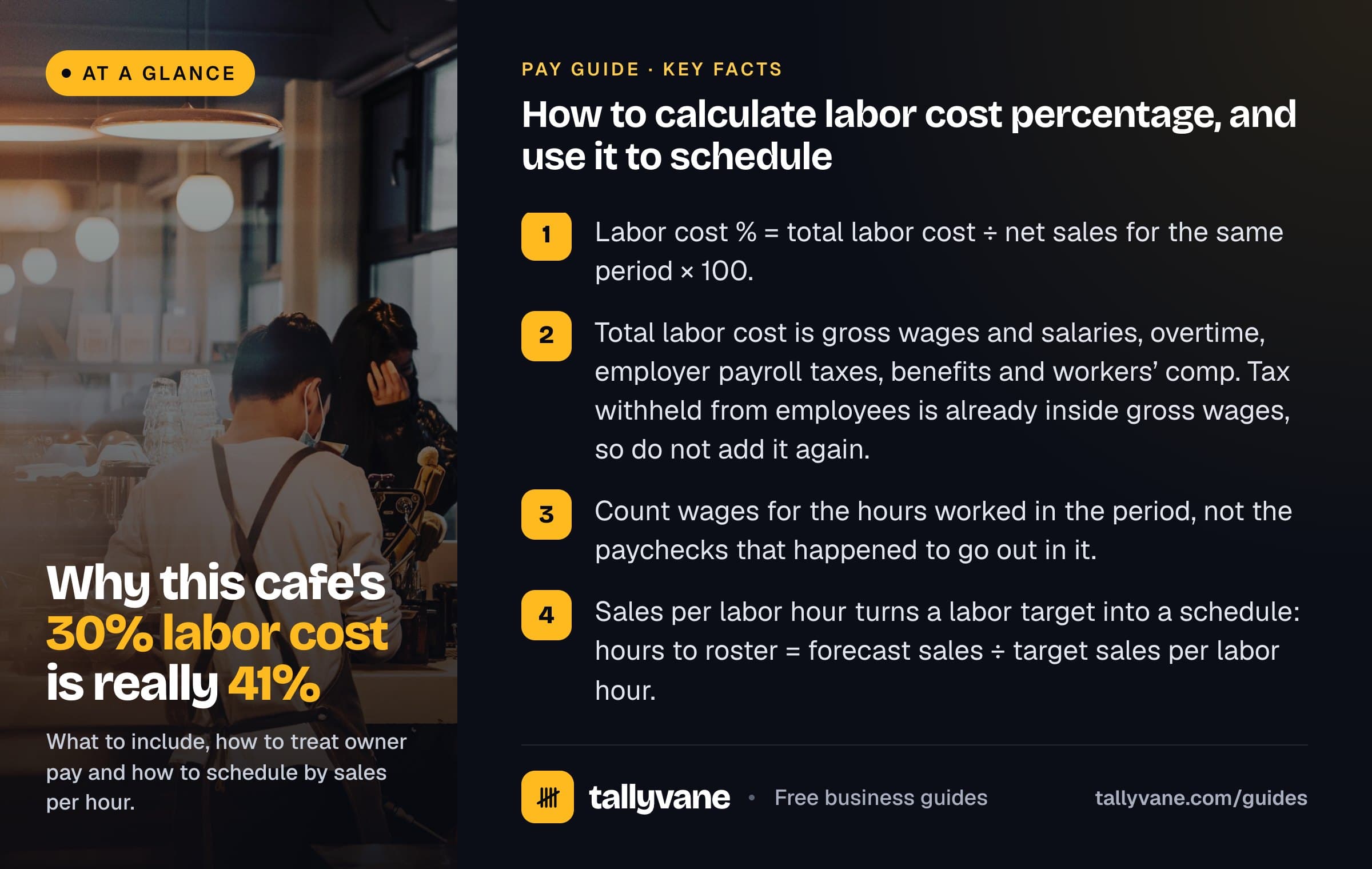
- Labor cost % = total labor cost ÷ net sales for the same period × 100.
- Total labor cost is gross wages and salaries, overtime, employer payroll taxes, benefits and workers’ comp. Tax withheld from employees is already inside gross wages, so do not add it again.
- Count wages for the hours worked in the period, not the paychecks that happened to go out in it.
- Sales per labor hour turns a labor target into a schedule: hours to roster = forecast sales ÷ target sales per labor hour.
- If you work in the business without a wage, add a market wage for your hours to see the true figure.
The labor cost percentage formula
Labor cost percentage compares what you spend on people with what they help you sell. A cafe that spends $12,700 on labor to take $42,000 has a labor cost of about 30%: thirty cents of every sales dollar goes on staff.
Use net sales: after discounts and refunds, and without sales tax or tips, neither of which is your revenue. Then make sure labor and sales cover exactly the same days. Pay periods rarely line up with calendar months, so if a two-week pay period straddles month end, split it by the days worked. Otherwise a month with three paydays looks far worse than one with two.
Labor cost % = Total labor cost ÷ Net sales × 100 Total labor cost = Gross wages and salaries + Overtime + Employer payroll taxes + Benefits + Workers’ comp
What to include in labor cost
Start from gross pay, the amount before any withholding, for everyone who works in the business: hourly staff, salaried managers and anyone on a bonus. The employee’s own income tax, Social Security and Medicare are withheld from that gross figure, so they are already counted. What you add on top is the employer’s side.
- Gross wages and salaries, including paid time off and paid sick leave.
- Overtime, at the full overtime rate, plus bonuses and commissions paid to staff.
- Employer payroll taxes: 7.65% Social Security and Medicare in the US, plus federal and state unemployment tax.
- Employer Social Security and Medicare on tips your staff report. The tips themselves are not your labor cost, but the tax on them is. Certain food and beverage businesses can claim a credit for part of that tax on IRS Form 8846.
- Benefits you pay for: the employer share of health insurance and retirement contributions.
- Workers’ compensation insurance, usually priced as a rate per $100 of payroll.
- Agency or temp staff who work shifts alongside your team. Leave out outside services such as your accountant or a cleaning company.
How to handle owner pay
If you pay yourself a salary through payroll, for example as an S corporation owner who works in the business, it is labor cost like any other wage. If you take draws from a sole proprietorship or LLC instead, those come out of profit and are not labor cost on your books.
The trouble is that a cafe whose owner works 50 unpaid hours a week will report a labor cost that would be impossible if the owner ever stepped back. Work out two figures: labor cost as booked, and labor cost with a market wage for your hours, the amount you would pay a manager to do what you do. The second tells you whether the business can afford to replace you, or to grow without you on the floor.
Worked example: the $42,000-a-month cafe
This is the same cafe as in our food cost percentage guide: $42,000 of net sales in a month. Its hourly team worked 680 regular hours at an average of $16.50, and one barista worked 12 overtime hours at time and a half, $24.75 an hour. The cafe offers no health plan. Employer payroll taxes are assumed at 9% of wages, 7.65% for Social Security and Medicare plus an allowance for unemployment taxes, and workers’ comp at 1.5% of payroll. Use your own rates.
- As booked, labor is $12,726.29 ÷ $42,000 = 30.3% of sales.
- With a wage for the owner’s hours, it is 40.8%. If the owner hired a manager to take those shifts, roughly a tenth of sales would move from profit to payroll.
- To check the figure in the employee cost calculator, enter 12 months of wages ($138,204) as the salary, 9% as the employer tax rate and workers’ comp of $2,073.06 as other benefits. The annual total of $152,715.42 divided by 12 is the same $12,726.29.
| Item | Working | Amount | % of sales |
|---|---|---|---|
| Regular wages | 680 hours × $16.50 | $11,220.00 | 26.7% |
| Overtime | 12 hours × $24.75 | $297.00 | 0.7% |
| Gross wages | $11,517.00 | 27.4% | |
| Employer payroll taxes | 9% × $11,517 | $1,036.53 | 2.5% |
| Workers’ comp | 1.5% × $11,517 | $172.76 | 0.4% |
| Total labor cost | $12,726.29 | 30.3% | |
| Owner’s 200 hours at a $22 market wage | 200 × $22 | $4,400.00 | 10.5% |
| Labor cost including the owner | $17,126.29 | 40.8% |
Sales per labor hour: turning the target into a schedule
A monthly percentage arrives too late to change anything. To control labor cost you need a target you can schedule against before the week starts, and sales per labor hour (SPLH) is the usual one.
The cafe’s labor costs it $12,726.29 ÷ 692 hours = $18.39 for each hour worked, once taxes and workers’ comp are included. To keep labor at 30% of sales, each of those hours has to bring in $18.39 ÷ 0.30 = $61.30 of sales. Divide each day’s sales forecast by that figure and you have the hours to roster.
Keep a minimum crew for safety and service even on the quietest shifts, and record actual clock-in and clock-out times so you can compare the hours scheduled with the hours worked.
Sales per labor hour = Net sales ÷ Hours worked Target SPLH = Loaded cost per hour ÷ Target labor % Hours to schedule = Forecast sales ÷ Target SPLH
| Day | Forecast sales | Hours to schedule |
|---|---|---|
| Saturday | $2,200 | About 36 |
| Tuesday | $1,100 | About 18 |
Overtime: the hours that cost half as much again
Under the federal Fair Labor Standards Act, non-exempt employees must be paid at least one and a half times their regular rate for hours over 40 in a workweek, and some states add daily overtime rules. An overtime hour at the cafe costs $24.75 in wages instead of $16.50, and the payroll taxes on it rise with it.
The cafe’s 12 overtime hours cost $297, of which $99 is the overtime premium. That is small on its own, but it often signals a schedule built around one or two people. Spreading those hours across part-time staff who are under 40 for the week keeps the same coverage at the straight-time rate.
Overtime premium = Overtime hours × Regular rate × 0.5 12 × $16.50 × 0.5 = $99
Free toolOvertime pay calculatorPrime cost: labor and food together
Labor is only half of the picture for a food business. Prime cost adds labor to food and beverage cost, because the two trade off: buying pre-made pastries lowers labor and raises food cost, and baking in house does the opposite. Judge a change by what it does to prime cost, not to one line.
Our food cost percentage guide works out the cafe’s food and beverage cost for the same month: $11,300. Add the $12,726 of labor and prime cost is $24,026, or 57.2% of sales. With the owner’s market wage it would be 67.7%. Set your own ceiling by taking rent, other overheads and your profit goal off sales.
Prime cost % = (Food cost + Beverage cost + Labor cost) ÷ Net sales × 100 ($11,300 + $12,726) ÷ $42,000 = 57.2%
Seasonal swings and the January problem
Much of labor cost does not fall when sales do. You still need someone on the till and someone in the kitchen whenever the doors are open. So a quiet month pushes the percentage up unless hours come down with sales.
Say the cafe’s sales drop to $33,000 in January. If it kept its 680 hours, labor would cost $12,398.10, or 37.6% of sales. Cutting to 600 hours, with no overtime, brings it to $10,939.50, or 33.2%. Shorter opening hours in the quietest weeks or a smaller crew mid-afternoon may do more than any wage decision.
Payroll taxes are lumpy too. Federal unemployment tax applies to the first $7,000 of each employee’s wages in a year, and state unemployment taxes also stop at a yearly wage base, so most of that cost lands in the first months of the year. Compare each month with the same month last year rather than with the month before, and judge the year on its full-year percentage.