
Key takeaways
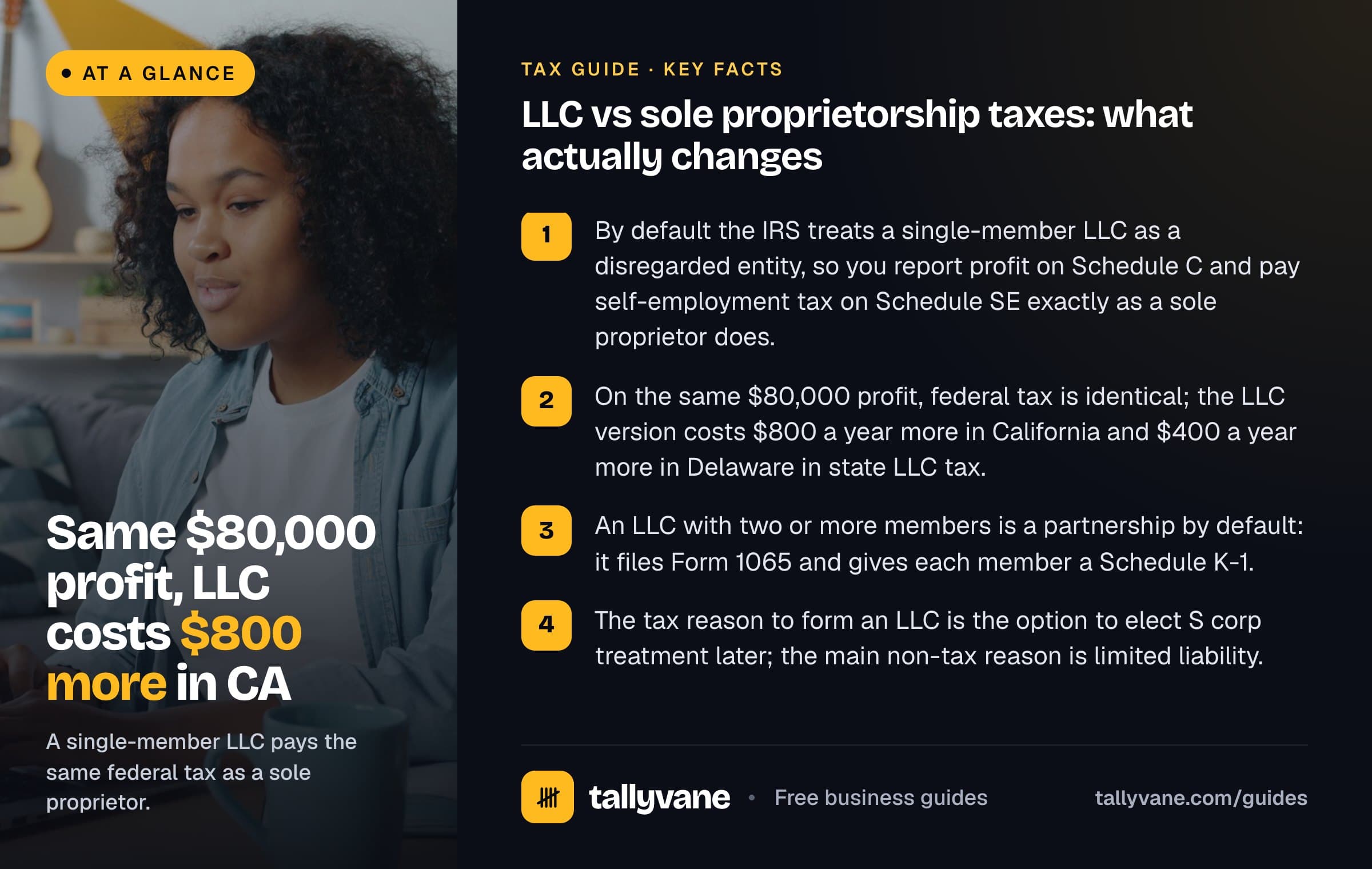
- By default the IRS treats a single-member LLC as a disregarded entity, so you report profit on Schedule C and pay self-employment tax on Schedule SE exactly as a sole proprietor does.
- On the same $80,000 profit, federal tax is identical; the LLC version costs $800 a year more in California and $400 a year more in Delaware in state LLC tax.
- An LLC with two or more members is a partnership by default: it files Form 1065 and gives each member a Schedule K-1.
- The tax reason to form an LLC is the option to elect S corp treatment later; the main non-tax reason is limited liability.
The short answer: same federal tax by default
An LLC is created under state law, not federal tax law. The IRS has no LLC tax return. Instead it slots each LLC into an existing category, and a domestic LLC with one owner is, by default, "disregarded as separate from its owner" for income tax.
Disregarded means the IRS looks straight through the LLC to you. The business income and expenses go on Schedule C of your Form 1040, the same form a sole proprietor uses. Your net profit flows to Schedule SE for self-employment tax, and you pay estimated tax on Form 1040-ES. Nothing about the rates, the deductions or the qualified business income (QBI) deduction changes because the business has "LLC" after its name.
The IRS says this directly: an individual owner of a single-member LLC is subject to self-employment tax in the same manner as a sole proprietorship. If you have been told an LLC will cut your tax bill on its own, that is not true at the federal level.
How the IRS classifies an LLC
Your LLC's tax treatment depends on how many members it has and whether it has filed an election. The default rules apply automatically unless you file Form 8832 (to be taxed as a corporation) or Form 2553 (to be taxed as an S corporation). An LLC that files a valid Form 2553 does not also need Form 8832.
| Structure | Default federal treatment | Income tax return | Owner's self-employment tax |
|---|---|---|---|
| Sole proprietorship | Not a separate entity | Schedule C with Form 1040 | Schedule SE on net profit |
| Single-member LLC | Disregarded entity | Schedule C with Form 1040 | Schedule SE on net profit |
| Multi-member LLC | Partnership | Form 1065, plus a K-1 for each member | Generally on each member's share of earnings |
| LLC electing S corp (Form 2553) | S corporation | Form 1120-S, plus a K-1 for each owner | None on distributions; payroll tax on salary |
Worked example: $80,000 profit in California and Delaware
A graphic designer, single, takes in $150,000 of revenue in 2026 and has $80,000 of net profit after expenses. Compare running the business as a sole proprietor with running it as a single-member LLC formed in California or in Delaware.
Self-employment tax on $80,000 is $11,303.64 in every column, because the IRS treats all three the same way. Federal income tax is also identical. With the 2026 standard deduction of $16,100 and the 20% QBI deduction, it comes to about $5,344.
The only difference is the state's annual charge for having an LLC. California charges every LLC organized or doing business there an $800 annual tax. Its separate LLC fee starts only at $250,000 of total California income, so this business does not owe it. Delaware currently lists a $400 annual tax for every LLC formed or registered there.
- State income tax on the $80,000 is the same in each case. The LLC tax is a charge for the entity, not a tax on your profit.
- The annual LLC tax is generally a deductible business expense, which trims federal tax slightly. The example leaves that out to keep the comparison clear.
- Forming in Delaware does not avoid California's tax. An LLC doing business in California owes the $800 there too.
| Item | Sole proprietor | SMLLC in California | SMLLC in Delaware |
|---|---|---|---|
| Federal return | Schedule C | Schedule C | Schedule C |
| Self-employment tax | $11,303.64 | $11,303.64 | $11,303.64 |
| Federal income tax (approx.) | $5,344 | $5,344 | $5,344 |
| State annual LLC tax | $0 | $800 | $400 |
| LLC fee on gross receipts | $0 | $0 (under $250,000) | $0 |
| Extra yearly cost of the LLC | $0 | $800 | $400 |
State LLC taxes and fees to check
State charges are where an LLC really costs more than a sole proprietorship. They come under different names, such as franchise tax, annual tax, annual report fee or privilege tax, and they apply whether or not the LLC makes a profit.
California is the best-known example. The $800 annual tax is due by the 15th day of the 4th month of the LLC's tax year, and it is owed every year until you formally cancel the LLC, even if you stop trading. The first-year exemption that applied to LLCs formed in 2021 to 2023 has ended. On top of that, an LLC with $250,000 or more of total California income pays an LLC fee, and a single-member LLC still files California Form 568.
- Look up your own state's secretary of state and revenue department before forming. Amounts, names and due dates vary widely from state to state.
- Count the cost of a registered agent if you form outside the state where you live, and of registering as a foreign LLC back home.
- Missing an annual payment can cost penalties and your LLC's good standing. Delaware, for example, adds a $200 penalty plus interest.
| Total California income | LLC fee |
|---|---|
| Under $250,000 | $0 |
| $250,000 to $499,999 | $900 |
| $500,000 to $999,999 | $2,500 |
| $1,000,000 to $4,999,999 | $6,000 |
| $5,000,000 or more | $11,790 |
Multi-member LLCs are taxed as partnerships
Add a second member and the default changes. A domestic LLC with two or more members is classified as a partnership. The LLC files Form 1065, an information return, and pays no federal income tax itself. Each member gets a Schedule K-1 showing their share of income, deductions and credits, and reports it on their own return.
Members who work in the business generally pay self-employment tax on their share of earnings, just as general partners do. The total tax may look similar to two sole proprietors, but the paperwork is heavier: a separate return due by the 15th day of the 3rd month after the tax year ends, and K-1s that members need before they can file.
Spouses should take care. A business that spouses run through an LLC cannot use the qualified joint venture election that lets unincorporated spouses each file a Schedule C. Spouses in community property states may be able to treat a jointly owned LLC as disregarded; check with a tax professional.

EIN, payroll and paperwork
A disregarded single-member LLC with no employees and no excise tax liability can use your Social Security number or EIN for income tax. Once it has employees, it needs its own EIN, because the IRS treats a disregarded LLC as a separate entity for employment taxes and certain excise taxes. The IRS also notes that most new single-member LLCs will end up needing an EIN, and most banks ask for one to open a business account.
An EIN is free from the IRS. Getting one does not change how the LLC is taxed.
The real day-to-day change is discipline. Liability protection depends on keeping business and personal money apart, so you will want a separate bank account and clean books. Those habits also make Schedule C easier at tax time.
When an LLC can lower your taxes
An LLC on its own does not reduce federal tax. What it does is let you elect S corporation treatment without incorporating. As an S corp, you pay yourself a reasonable salary through payroll and take the rest of the profit as distributions that carry no Social Security or Medicare tax. At higher profits that can save thousands, but it brings payroll costs, a separate return and possible state taxes. Our guide to S corp tax savings works out where the break-even point sits.
Liability protection is a legal matter, not a tax one. An LLC can keep business debts and lawsuits away from your personal assets, though it will not protect you from your own negligence, and lenders often ask for a personal guarantee anyway.
If you stay a sole proprietor or a default single-member LLC, nothing changes about how you pay tax during the year. Keep paying quarterly estimates that cover both income tax and self-employment tax.
Free toolQuarterly tax calculator