Key takeaways
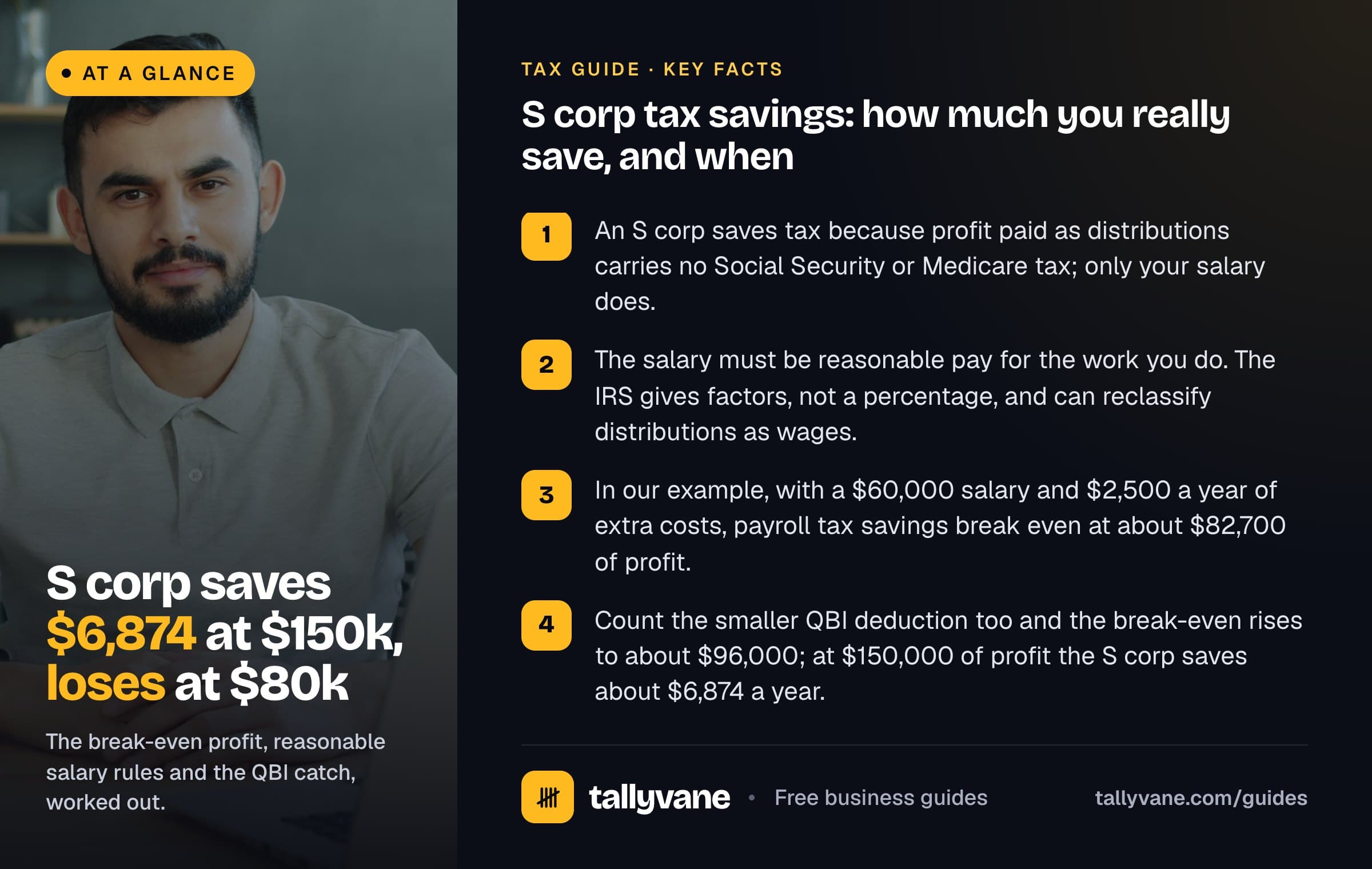
- An S corp saves tax because profit paid as distributions carries no Social Security or Medicare tax; only your salary does.
- The salary must be reasonable pay for the work you do. The IRS gives factors, not a percentage, and can reclassify distributions as wages.
- In our example, with a $60,000 salary and $2,500 a year of extra costs, payroll tax savings break even at about $82,700 of profit.
- Count the smaller QBI deduction too and the break-even rises to about $96,000; at $150,000 of profit the S corp saves about $6,874 a year.
- Salary above the 2026 Social Security wage base of $184,500 pays only Medicare tax, which shrinks the saving for very high earners.
How the S corp saving works
As a sole proprietor or single-member LLC, you pay self-employment tax on all of your net profit: 15.3% on 92.35% of it, up to the Social Security wage base. Our guide to LLC vs sole proprietorship taxes explains why an LLC alone does not change this.
An S corporation is taxed differently. You become an employee of your own business. The company pays you a salary through payroll, withholds your 7.65% share of Social Security and Medicare, and pays a matching 7.65% as the employer. Whatever profit is left passes to you as a distribution. It is still taxed as income on your personal return through Schedule K-1, but it carries no Social Security or Medicare tax.
The saving is the gap between self-employment tax on all your profit and payroll tax on your salary alone. The lower the salary relative to profit, the bigger the gap, which is exactly why the IRS insists the salary be reasonable.
Payroll tax saved = (Profit × 92.35% × 15.3%) − (Salary × 15.3%) Net saving = Payroll tax saved − extra costs − extra income tax from a smaller QBI deduction
Electing S corp status with Form 2553
You can make the election as a corporation or as an LLC. An LLC that files a valid Form 2553 is treated as a corporation from the election date, so it does not also need Form 8832. All shareholders must sign.
Timing matters. Form 2553 must be filed no more than 2 months and 15 days after the start of the tax year the election is to take effect, or at any time in the year before. For a calendar-year business that wants S status from January 1, that means by March 15. A late election may qualify for relief, but it is easier to file on time.
S corps have their own eligibility rules: a domestic company, no more than 100 shareholders, only one class of stock, and only allowed shareholders, such as US citizen or resident individuals and certain trusts and estates.
Reasonable compensation: what the IRS expects
The IRS says an S corporation must pay reasonable compensation to a shareholder-employee for their services before making non-wage distributions. If it does not, the IRS can reclassify distributions as wages and charge the payroll tax, penalties and interest.
There is no safe-harbor percentage. Rules of thumb such as "pay yourself 60% of profit" do not come from the IRS. Courts and the IRS look at what you actually do and what it would cost to hire someone else to do it. Where the company's income comes from your own personal services, that income should mostly be treated as wages.
Write down how you set your salary, with evidence such as job ads or salary surveys for your role and hours. Revisit it as the business grows.
- Your training and experience
- Your duties and responsibilities, and the time and effort you put in
- What comparable businesses pay for similar services
- The company's dividend and distribution history
- Payments to non-shareholder employees, and bonus timing
The costs of running an S corp
The payroll tax saving is not free. Before electing, add up what the S corp will cost you each year that a sole proprietorship does not.
The QBI deduction deserves the most attention. The One Big Beautiful Bill Act made the 20% section 199A deduction permanent, so it is still part of the comparison in 2026. But amounts you receive as reasonable compensation from an S corporation are not qualified business income. As a sole proprietor, nearly all your profit counts. As an S corp owner, your salary does not, so your QBI deduction usually shrinks and your income tax goes up.
- Payroll: a payroll service or software, quarterly payroll returns (Form 941 for most employers), W-2s, and federal and state unemployment tax on your own wages.
- A separate federal return, Form 1120-S, due by the 15th day of the 3rd month after the tax year ends, plus K-1s. Most owners pay a preparer for it.
- State taxes and fees. California, for example, taxes S corporations at 1.5% of net income with an $800 minimum franchise tax.
- Smaller retirement contributions where they are based on pay, such as the employer part of a solo 401(k), because they are figured on your salary.
- Lower Social Security earnings on record, since distributions do not count toward future benefits.
- Health insurance for an owner of more than 2% is reported as W-2 wages, adding a little bookkeeping.
Worked example: payroll tax at four profit levels
Take a single electrician whose business earns the profit shown before paying the owner. These figures are assumptions for the example: a reasonable salary of $60,000 for the work, and $2,500 a year of extra S corp costs for payroll, the extra return and unemployment tax. Your salary and costs will differ.
The sole proprietor column is self-employment tax as our calculator works it out: profit × 92.35% × 15.3%, with the 12.4% Social Security part capped at $184,500. The S corp column is 15.3% of the $60,000 salary, both halves together, which is $9,180.
On payroll tax alone, the saving covers the $2,500 of costs once profit reaches about $82,700. That is ($9,180 + $2,500) ÷ (92.35% × 15.3%).
| Profit before owner pay | Sole prop SE tax | S corp payroll tax | Payroll tax saved | After $2,500 costs |
|---|---|---|---|---|
| $80,000 | $11,303.64 | $9,180.00 | $2,123.64 | −$376.36 |
| $100,000 | $14,129.55 | $9,180.00 | $4,949.55 | $2,449.55 |
| $150,000 | $21,194.32 | $9,180.00 | $12,014.32 | $9,514.32 |
| $250,000 | $29,573.38 | $9,180.00 | $20,393.38 | $17,893.38 |

Adding income tax: where the S corp really breaks even
Payroll tax is only part of the picture. The full comparison below adds federal income tax for a single filer with no other income, the $16,100 standard deduction, the 2026 brackets and the 20% QBI deduction, for a business that is not a specified service trade or business.
In the S corp, the employer half of payroll tax ($4,590) and the $2,500 of costs are deducted by the company, so less profit reaches your K-1. Your QBI is only the K-1 income, not the $60,000 salary. At $100,000 of profit, the QBI deduction falls from $15,367 as a sole proprietor to $6,582 as an S corp, which adds about $1,927 of income tax and eats most of the payroll saving.
At $250,000, the sole proprietor also owes $277.88 of Additional Medicare Tax on self-employment earnings over $200,000, which is included. Both owners are above the $201,750 QBI threshold there, so the deduction is partly limited; the S corp's $60,000 of W-2 wages helps it keep more.
- With income tax included, the break-even moves from about $82,700 to about $96,000 of profit.
- State income tax and any state S corp tax are left out. In California, the 1.5% tax and $800 minimum would push the break-even higher.
- At $250,000, a $60,000 salary may be hard to defend if the profit comes from your own work. Each extra $10,000 of salary adds $1,530 of payroll tax.
| Profit before owner pay | Sole prop: income tax + SE tax | S corp: income tax + payroll tax + $2,500 | S corp saves |
|---|---|---|---|
| $80,000 | $5,344 + $11,304 = $16,648 | $6,642 + $9,180 + $2,500 = $18,322 | −$1,674 |
| $100,000 | $8,235 + $14,130 = $22,365 | $10,162 + $9,180 + $2,500 = $21,842 | $523 |
| $150,000 | $16,413 + $21,194 = $37,607 | $19,053 + $9,180 + $2,500 = $30,733 | $6,874 |
| $250,000 | $36,509 + $29,851 = $66,360 | $38,781 + $9,180 + $2,500 = $50,461 | $15,899 |
Paying yourself and the 2026 wage base
Once you elect, your salary runs through payroll like any employee's: federal income tax withholding, 6.2% Social Security and 1.45% Medicare withheld from you, and the matching employer share paid by the company. Distributions have no withholding, so you will usually still make quarterly estimated payments to cover income tax on your K-1 income.
For 2026 the Social Security wage base is $184,500. Salary above that pays only the 2.9% Medicare part, plus the 0.9% Additional Medicare Tax on wages above $200,000 for a single filer. A sole proprietor gets the same cap, which is why the saving grows more slowly at very high profits.
If your profit is still near the break-even, the extra paperwork and audit attention may not be worth a few hundred dollars. Run your numbers with a tax professional before filing Form 2553.
Free toolPaycheck calculator