
Key takeaways
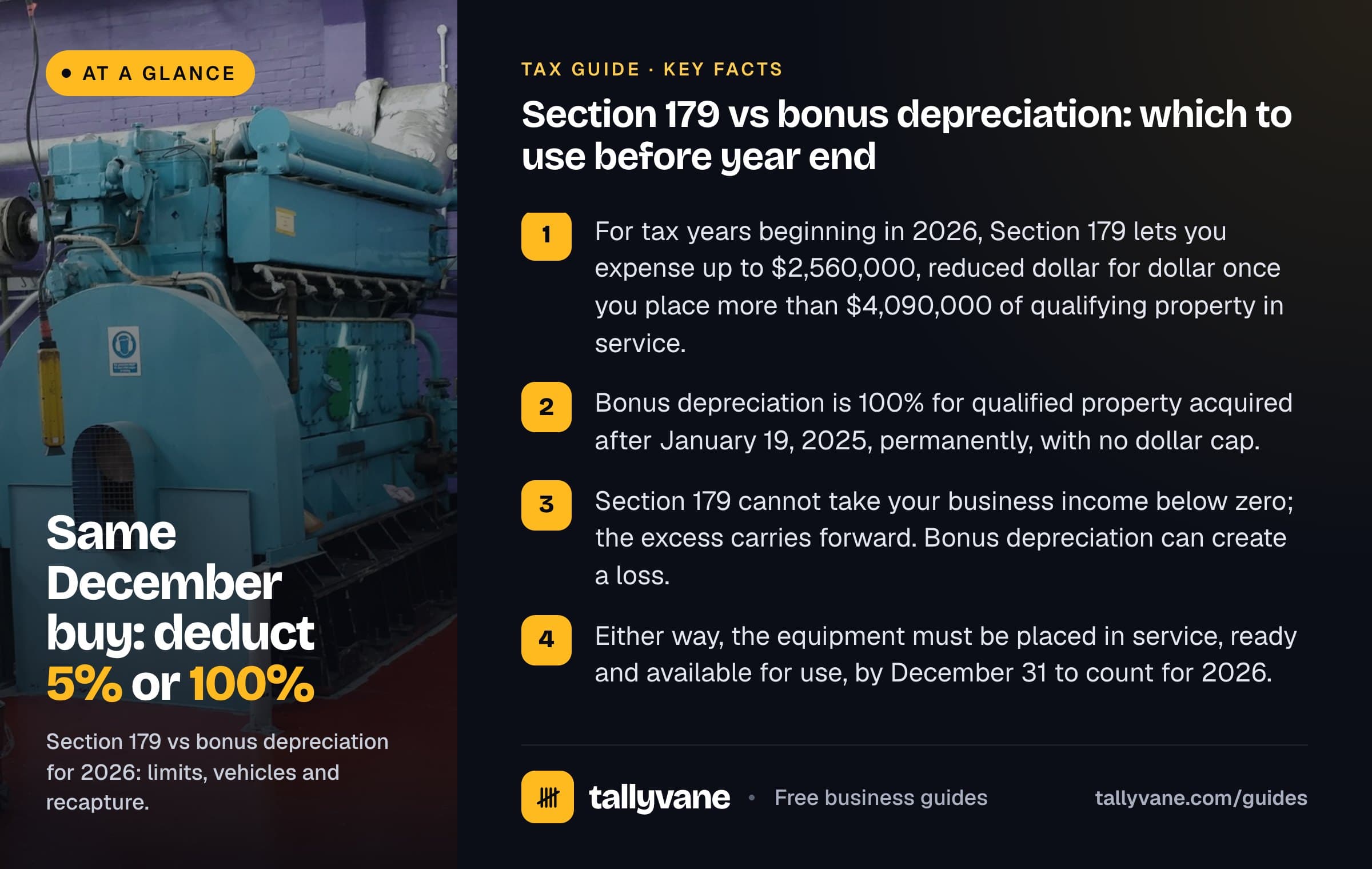
- For tax years beginning in 2026, Section 179 lets you expense up to $2,560,000, reduced dollar for dollar once you place more than $4,090,000 of qualifying property in service.
- Bonus depreciation is 100% for qualified property acquired after January 19, 2025, permanently, with no dollar cap.
- Section 179 cannot take your business income below zero; the excess carries forward. Bonus depreciation can create a loss.
- Either way, the equipment must be placed in service, ready and available for use, by December 31 to count for 2026.
- If business use later falls to 50% or less, part of a Section 179 deduction, and on vehicles any bonus too, is added back to income.
Two routes to a first-year write-off
Normally the IRS makes you spread the cost of equipment over several years using MACRS: 5 years for computers and vehicles, 7 for office furniture. Section 179 and bonus depreciation let you skip that wait and deduct the cost in the year you start using the asset.
Section 179 is an election. You choose which assets to expense and how much of each, up to a yearly dollar limit and your business income. Bonus depreciation, which the IRS calls the special depreciation allowance, is automatic. It applies to every qualifying asset unless you elect out, and you can only elect out for a whole class of property, such as all 5-year property placed in service that year.
You can use both on the same return. Section 179 comes first, then bonus depreciation on whatever cost is left, then regular MACRS on anything remaining. You claim all three on IRS Form 4562.
The 2026 numbers
Section 179 limits rise with inflation each year. Bonus depreciation changed with the One, Big, Beautiful Bill Act in July 2025, which restored the 100% rate after it had been stepping down by 20 points a year.
- The 100% rate covers qualified property acquired after January 19, 2025. If you signed a binding contract before January 20, 2025, the property counts as acquired then and gets the old phase-down rate: 20% if placed in service in 2026.
- A business placing $4,500,000 of qualifying property in service in 2026 would see its Section 179 limit cut by $410,000, to $2,150,000. Most small businesses never come near the phase-out.
| Rule | Section 179 | Bonus depreciation |
|---|---|---|
| Maximum deduction | $2,560,000 | 100% of cost, no dollar cap |
| Phase-out | Limit falls $1 for each $1 of property above $4,090,000; zero at $6,650,000 | None |
| Income limit | Cannot exceed taxable business income | None; can create a loss |
| Heavy SUVs (6,001 to 14,000 lb) | $32,000 cap per vehicle | No separate cap |
| How it applies | Elected asset by asset, any amount | Automatic unless you elect out by class |
The difference that matters most: low-profit years
Section 179 is capped at your taxable income from the active conduct of a trade or business. For a sole proprietor that includes net profit from all your businesses plus any wages you or a spouse on a joint return earned as an employee. Anything you elect above that limit is not lost. It carries forward to later years, but you get no benefit from it this year.
Bonus depreciation has no such limit. If it pushes your business into a loss, the loss can offset other income on your return, subject to the usual loss limits, or carry forward as a net operating loss. A net operating loss carried forward can generally offset at most 80% of taxable income in a later year.
So in a strong year the two give the same result. In a thin year, bonus gives a bigger deduction now, while Section 179 lets you take exactly as much as you need and stop. That control is useful if you want to keep some income in a lower bracket or show a profit to a lender.
Worked example: $120,000 of equipment bought in December
A landscaping company buys a mini excavator, a trailer and two mowers for $120,000, all 5-year property, delivered and working on December 10, 2026. They are its only equipment purchases of the year and are used 100% for business. Its net business profit before this purchase is $80,000, and the owner has no other wages.
- Regular MACRS gives only $6,000 because all of the year’s purchases arrived in the last quarter, so the mid-quarter convention allows just 5% in year one.
- Section 179 stops at the $80,000 income limit. The company could also elect $80,000 and let bonus depreciation cover the other $40,000, which lands in the same place as bonus alone.
- If the company’s profit had been $200,000, Section 179 and bonus would both deduct the full $120,000, and the choice would come down to state tax and control.
- Its own books are separate: straight-line over 5 years with a $12,000 salvage value shows $21,600 a year, whatever the tax return says.
| Approach | 2026 deduction | 2026 business income after | What happens to the rest |
|---|---|---|---|
| Regular MACRS only (elect out of bonus) | $6,000 | $74,000 | $114,000 deducted over 2027 to 2031 |
| Section 179 on the full $120,000 | $80,000 | $0 | $40,000 carried forward to 2027 |
| 100% bonus depreciation | $120,000 | −$40,000 (a loss) | Loss offsets other income or carries forward |
Used equipment, buildings and states
Both rules cover used equipment if you buy it, rather than receive it as a gift or inheritance, and not from a related person such as a spouse, parent, child or a company you control. For bonus depreciation, you or a predecessor must also not have used it in the previous five calendar years.
Buildings are where the two rules split. You can elect Section 179 for qualified improvement property, the interior improvements to a commercial building after it was first put in use, and for roofs, heating and air conditioning, fire protection, alarm and security systems on nonresidential buildings. Bonus depreciation covers qualified improvement property but not roofs or HVAC, which are 39-year property.
States often go their own way. Many do not follow federal bonus depreciation, and some set a much lower Section 179 limit. California, for example, has capped Section 179 at $25,000 and does not allow federal bonus depreciation. Where your state does not follow bonus but does allow Section 179, electing 179 can give you a state deduction that bonus alone would not. Check your state’s depreciation form before you choose.

Vehicles and the SUV cap
Vehicles bring extra limits. Both Section 179 and bonus depreciation require more than 50% business use in the year a vehicle is placed in service, and you can only deduct the business share of its cost.
Cars and light trucks rated at 6,000 pounds gross vehicle weight or less are passenger automobiles with yearly depreciation caps. For one placed in service in 2026, the first-year cap is $20,300 with bonus depreciation and $12,300 without, then $19,800, $11,900 and $7,160 a year after that.
An SUV rated from 6,001 to 14,000 pounds escapes those caps, but Section 179 on it is limited to $32,000. Bonus depreciation can cover the rest, so a $70,000 heavy SUV used only for business can still be written off in full: $32,000 under Section 179 plus $38,000 of bonus, or $70,000 of bonus alone. The cap bites only where you rely on Section 179 alone, such as in a state that does not follow bonus. Pickups with a cargo bed of at least six feet that is not reachable from the cabin, and vans that seat more than nine people behind the driver, are not treated as SUVs for this cap.
Placed in service by December 31, and how to pay for it
The deduction belongs to the year the asset is placed in service, meaning ready and available for its specific use. Paying in December for equipment that arrives in January gives you a 2027 deduction, not a 2026 one. Equipment that is delivered and set up but idle over the holidays does count.
You do not have to pay cash. Equipment bought with a loan qualifies for the full cost in the year it goes into service, even though you repay the loan over several years. That helps cash flow in year one, but leaves nothing to deduct in the years you are still paying. Buy because the business needs the equipment: a deduction saves tax only at your marginal rate.
Free toolLoan payment calculatorRecapture: when the deduction comes back
If business use of Section 179 property falls to 50% or less in any year of its recovery period, you must add back part of the deduction as ordinary income. The amount is the Section 179 deduction you took minus the depreciation you would have been allowed without it. For vehicles and other listed property, the same test also catches bonus depreciation: the excess over straight-line depreciation under the alternative depreciation system is recaptured. You report it on Part IV of Form 4797.
Say you deduct the full $40,000 cost of a pickup rated over 6,000 pounds in 2026, use it entirely for business in 2026 and 2027, then business use drops to 40% in 2028. Straight-line over 5 years with a half-year convention would have allowed $4,000 in 2026 and $8,000 in 2027, $12,000 in all. You add $28,000 to your 2028 income and depreciate the truck slowly from there.
Selling has a similar effect: any gain up to the depreciation you claimed is taxed as ordinary income. And with nothing left to deduct in later years, your estimated tax payments may need to rise.
Free toolQuarterly tax calculator