Key takeaways
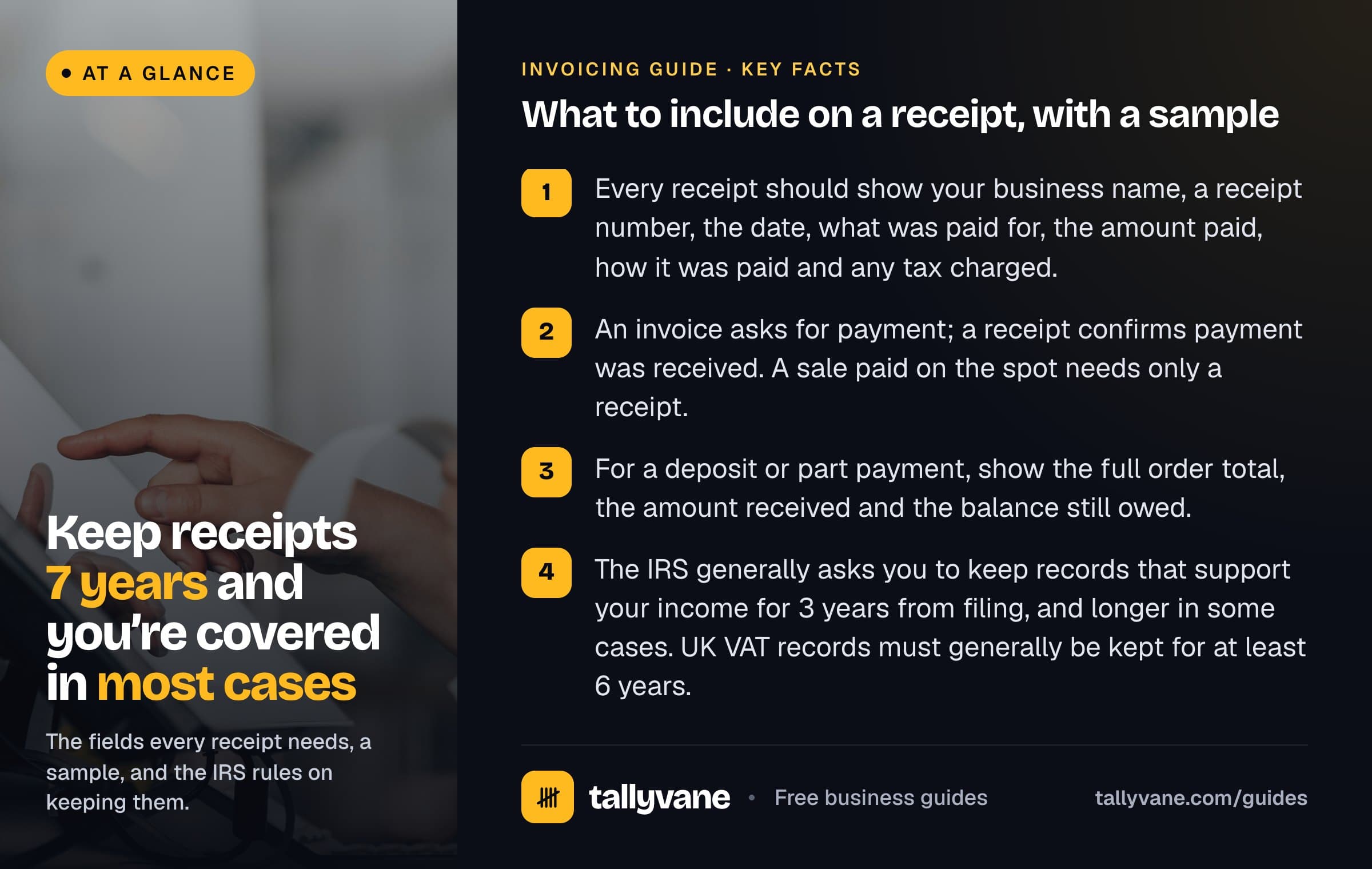
- Every receipt should show your business name, a receipt number, the date, what was paid for, the amount paid, how it was paid and any tax charged.
- An invoice asks for payment; a receipt confirms payment was received. A sale paid on the spot needs only a receipt.
- For a deposit or part payment, show the full order total, the amount received and the balance still owed.
- The IRS generally asks you to keep records that support your income for 3 years from filing, and longer in some cases. UK VAT records must generally be kept for at least 6 years.
What a receipt is for
A receipt records that money changed hands. For the customer it is proof of payment: something to show if a product is returned, if a payment is disputed, or if they need to claim the cost as a business expense. For you it is part of your record of income, and it lets you match each payment to a deposit in your bank account.
The IRS lists receipt books, register tapes, invoices and deposit records among the documents that support the gross receipts on a business tax return. A numbered receipt for every sale makes those records easy to build and easy to check.
What should a receipt include?
There is no single format, but a receipt that answers these questions will work for almost any small business. Most point-of-sale systems print these fields automatically. If you sell at markets, by appointment or by bank transfer, you can make the same receipt yourself.
- Your business name and contact details, such as an address, email or phone number.
- A unique receipt number, in a running sequence such as R-0001, R-0002.
- The date of payment.
- Who paid, if you know: a customer name or company. A walk-in retail sale can leave this out.
- What was paid for: each item or service, with quantity and price.
- Any discount, and any shipping or delivery charge.
- Tax, on its own line with the rate, and your tax registration number if you have one.
- The total, the amount paid and how it was paid: cash, card, check, bank transfer or a payment app.
- The balance still owed, if the customer paid only part of the total.
Sample receipt: a candle stall at a craft market
A small candle business sells at a weekend market in a state with a 7% combined sales tax rate. A customer buys two soy candles at $18 each and one gift set at $42 and pays by card.
- The header would show the business name, email, receipt number R-0147 and the date.
- The tax line shows the rate as well as the amount, so the customer can see how the total was reached.
- A zero balance tells both sides the sale is fully paid.
| Line | Detail | Amount |
|---|---|---|
| Soy candle, cedar | 2 × $18.00 | $36.00 |
| Gift set, three tins | 1 × $42.00 | $42.00 |
| Subtotal | $36.00 + $42.00 | $78.00 |
| Sales tax (7%) | $78.00 × 7% | $5.46 |
| Total | $78.00 + $5.46 | $83.46 |
| Paid by card | 5 Nov 2026 | $83.46 |
| Balance | $83.46 − $83.46 | $0.00 |
Receipt vs invoice
An invoice is a request for payment. It is sent before you are paid, usually has a due date and payment terms, and shows the amount due. A receipt comes after the money arrives and shows the amount paid. Many businesses use both: an invoice when the work is done, then a receipt once the invoice is paid.
If a customer pays at the moment of sale, in a shop, at a market or online at checkout, a receipt alone is enough. Our guide to writing an invoice covers the fields and payment terms an invoice needs.
Free toolInvoice generatorShowing sales tax or VAT on a receipt
If you collect sales tax, show it on its own line with the rate rather than folding it into the item prices. It helps the customer, and it makes it simple to total the tax you owe when you file. Rates and what is taxable differ by state and sometimes by city, so use the rate for where the sale takes place.
In the UK, a VAT-registered retailer does not have to issue a VAT invoice to customers who are not VAT registered, and can assume none is needed unless the customer asks. When a business customer does ask and the sale is £250 or less including VAT, HMRC allows a simplified VAT invoice. That must show your name, address and VAT registration number, the time of supply, a description of what was sold, and for each VAT rate, the total payable including VAT and the rate charged. Sales above £250 need a full or modified VAT invoice. Our VAT invoice guide covers both.
Free toolSales tax calculator
Receipts for cash payments and deposits
Cash leaves no trail in your bank or card statement, so a receipt is often the only record of the sale. Give one for every cash payment, keep a copy, and use the same numbered sequence as your other receipts. Note "Paid in cash" on the receipt. If you bank the cash later, keep the deposit slip with your copies so the totals can be traced.
For a deposit or instalment, list the full order as the items and enter only the money you actually received as the amount paid. The receipt then shows the total, the payment and the balance, so you and the customer agree on what is still owed.
- When the balance is paid, issue a second receipt for $440 that refers to the first one, or to the order number.
- If deposits are non-refundable, say so on the receipt as well as in the quote or order.
Balance = Total − Amount paid
| Line | Amount |
|---|---|
| Order total | $640.00 |
| Deposit paid by bank transfer | $200.00 |
| Balance due on delivery | $440.00 |
Digital receipts
An emailed PDF or a receipt sent by a card reader app works as well as paper for most purposes, and it is easier to search. The IRS says the same requirements that apply to paper books and records also apply to electronic ones, so a digital receipt needs the same details as a printed one.
Name each file with the receipt number and date, keep them in folders by year, and back them up somewhere other than the device you made them on. If a customer asks for a receipt to be emailed, check the address before you send it, because a receipt shows what they bought and how much they paid.
How long to keep receipts
In the US, the IRS ties record keeping to the period during which a tax return can be amended or examined. For most businesses that means 3 years from the date you filed. Some situations need longer. Keeping records for 7 years covers every case in the table below except the ones that have no time limit.
In the UK, HMRC says you must generally keep VAT records for at least 6 years, and records needed for other taxes may need to be kept longer. Check the rule for the tax you file if you are outside the US and UK.
| Situation | Keep records for |
|---|---|
| Most returns | 3 years from filing |
| You claim a credit or refund after filing | 3 years from filing or 2 years from paying the tax, whichever is later |
| You leave out income worth more than 25% of the gross income on your return | 6 years |
| You claim a loss from worthless securities or a bad debt deduction | 7 years |
| Employment tax records | At least 4 years after the tax is due or paid, whichever is later |
| You do not file a return, or file a fraudulent one | Indefinitely |