
Key takeaways
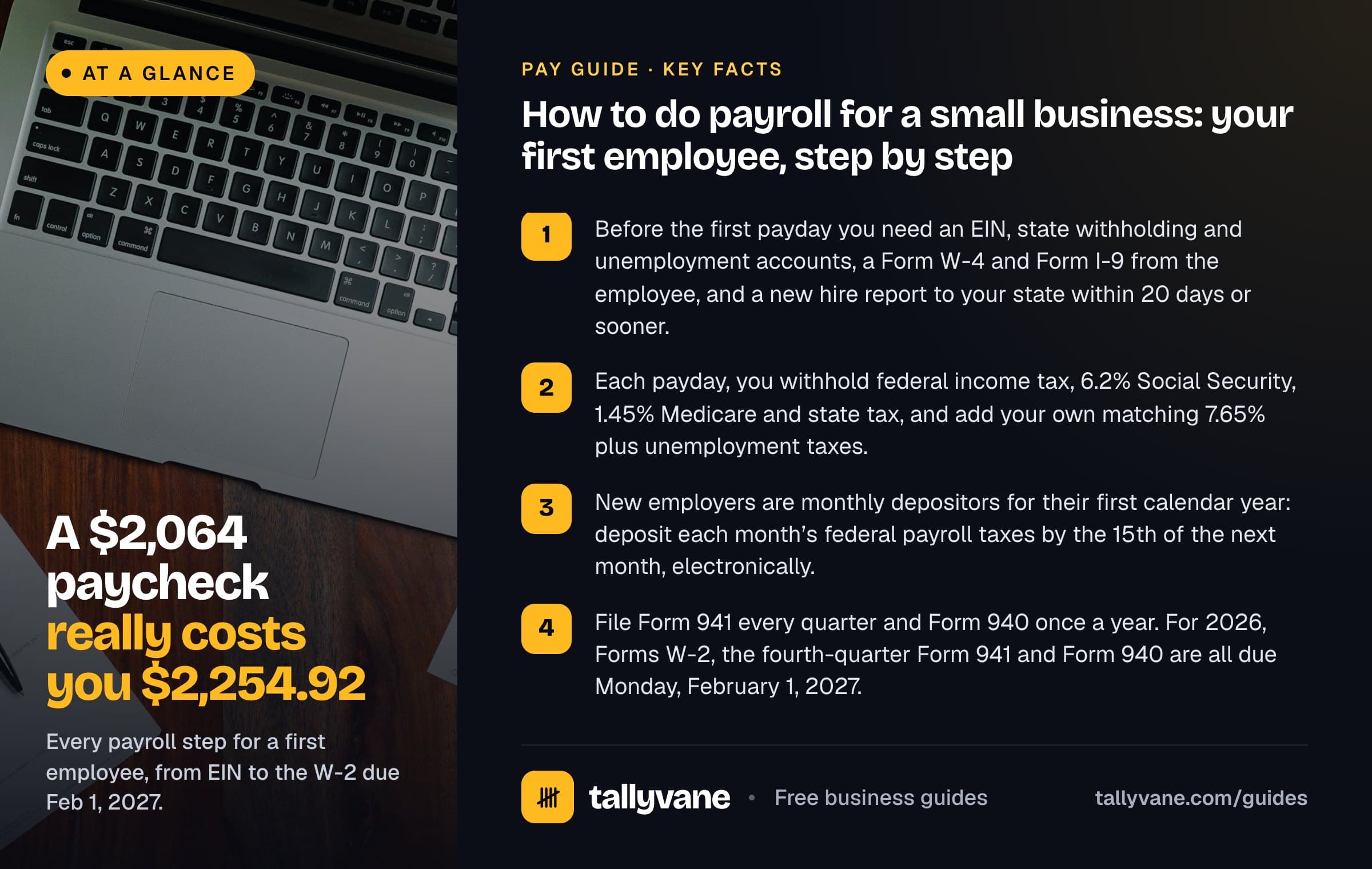
- Before the first payday you need an EIN, state withholding and unemployment accounts, a Form W-4 and Form I-9 from the employee, and a new hire report to your state within 20 days or sooner.
- Each payday, you withhold federal income tax, 6.2% Social Security, 1.45% Medicare and state tax, and add your own matching 7.65% plus unemployment taxes.
- New employers are monthly depositors for their first calendar year: deposit each month’s federal payroll taxes by the 15th of the next month, electronically.
- File Form 941 every quarter and Form 940 once a year. For 2026, Forms W-2, the fourth-quarter Form 941 and Form 940 are all due Monday, February 1, 2027.
- Keep employment tax records for at least four years.
Before your first payday: set up the accounts
You need an Employer Identification Number (EIN) to run payroll, even if you are a sole proprietor who has never needed one. It is free from the IRS and you can apply online. Use the same EIN on every payroll form, tax deposit and state report.
Next, register with your state. Most states that tax wages require a withholding account before you pay anyone, and every state runs an unemployment insurance program that will give you an account number and a tax rate. Most states also require workers’ compensation insurance.
- EIN from the IRS
- State income tax withholding account, if your state taxes wages
- State unemployment insurance account and rate
- Workers’ compensation policy, under your state’s rules
- A business bank account that payroll and tax payments come from
Paperwork from your new hire
Form W-4 tells you how much federal income tax to withhold. Keep it on file; you do not send it to the IRS. If an employee does not give you one, Publication 15 says to withhold as if they were single with no other entries. Many states have their own withholding form as well.
Form I-9 confirms the employee can legally work in the United States. Under the federal rules, the employee completes Section 1 by their first day of work, and you must examine their documents and complete Section 2 within three business days of the hire. The I-9 stays in your files.
Finally, report the hire to your state’s new hire directory. Federal law requires this within 20 days of the hire date, and some states set a shorter deadline. Many states accept a copy of the W-4 with your details added, though online reporting is preferred. Rehires count as new hires if they were gone for at least 60 consecutive days.
Choose a pay schedule and track hours
Pick weekly (52 paydays), biweekly (26), semimonthly (24) or monthly (12) and stick to it. Federal law does not set a pay frequency, but many states do, and some require hourly workers to be paid at least twice a month. Check your state labor department before you choose monthly.
For hourly employees, keep a record of hours worked each day and week. Overtime is owed at 1.5 times the regular rate for hours over 40 in a workweek, and a biweekly pay period is two separate workweeks for that test. A timesheet calculator turns clock times into the decimal hours payroll needs.
Free toolTimesheet calculatorWork out each paycheck, gross to net
Every pay run follows the same order. Work out gross pay from salary or hours. Take off pre-tax deductions such as a 401(k) or cafeteria-plan health premiums. Withhold federal income tax using the Publication 15-T method and the employee’s W-4, then Social Security at 6.2% (up to $184,500 of wages in 2026) and Medicare at 1.45%. Withhold state and local income tax, then any after-tax deductions. What is left is net pay. Our gross vs net pay guide walks through each step in detail.
Then add your own share. You match the employee’s 6.2% and 1.45%, and you pay federal unemployment tax (FUTA, usually 0.6% of the first $7,000 of each employee’s wages after the state credit) and your state unemployment rate. Our guide to how much an employee costs covers these employer costs and the benefits on top.
Net pay = Gross pay − Pre-tax deductions − Federal income tax − Social Security − Medicare − State and local tax − After-tax deductions Employer cost = Gross pay + 6.2% + 1.45% + FUTA + State unemployment tax
Free toolPaycheck calculatorWorked example: one biweekly pay run
A café in North Carolina pays its first employee $24 an hour, every two weeks. The timesheets show 42 hours in each week, so the period has 80 regular hours and 4 overtime hours at $36. The employee is single with no dependents and nothing else on the W-4, and has no benefit deductions.
Gross pay is 80 × $24 + 4 × $36 = $2,064. Federal withholding follows Publication 15-T: $2,064 × 26 = $53,664 a year, less $8,600, is $45,064, and the 2026 schedule gives $1,240 plus 12% of the amount over $19,900, or $4,259.68 a year, which is $163.83 per paycheck. North Carolina’s figure is our calculator’s estimate at the 3.99% flat rate after the $12,750 standard deduction; the state’s own withholding tables can differ by a few cents. The unemployment rate is an assumption, since your state sets yours.
- The federal deposit for this payday is $163.83 + 2 × $127.97 + 2 × $29.93 = $479.63. That is the figure that goes on Form 941.
- Two paydays in a month make a monthly deposit of $959.26. Six or seven paydays a quarter puts the quarter well over $2,500, so you cannot wait and pay with the return.
- Give the employee a pay stub showing each line and year-to-date totals. Many states require one.
| Line | Working | Amount | Paid to |
|---|---|---|---|
| Gross pay | 80 × $24 + 4 × $36 | $2,064.00 | |
| Federal income tax withheld | $4,259.68 ÷ 26 | −$163.83 | IRS deposit |
| Employee Social Security | 6.2% × $2,064 | −$127.97 | IRS deposit |
| Employee Medicare | 1.45% × $2,064 | −$29.93 | IRS deposit |
| North Carolina income tax withheld | ($53,664 − $12,750) × 3.99% ÷ 26 | −$62.79 | NC Department of Revenue |
| Net pay | Gross minus the lines above | $1,679.48 | Employee |
| Employer Social Security | 6.2% × $2,064 | $127.97 | IRS deposit |
| Employer Medicare | 1.45% × $2,064 | $29.93 | IRS deposit |
| FUTA | 0.6% × $2,064 | $12.38 | IRS, once over $500 |
| State unemployment tax | Assumed 1% × $2,064 | $20.64 | State unemployment agency |
| Total cost of this pay run | Gross pay + employer taxes | $2,254.92 |

Deposit the taxes on time
Withheld income tax, both halves of Social Security and Medicare are deposited together. Your schedule depends on a lookback period: for 2026, July 1, 2024 to June 30, 2025. If you reported $50,000 or less of these taxes in it, you are a monthly depositor; above that, semiweekly. A new employer has no lookback history, so it is a monthly depositor for its first calendar year.
Every federal tax deposit must be made electronically. You can use EFTPS, IRS Direct Pay for businesses or your IRS business tax account. State withholding and unemployment tax are paid to the state on its own schedule.
| Situation | Deposit due |
|---|---|
| Monthly depositor | By the 15th of the following month |
| Semiweekly, payday Wednesday to Friday | By the following Wednesday |
| Semiweekly, payday Saturday to Tuesday | By the following Friday |
| $100,000 or more owed on any day | By the next business day |
| Less than $2,500 owed for the whole quarter | Can be paid with Form 941 |
| FUTA owed over $500 | By the last day of the month after the quarter |
File the returns: 941, 940 and W-2
Form 941 reports wages, withheld tax and both shares of Social Security and Medicare for each quarter. It is due by the last day of the month after the quarter: April 30, July 31, October 31 and January 31. If you deposited every amount on time, you get until the 10th of the following month. Form 940 reports FUTA once a year, due January 31.
Form W-2 goes to each employee and to the Social Security Administration. When a due date falls on a weekend or holiday, it moves to the next business day. January 31, 2027 is a Sunday, so the 2026 deadlines move to Monday, February 1, 2027. If you file 10 or more information returns in total, W-2s must be filed electronically. Your state will also want quarterly wage reports for unemployment tax and, in most income tax states, withholding returns.
| What | Due |
|---|---|
| December 2026 deposit (monthly depositor) | Friday, January 15, 2027 |
| Form 941 for October to December 2026 | Monday, February 1, 2027 (February 10 if all deposits were on time) |
| Form 940 for 2026 | Monday, February 1, 2027 (February 10 if all FUTA was deposited on time) |
| Forms W-2 to employees and Copy A to SSA | Monday, February 1, 2027 |
| Form 941 for January to March 2027 | Friday, April 30, 2027 |
Keep the records
The IRS says to keep all employment tax records for at least four years. Keep each I-9 for three years after the hire date or one year after the employee leaves, whichever is later.
- Your EIN, state account numbers and deposit confirmations
- Each employee’s W-4, state withholding form and I-9
- Timesheets, pay rates, pay dates and amounts for every pay run
- Copies of Forms 941, 940, W-2 and W-3 and your state returns
- Records of tips reported, fringe benefits and any adjustments