Key takeaways
- Wholesale price = Unit cost ÷ (1 − Your wholesale margin). Retail price = Wholesale price ÷ (1 − Retailer margin).
- In many retail sectors the convention is that the retail price is around 2× the wholesale price, so wholesale is roughly half of retail.
- Check your margin after the costs that only wholesale has, such as freight to the shop and rep commission, not just against the unit cost.
- Publish an MSRP and charge direct customers the same price, so stockists are not undercut by your own website.
- Selling direct earns more per unit than wholesale, but you pay for the marketing, fees and shipping that a shop would have covered.
The price chain: cost, wholesale, retail
Start with your unit cost: everything it takes to get one unit ready to ship to a shop. That means materials, labour, packaging and labels, plus inbound freight and import duty if you buy in. Leave out costs that only apply to one channel, such as postage to a direct customer. Those come later.
Your wholesale price is your unit cost plus your margin. The retail price is the wholesale price plus the retailer’s margin. Both margins are worked out on the selling price at that step, because that is how retail buyers quote them. If a buyer says they need 50%, they mean 50% of the shelf price, not a 50% markup.
Wholesale price = Unit cost ÷ (1 − Wholesale margin % ÷ 100) Retail price = Wholesale price ÷ (1 − Retailer margin % ÷ 100)
Free toolRetail price calculator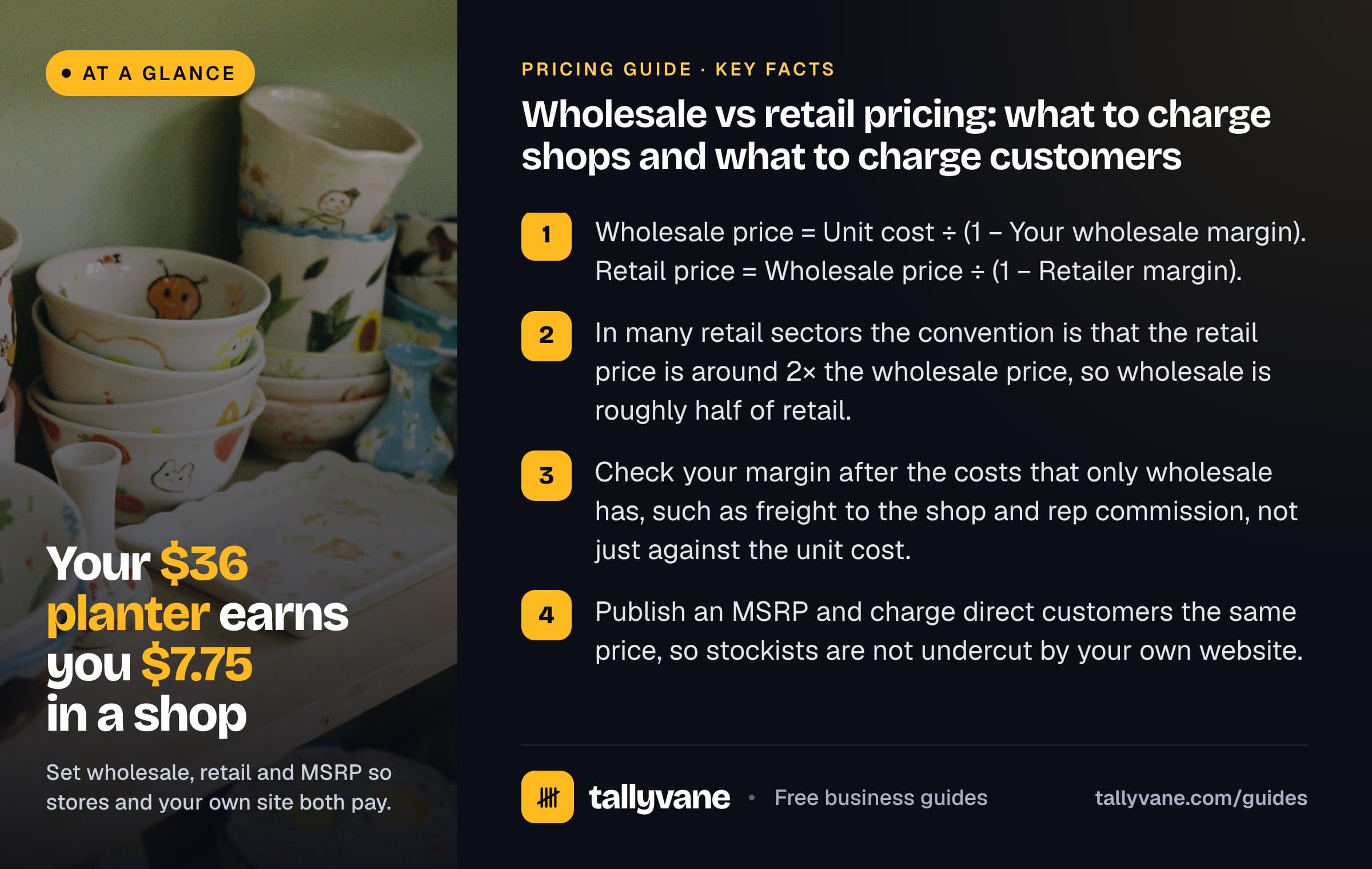
Common multipliers, and how much wholesale should be
In many retail sectors, such as gifts, homeware, fashion and independent shops, the common convention is that a shop sells at around twice what it paid you. That is keystone pricing, a 50% retailer margin. It is a starting point, not a rule: some shops ask for more, and categories like electronics often run on much thinner retail margins. Keystone and cost-plus pricing are covered in our guide to pricing a product, so here it is enough to know the shop’s multiplier before you set your own price.
On your side, the same logic gives a second multiplier. A 50% wholesale margin means your wholesale price is 2× your unit cost. Put the two together and the shelf price is about 4× what the product costs you to make. Many small product brands aim for a wholesale margin in the 40% to 60% range, so a 3× to 5× gap between cost and shelf price is normal.
So how much should wholesale be? Roughly half of your intended retail price, and enough above your unit cost to leave a real margin. If half the retail price does not leave you a margin you can live on, the fix is a higher retail price, a lower cost or a different channel, not a wholesale price the shop cannot work with.
| Margin at that step | Selling price ÷ buying price | Markup on buying price |
|---|---|---|
| 40% | 1.67× | 66.7% |
| 50% (keystone) | 2× | 100% |
| 55% | 2.22× | 122.2% |
| 60% | 2.5× | 150% |
Make sure your wholesale price still leaves a margin
A 50% margin on paper can shrink fast once wholesale costs arrive. Shipping a case to a shop, a sales rep’s commission, a wholesale platform’s fee, trade show stands, free samples and longer payment terms all come out of your wholesale price, not the shop’s.
Work out the margin you actually keep. Take your wholesale price, subtract the unit cost and every wholesale cost per unit, and divide by the wholesale price. Then compare the result with what you need to cover your overheads and pay yourself.
For example, a planter with a $9 unit cost sells at $18 wholesale, a 50% margin. Shipping a 24-unit order costs $30, or $1.25 a unit, so the real margin is ($18 − $9 − $1.25) ÷ $18 = 43.1%. If a rep then takes 15% of the wholesale price ($2.70), you keep $5.05 a unit, a 28.1% margin. Price for the channel you will really sell through.
Real wholesale margin % = (Wholesale price − Unit cost − Wholesale costs per unit) ÷ Wholesale price × 100
Free toolProfit margin calculatorWhat MSRP is and why retailers want it
MSRP stands for manufacturer’s suggested retail price. In the UK and many other countries it is called RRP, recommended retail price. It is the shelf price you suggest to stockists, and it normally goes on your wholesale price list or line sheet next to each wholesale price.
Retailers want it for three reasons. It tells them at a glance what margin they will make. It keeps the price consistent across shops, so customers do not see the same item at very different prices down the street. And it is the price you should charge on your own website, so the shop is not undercut by the brand it stocks.
The word that matters is suggested. In the US, the Federal Trade Commission says a retailer may sell at the MSRP or at any other price, as long as it decides that on its own. A brand may choose not to supply retailers who ignore its pricing policy, but minimum price agreements are judged case by case under federal law, and some states and other countries treat them as illegal. Check local rules before writing a minimum price into a stockist agreement.
Minimum orders and tiered wholesale pricing
Wholesale only pays when orders are big enough to cover the time spent packing and invoicing them. Most brands set a minimum order quantity (MOQ) per item, such as 6 or 12 units, a minimum opening order value, or both. A lower minimum for reorders makes it easier for a shop to keep your product in stock.
Tiered pricing rewards bigger orders with a lower unit price. Keep the tiers few and the discounts modest, and check your real margin at the cheapest tier, because that is where large stockists will buy.
- Keep the MSRP the same at every tier, so a large stockist does not undercut small ones.
- Offer free freight above an order value instead of a deeper discount if shipping is your biggest wholesale cost.
- Put the minimums, tiers, payment terms and MSRP on one line sheet so buyers can order without emailing you.
| Order size | Wholesale price | Margin before freight | Profit per unit after freight | Margin after freight |
|---|---|---|---|---|
| 12 to 23 units | $18.00 | 50.0% | $7.75 | 43.1% |
| 24 to 47 units (5% off) | $17.10 | 47.4% | $6.85 | 40.1% |
| 48 units or more (10% off) | $16.20 | 44.4% | $5.95 | 36.7% |

Selling direct at retail: more per unit, more costs
When you sell on your own website at the MSRP, you keep both margins: yours and the one a shop would have taken. That is why direct sales look so much better per unit. But the shop’s margin was paying for real work, and when you sell direct you take that work on.
You pay for the customer to find you, through ads, social media, email and discounts. You pay a card processing fee on every order. You pack and post single orders, often with free or cheap shipping. You answer questions and handle returns. Marketplaces such as Etsy bring buyers to you, but take a share of each sale in return.
Most small brands do both. Wholesale gives fewer, bigger orders with low selling costs and predictable cash. Direct sales give a higher profit per unit and a closer link with customers.
Worked example: one planter, three channels
A maker sells a ceramic planter. Clay, glaze, kiln time, labour and a protective sleeve cost $9 per planter. She wants a 50% wholesale margin, which makes her wholesale price $9 ÷ (1 − 0.50) = $18. Her stockists use keystone pricing, so the MSRP is $18 × 2 = $36. That is the ladder the retail price calculator shows: $9 cost, $18 wholesale, $36 retail, and a shelf price 4× her cost.
She sells at $36 on her own site and on Etsy, with free shipping in both. Assumptions: a shipping box costs $1.20 and postage $6.50 per order; card processing on her site is 3% + $0.30; she spends about $6 of advertising per website order and about $2 of Etsy Ads per Etsy order. Etsy’s standard US fees are a $0.20 listing fee, a 6.5% transaction fee and 3% + $0.25 payment processing. Wholesale orders are 24 units, and freight to the shop costs $30.
- Direct and marketplace sales earn more per planter, but each is one order to win, pack and post.
- One wholesale order earns $7.75 × 24 = $186 with a single shipment and no ad spend.
- If her website ad cost per order doubled to $12, direct profit would fall to $5.92, below wholesale.
| Line | Own website | Wholesale to a shop | Etsy |
|---|---|---|---|
| Price you receive | $36.00 | $18.00 | $36.00 |
| Unit cost | −$9.00 | −$9.00 | −$9.00 |
| Shipping box | −$1.20 | Included in freight | −$1.20 |
| Postage or freight | −$6.50 | −$1.25 ($30 ÷ 24) | −$6.50 |
| Payment or platform fees | −$1.38 | $0.00 | −$3.87 |
| Marketing per unit | −$6.00 | $0.00 | −$2.00 |
| Profit per unit | $11.92 | $7.75 | $13.43 |
| Margin on price received | 33.1% | 43.1% | 37.3% |